Community engagement does not happen by accident. Even the most interesting communities face the same problem: a small percentage of members create most of the content while the majority lurks silently. Gamification — the strategic use of game mechanics like points, badges, and leaderboards — is one of the most effective ways to turn passive members into active participants.
When done right, gamification taps into fundamental human psychology: the desire for recognition, achievement, and social status. When done wrong, it feels manipulative and cheap. This guide covers the gamification systems that actually work in online communities, the psychology behind them, and how to implement them on your platform.
Why Gamification Works: The Psychology
Gamification is not about making your community into a game. It is about applying proven psychological principles that games have perfected over decades:
- Intrinsic motivation: People want to feel competent, autonomous, and connected (Self-Determination Theory, Deci & Ryan). Gamification provides clear progress markers that satisfy the competence need
- Variable reward schedules: Unpredictable rewards (like earning a surprise badge) are more engaging than predictable ones. This is the same mechanism that makes social media feeds addictive
- Social proof: When members see others earning badges and climbing leaderboards, they are motivated to participate. Leaderboards create visible benchmarks
- Loss aversion: Streaks (“7-day posting streak”) leverage the psychological pain of losing progress. Members will post to maintain their streak rather than let it break
Research from Gartner found that gamified platforms see up to 48% higher engagement than non-gamified equivalents. A 2024 TalentLMS study reported that 89% of users say gamification makes them feel more productive and engaged in professional communities.
The best gamification systems do not make your community feel like a game. They make it feel like a place where every contribution matters and every member is recognized for the value they bring.
Points Systems: The Foundation
Points are the most basic gamification mechanic and the foundation that other systems build on. Members earn points for actions that benefit the community:
| Action | Suggested Points | Why |
|---|---|---|
| Creating a new discussion topic | 10 points | Highest-value action — new content for others to engage with |
| Replying to a discussion | 5 points | Keeps conversations alive |
| Receiving a “helpful” vote on a reply | 8 points | Rewards quality, not just quantity |
| Completing their profile | 15 points | Complete profiles improve the member directory |
| Uploading a resource or file | 12 points | Sharing knowledge benefits everyone |
| Attending a live event | 10 points | Events need attendance to succeed |
| Referring a new member | 25 points | Community growth is the highest-impact action |
| Daily login | 2 points | Builds habit, but low value to prevent gaming |
Points Design Principles
- Weight points by community value: Actions that create content for others should earn more than passive actions like logging in
- Avoid inflation: If points are easy to earn, they become meaningless. Keep the economy balanced
- Make points visible: Display point totals on member profiles and in the activity feed so the community sees who is contributing
- Consider point decay: Optional — points earned more than 90 days ago could be worth less, encouraging ongoing participation rather than one-time bursts
BuddyPress communities can implement points using plugins like GamiPress, myCred, or BadgeOS. These integrate directly with BuddyPress activity streams, so members see point awards in their feeds. For the technical implementation of custom activity feeds, our developer guide to BuddyPress activity feeds covers the hooks and filters you need.
Badges: Recognition That Matters
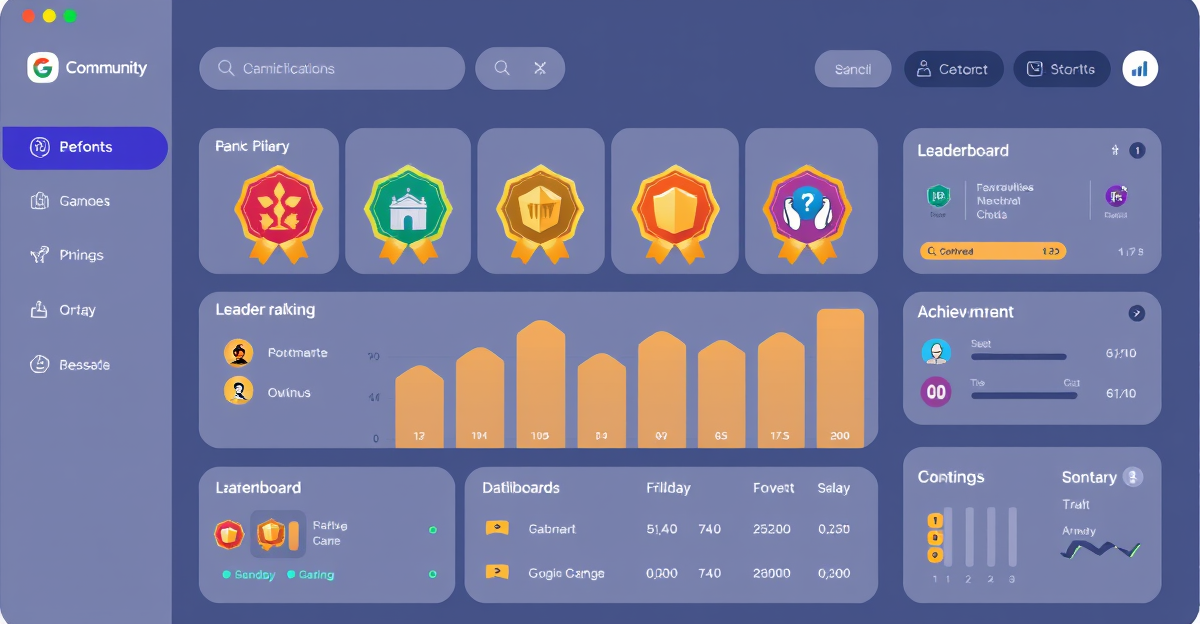
Badges are visual achievements that recognize specific accomplishments. Unlike points (which accumulate continuously), badges mark distinct milestones. They work because humans are natural collectors — once someone earns 5 badges, they are motivated to earn the 6th.
Badge Categories
- Milestone badges: “First Post,” “100 Replies,” “1 Year Member” — awarded automatically when a threshold is reached
- Quality badges: “Top Contributor,” “Most Helpful,” “Expert” — awarded based on peer votes or moderator recognition
- Skill badges: “JavaScript Expert,” “Certified Mentor,” “Workshop Leader” — awarded for demonstrated expertise or completing learning paths
- Social badges: “Connector” (introduced 10 members to each other), “Welcome Committee” (greeted 50 new members) — rewards community-building behavior
- Event badges: “Summit 2026 Attendee,” “Hackathon Winner” — marks participation in specific community events
Badge Design Best Practices
- Make them visually distinct: Each badge should have a unique icon and color scheme. Members should recognize badges at a glance
- Keep descriptions clear: “Earned by posting 10 helpful replies that received upvotes” is better than “Active Community Member”
- Mix achievable and aspirational: Some badges should be easy (complete your profile, first post) to get new members engaged. Others should be hard (500 helpful replies, community moderator) to give long-term members goals
- Display prominently: Show badges on member profiles, next to usernames in discussions, and in the member directory
Leaderboards: Healthy Competition
Leaderboards rank members by points, badges, or other metrics. They create social comparison that drives engagement — but they need careful design to avoid toxicity.
Types of Leaderboards
- All-time leaderboard: Ranks by total points ever earned. Rewards long-term members but can discourage newcomers who see an insurmountable gap
- Monthly leaderboard: Resets every month. Gives everyone a fresh start and creates recurring competition cycles
- Category leaderboards: Separate boards for different activities (most helpful replies, most events attended, most referrals). Lets different member types shine
- Team leaderboards: Groups compete against groups. This builds collaboration within teams while maintaining competition between them
Avoiding Leaderboard Pitfalls
- Show relative position: Instead of showing only the top 10, show each member where they rank: “You are #47 out of 500 members.” This keeps the leaderboard relevant to everyone, not just the top performers
- Prevent gaming: If points are earned per post, some members will spam low-quality posts. Weight points by quality metrics (votes, replies received) to reward substance over volume
- Offer opt-out: Some members prefer privacy. Let members choose whether they appear on public leaderboards
Challenges and Quests
Challenges are time-limited goals that create urgency and focus. Unlike badges (which are always available), challenges run for a specific period and create communal energy around shared goals.
Examples:
- “30-Day Introduction Challenge”: New members who complete their profile, introduce themselves, and make 5 replies within 30 days earn a special badge and a welcome gift
- “Content Sprint”: The community collectively aims to create 100 new discussion topics in a week. If the goal is reached, everyone who participated gets a badge
- “Mentor Month”: Experienced members who mentor 3 newcomers during the month earn mentor status and recognition
Challenges are especially effective for onboarding new members. A structured “first 7 days” challenge that guides new members through key community actions dramatically improves retention. Communities that implement onboarding challenges see 40-60% higher 30-day retention compared to communities with no onboarding structure.
Reward Tiers: Leveling Up
Tiers turn accumulated points into status levels that unlock benefits. This creates a progression system similar to loyalty programs:
| Level | Points Required | Perks |
|---|---|---|
| Newcomer | 0 | Basic access, can post and reply |
| Contributor | 100 | Custom profile banner, access to exclusive groups |
| Expert | 500 | Can moderate discussions, early event access |
| Champion | 2,000 | Featured profile, input on community decisions, free event tickets |
| Legend | 10,000 | Advisory council membership, direct access to community leadership |
The key is making each tier unlock tangible benefits — not just cosmetic badges. When reaching “Expert” level gives you moderation privileges, and “Champion” gives you influence over community direction, the tiers have real meaning.
Implementation: Tools and Plugins
For BuddyPress and WordPress communities, these tools handle gamification:
- GamiPress (free + premium): The most comprehensive gamification plugin for WordPress. Points, achievements, ranks, leaderboards, and 40+ integrations including BuddyPress
- myCred (free + premium): Points management system with hooks for BuddyPress activities, WooCommerce purchases, and content creation
- BadgeOS (free + premium): Achievement and badge system with visual badge builders and BuddyPress integration
All three integrate with BuddyPress activity feeds, so point awards and badge achievements appear in the community stream — creating social proof that encourages other members to participate. For communities that also want monetization through subscriptions, our guide on subscription community payments and access levels covers how to combine paid tiers with gamification.
Common Gamification Mistakes
- Rewarding quantity over quality: If members earn the most points by posting frequently, they will post frequently — regardless of quality. Always include quality signals (peer votes, moderator endorsements) in your point system
- Too many badges: If everything earns a badge, nothing feels special. Start with 10-15 badges and add more as the community grows
- No path for newcomers: If the leaderboard is dominated by early members with insurmountable point totals, new members will not bother competing. Monthly resets and category-specific boards solve this
- Ignoring intrinsic motivation: Gamification supplements intrinsic motivation — it does not replace it. If your community is not providing genuine value, points and badges will not save it
Gamification works when it makes visible the contributions that would otherwise go unnoticed. Points, badges, and leaderboards are not about turning your community into a game — they are about recognizing and rewarding the members who make the community worth joining. For mobile optimization of these engagement features, see our guide on what members expect from mobile-friendly community platforms. Start with a simple points system and one category of badges. Measure the impact on engagement over 30 days. Then expand based on what your members respond to. Need help implementing gamification on your BuddyPress community? Contact our team — we build custom engagement systems for community platforms.