How To Build A Job Board For Your Website?
How to build a job board for your website in 2026: WordPress plugins compared with WordPress.org data, Google JobPosting rules, and how job boards make money.
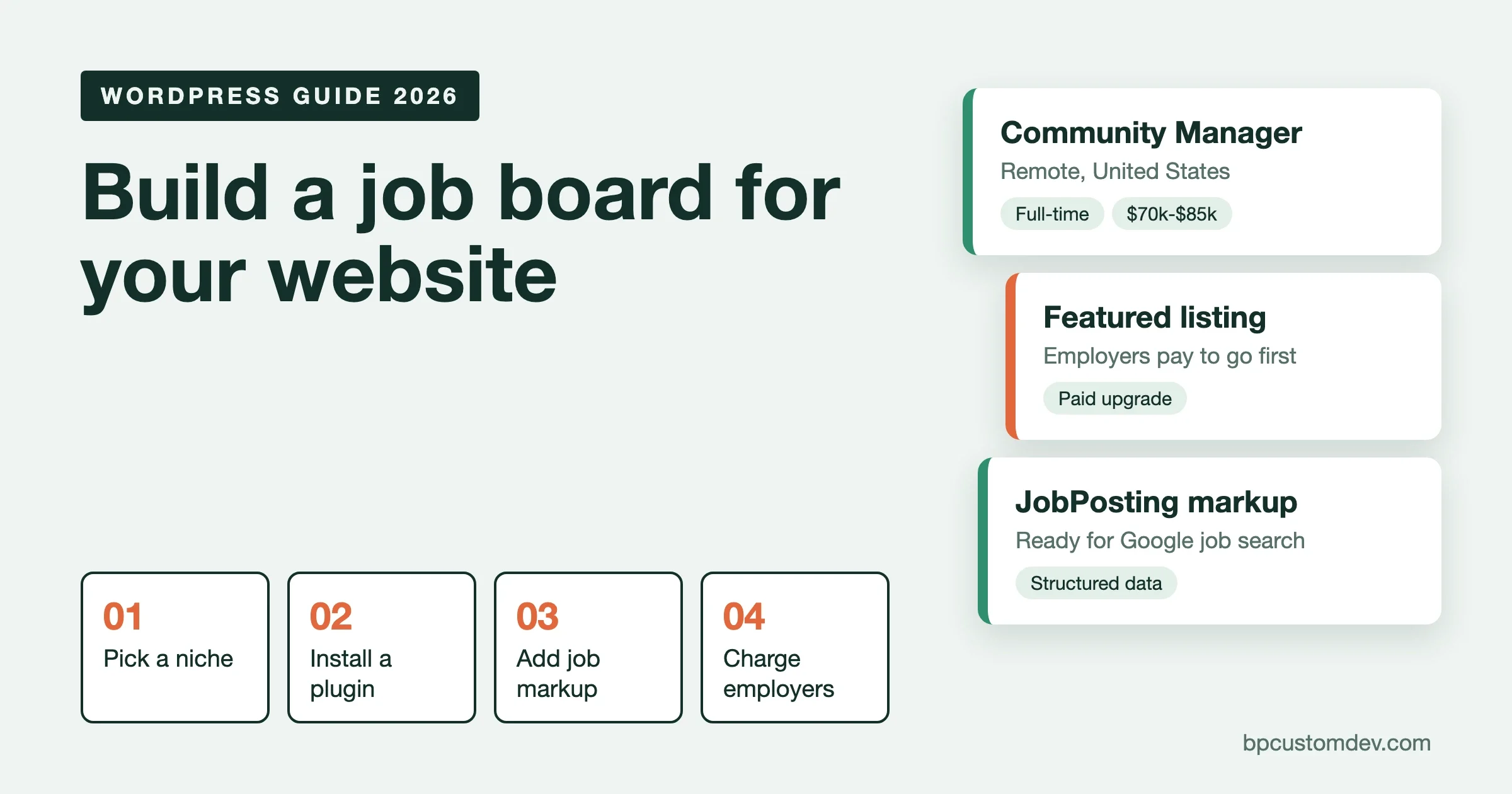
To build a job board for your website, install WordPress, add a job board plugin such as WP Job Manager or WP Career Board, create pages for the job list, the “post a job” form and the employer dashboard, then turn on paid listings once employers start posting. A small niche board can be live in a weekend for the cost of hosting. If you would rather not run WordPress at all, a hosted job board builder does the same job for a monthly fee, starting around $119 to $149 a month.
This guide walks through both routes, the plugins worth using in November 2026 (with WordPress.org data we pulled on 18 November 2026), the structured data Google needs before your jobs can appear in Google’s job search results, and the ways a job board actually makes money.
One honest note before we start. The software is the easy part. A job board lives or dies on whether employers post and candidates visit, so most of the work after launch is getting both sides to show up.
How do you create a job board website, step by step?
You create a job board website in seven steps: pick a niche, choose a platform, install a job board plugin, set up the core pages, configure listing rules, add Google job structured data, and decide how you will charge. The order matters, because the niche decides almost everything else.
- Pick one niche. “Remote nursing jobs in Ohio” beats “jobs”. A narrow board can rank in search and become the place a small group of employers trust. A general board competes with Indeed and LinkedIn from day one.
- Choose a platform. Self-hosted WordPress (free software, you pay hosting) or a hosted builder (monthly fee, less maintenance). The comparison below helps.
- Install a job board plugin. WP Job Manager, WP Career Board, JobBoardWP or another option from the table further down.
- Create the core pages. A jobs list, a job submission form, an employer dashboard and, if you want it, a candidate dashboard. Most plugins create these with blocks or shortcodes.
- Set listing rules. How long a job stays live (30 days is common), whether new posts need approval, and which fields are required. Make salary and location required if you can; candidates skip listings without them.
- Check your structured data. Each job page needs valid JobPosting markup to appear in Google’s job search experience. We cover the rules below.
- Decide how you will earn. Free listings while you build supply, then paid or featured listings once employers see results.
If your board will sit inside an existing community, plan the sign-up flow at the same time. Our roundup of WordPress user registration plugins covers employer and candidate registration forms.
What is the best job board website builder?
For most site owners the best job board website builder is WordPress with a job board plugin, because the software is free, you own the data and there is no per-listing platform cut. A hosted builder is the better choice if nobody on your team wants to manage hosting, updates and backups.
Route | What it costs | You get | You give up |
|---|---|---|---|
WordPress + free job plugin | Hosting only | Full control, your own data, any design | Updates, backups and security are your job |
WordPress + premium job plugin | Hosting plus a yearly licence | Pipelines, resumes, paid listings out of the box | A licence to renew |
From $149 a month, or $119 a month billed yearly (Basic, 18 Nov 2026) | Hosting, job scrapers and a builder handled for you | Monthly rent that grows with plan limits; harder to leave |
The cost gap is wider than it looks. A hosted Basic plan at $119 a month is $1,428 a year before you charge a single employer. A WordPress board on decent shared hosting plus a premium plugin licence usually costs a fraction of that, but you or a developer will spend a few hours a month keeping it healthy.
Which WordPress job board plugins are worth using in 2026?
We pulled each plugin’s data from the WordPress.org plugin API on 18 November 2026. Ratings are converted from the API’s 100-point scale to five stars. “Resolved” is the share of support threads from the last two months marked resolved.
Plugin | Type | Active installs | Rating (reviews) | Last updated | Resolved threads |
|---|---|---|---|---|---|
Two-sided job board | 70,000+ | 4.4 (237) | 16 Nov 2026 | 6 of 7 | |
Single-company career page | 30,000+ | 4.8 (194) | 13 Nov 2026 | 0 of 2 | |
Single-company career page | 10,000+ | 4.7 (133) | 8 Sep 2026 | 0 of 1 | |
Single-company career page | 10,000+ | 4.4 (58) | 4 Nov 2026 | 0 of 4 | |
Two-sided job board | 900+ | 5.0 (10) | 10 Nov 2026 | 0 of 1 | |
Two-sided job board | Not on WordPress.org | Not listed | Downloaded from its own site | Not listed |
The “type” column matters more than the ratings. A career page plugin lists jobs for one company: yours. A two-sided job board lets outside employers register, post jobs and manage applicants. If you are building a job board for other people to post on, only the two-sided plugins fit.
WP Job Manager: the long-running standard
WP Job Manager is made by Automattic and is the most installed job board plugin on WordPress.org. Version 2.4.12 shipped on 16 November 2026 and is tested up to WordPress 7.1.4. The free core handles job listings, front-end job submission, an employer dashboard, expiry dates and Google job structured data.
Its weakness is the add-on model. Applications, resumes, alerts and paid listings are separate paid extensions sold on wpjobmanager.com. One reviewer on WordPress.org summed it up: the free version is limited to simple job ads where “visitors can then click to email you to apply.” Budget for the add-ons you need before you commit, and check current prices on the vendor site.
WP Career Board: a full board in one plugin (our product)
WP Career Board is built by Wbcom Designs, the team behind this site, so weigh our view accordingly. The free version runs a complete two-sided board: a public job list with live search and filters, employer and candidate dashboards, a single-page job submission and application form, company profiles, CSV export and BuddyPress integration. It is built on Gutenberg blocks and the WordPress Interactivity API. Pro (from $69 a year for one site, checked on its pricing page on 18 November 2026) adds a Kanban-style hiring pipeline, a resume builder and resume search, maps with radius search, AI-assisted job writing, and paid listings and credit packs through Stripe, PayPal or WooCommerce.
The real cons. It is not listed on WordPress.org, so you download the zip from its own site and there are no public WordPress.org reviews or install counts to judge it by. It is a newer plugin than WP Job Manager, so there are fewer third-party tutorials and add-ons. And monetisation is a Pro feature: if you want to charge employers, the free version will not do it.
JobBoardWP: free, lightweight, small user base
JobBoardWP comes from the team behind Ultimate Member. It is free, updated on 10 November 2026, and covers job listings, front-end posting and an employer dashboard. With 900+ installs and 10 ratings, it has a much smaller user base than WP Job Manager, which means fewer answers on forums when you get stuck.
Career page plugins: HireZoot, Simple Job Board, Job Postings
These three are good at a different job. If you are one company hiring for your own roles, they give you a careers page, an application form and an applicant list without the overhead of a full job board. They are not built for outside employers to sign up and post.
How do you make your jobs show up in Google?
Your jobs can appear in Google’s job search experience only if each job page carries valid JobPosting structured data that follows Google’s job posting guidelines (page last updated 8 September 2026, checked 18 November 2026). Most job board plugins output this markup for you, but the defaults do not cover every rule.
Google’s required properties are:
- datePosted: the date the employer posted the job, in ISO 8601 format.
- description: the full job description in HTML, covering responsibilities, qualifications and working hours. It cannot be the same as the title.
- hiringOrganization: the company name (or “confidential” for anonymous postings).
- jobLocation: the physical workplace, including addressCountry. For 100% remote jobs, use jobLocationType TELECOMMUTE plus applicantLocationRequirements naming at least one country.
- title: the job title only, with no salary, dates, codes or “HIRING NOW!!” text.
Three rules catch job board owners most often:
- JobPosting markup belongs on single job pages only. Putting it on a list or search results page triggers a “Structured data policy violation” message in Search Console.
- Expired jobs must be marked expired. Set validThrough to a past date, return a 404 or 410, or remove the markup. Google warns that ignoring expired jobs can lead to a manual action.
- Remote means fully remote. Do not mark hybrid or “occasional work from home” roles as TELECOMMUTE.
Google also recommends its Indexing API for job posting URLs, because it prompts a faster crawl than a sitemap alone. Its Indexing API quickstart explains the setup. Test any job page with the Rich Results Test before you promote the board.
A gap in WP Job Manager’s remote-job markup
We read WP Job Manager’s structured data function on GitHub on 18 November 2026. It sets jobLocationType to TELECOMMUTE only when a remote job also has a location entered, and it never adds applicantLocationRequirements. A fully remote job with no location therefore misses a field Google requires. The plugin offers a filter, wpjm_get_job_listing_structured_data, so you can add the field yourself. This snippet goes in a small custom plugin or your child theme’s functions.php (checked against WP Job Manager 2.4.12 source on 18 November 2026; test on staging first):
<?php
add_filter( 'wpjm_get_job_listing_structured_data', function ( $data, $post ) {
	if ( ! is_array( $data ) || empty( $post->_remote_position ) ) {
		return $data;
	}
	$data['jobLocationType'] = 'TELECOMMUTE';
	if ( empty( $data['applicantLocationRequirements'] ) ) {
		// Change 'US' to the country (or countries) your remote hires must live in.
		$data['applicantLocationRequirements'] = array(
			'@type' => 'Country',
			'name'  => 'US',
		);
	}
	return $data;
}, 10, 2 );
Change the country to wherever your remote hires must live. Then run one remote job through the Rich Results Test to confirm the warning is gone.
What features does a job board need on day one?
Fewer than most people think. Employers need to post a job without emailing you, and candidates need to find and apply for it in under a minute. Everything else can wait until real users ask for it.
- Search with filters for keyword, location, job type and remote. This is the one feature candidates use every visit.
- Front-end job submission so employers never see wp-admin.
- An employer dashboard to edit, renew, mark filled and see applicants.
- Automatic expiry so old jobs drop off the list and out of Google.
- Email notifications for new applications and expiring listings.
- Salary and location fields, ideally required.
Leave resume databases, job alerts and applicant tracking for later. They are useful, but each one adds settings to maintain, and none of them helps until the board has steady traffic.
How do job boards make money?
Job boards make money mainly by charging employers, not job seekers. Candidates expect to search and apply for free, and a board that charges them struggles to grow. The common models are:
Model | How it works | When it fits |
|---|---|---|
Paid job listings | Employers pay per post, for a set number of days | Once you have steady candidate traffic |
Featured listings | A free post, with a paid upgrade to the top of the list | Early on, to keep posting friction low |
Listing packs or credits | Employers buy several posts at a discount | Agencies and repeat employers |
Employer subscriptions | Monthly fee for unlimited or capped posts | Niche boards with loyal employers |
Resume database access | Employers pay to search candidate profiles | Boards with many active candidates |
Sponsorship and ads | A sponsor banner, newsletter slot or sponsored category | Boards with a strong email list |
Our advice is to start free. Let employers post at no cost until the board has enough candidates to deliver applications, then switch on featured upgrades, then paid listings. Charging before you can deliver results is the fastest way to end up with an empty board.
On WordPress, paid listings usually run through WooCommerce or a payment add-on. WP Job Manager sells paid listing extensions; WP Career Board Pro includes paid listings and credit packs. If the board is part of a wider community business, our guide to community monetization models shows how job listings sit alongside memberships and sponsorships.
Can you build a job board website for free?
Yes. WordPress, WP Job Manager’s free core, JobBoardWP and WP Career Board’s free version all cost nothing, so the only required spend is hosting and a domain. A free board can list jobs, accept front-end submissions and output Google job markup.
Free stops at a few predictable points. Built-in application forms, resume databases, job alerts and paid listings usually need a paid add-on or a Pro version. If you only need employers to post and candidates to apply by email or an external link, the free route is enough to launch and test the niche.
Should a job board be part of a community site?
A job board grows faster when it sits inside a community people already visit. Members see new jobs in their feed, employers reach people who already trust the site, and candidates have profiles that say more than a CV. Professional associations, alumni networks and industry communities often add a board for exactly this reason.
If you are building that kind of site, the community layer matters as much as the job plugin. BuddyNext, our free community plugin for WordPress, includes jobs among its built-in apps along with spaces, forums and courses; its honest limit is that charging for access is a Pro feature. On BuddyPress sites, the Reign theme bundles WP Career Board free with every licence. For the bigger picture, see our guides to building a community-based website and building a community-driven marketplace.
Common mistakes people report
These problems come up again and again in WordPress.org support threads and GitHub issues for job board plugins. We checked each link on 18 November 2026.
- Jobs not showing structured data. In May 2026 a WP Job Manager user asked why a site checker found no JobPosting structured data on their job pages. The markup only prints on single, published, unfilled job pages, so testing the job list page or a filled job shows nothing. Test one open job URL.
- Applications breaking after an add-on update. In November 2026, an update to the Applications add-on left candidates seeing a failed “Are you human?” check with reCAPTCHA v3, even when logged in as an admin. Update add-ons on staging first and submit a test application after every update.
- Thousands of duplicate company logos. One site owner reported in July 2026 that front-end submissions had filled the media library with over 20,000 duplicate logo images. Watch your uploads folder size in the first weeks after launch.
- Searches timing out on busy boards. A GitHub issue opened on 8 November 2026 shows that searching several locations at once can time out, because each location adds more database joins. On a 170-listing demo site, more than two locations failed. Limit multi-location searches until the fix ships, and load-test search before launch.
- Expiry dates shown one day off. After an update in July 2026, a user saw the employer dashboard show expiry a day later than the admin screen. Check your site timezone setting and compare both screens after updates.
- Buying the wrong add-on. A May 2026 thread shows a site owner who bought Applications but kept getting the “apply using your online resume” flow from the Resume add-on. Map out exactly how candidates should apply before buying extensions.
How long does it take to build a job board?
A basic niche job board on WordPress takes a weekend to set up: a day for hosting, theme and plugin, and a day for pages, settings and test posts. Getting it ready for real traffic takes longer. Plan two to four weeks for design changes, employer onboarding, structured data testing and a handful of seed listings so the board does not look empty on launch day.
Big-board readiness is worth planning from the start. Test search with a few thousand dummy listings before launch, keep an eye on database size, and pick hosting that can grow. If membership plans are part of your model, compare them in our roundup of WordPress membership plugins.
Frequently asked questions
What is the best free job board plugin for WordPress?
WP Job Manager is the most used free job board plugin, with 70,000+ active installs on WordPress.org. WP Career Board’s free version includes more out of the box (dashboards and applications) but is not listed on WordPress.org.
Do I need a special theme for a job board?
No. Modern job board plugins work with any well-built theme. A theme with good typography and a clean list layout helps, and block-based plugins fit block themes best.
Will my jobs show up on Google for Jobs?
Only if each job page has valid JobPosting structured data that follows Google’s guidelines, and Google chooses to show it. Test pages with the Rich Results Test and keep expired jobs marked as expired.
Can I import jobs from other sites?
Some plugins and hosted builders offer feed importers or job scrapers. Check the source site’s terms before importing, and remember that duplicate listings rarely help candidates or rankings.
How much should I charge employers to post a job?
There is no standard price. Look at what other boards in your niche charge, start below them while you build traffic, and raise prices once employers tell you the applications are good.
Can a job board run on BuddyPress?
Yes. WP Career Board lists BuddyPress integration in its free version, and WP Job Manager has a BuddyPress extension in its add-on catalogue. For new community sites, BuddyNext includes jobs as a built-in app.
Plugin data on this page comes from the WordPress.org plugin API and vendor pricing pages, checked on 18 November 2026. Plugin versions and prices change often, so confirm current details before you buy.