Online Communities vs Forums vs Portals vs Knowledge Bases (2026)

Updated August 2026.
Someone on your team wants to add a community feature. Someone else wants a forum. A third person is pushing for a knowledge base because support tickets are piling up. All three might be right, and all three might be describing the same underlying need with different words.
These four formats get used interchangeably in planning meetings, which is a problem, because they solve different problems and picking the wrong one wastes months. Here’s what actually separates them, and how to tell which one your site needs.
What Each Format Is Actually For
An online community is built around relationships between members. Profiles, activity feeds, groups, direct messaging, the infrastructure exists to help people find each other and keep coming back to see what their connections are doing. The content isn’t the point. The people are.
A forum is built around a question and an answer. Someone posts a problem, someone else solves it, and the thread becomes a permanent record other people can search later. Forums reward expertise more than social connection. You don’t need a profile picture to get a good answer in a forum thread.
A portal is a hub, not a destination in itself. Think of an employee portal or a customer account area: it aggregates resources and tools, links and updates, into one login-gated place. Nobody visits a portal to hang out. They visit to get something specific done and leave.
A knowledge base is documentation dressed up as a website. Articles, guides, searchable answers, written once and read by thousands of people who never interact with each other or with a human at all. It’s the format built for zero-touch support.
Where People Get This Wrong
The most common mistake is building a forum when what the business actually needs is a knowledge base. A support team drowning in repeat questions doesn’t need a place for members to discuss things with each other; it needs searchable, authoritative answers that close tickets before they open. A forum full of unanswered threads from 2023 looks worse than no forum at all.
The reverse mistake happens too. Companies build a knowledge base when what their users actually want is to talk to each other. If your product has power users who’d happily answer each other’s questions and swap tips, a static article library caps engagement at “read and leave.” You’re sitting on free peer support and not using it.
Portals get misused as a catch-all. A lot of “member portals” are really just a login wall in front of static pages, no interactivity, no reason to return more than once a quarter. That’s fine if the goal is access control. It’s not fine if the goal was actually retention, because access control alone doesn’t build a habit.
The Cost of Choosing Wrong
Nobody budgets for a platform migration when they’re picking their first tool. That’s exactly when it should be budgeted for, because the wrong pick doesn’t fail immediately. It fails slowly, over eighteen months, as engagement quietly drops and nobody can pin down why.
A team that builds a forum when it needed a knowledge base ends up with a graveyard of half-answered threads that rank poorly in search and look unmaintained to a new visitor. Migrating that content into structured documentation later means someone has to read hundreds of threads and pull the actual answers out of them. Then it all gets rebuilt as standalone articles, with redirects pointing the old thread URLs at the new ones. That’s weeks of unglamorous work that could have been avoided by asking the right question up front: does this content need a conversation, or does it need an answer?
A team that builds a knowledge base when it needed a community loses something harder to migrate: momentum. Users who wanted to talk to each other and couldn’t found somewhere else to do it, usually a Discord server or a Facebook group the business doesn’t control. Winning that audience back onto an owned platform months later is a much harder sell than building the right thing the first time.
How Content Behaves Differently in Each Format
Community content is ephemeral by design. A status update or activity post has a shelf life measured in hours, and that’s fine, because its job is to give people a reason to check back today, not to rank on Google two years from now.
Forum content compounds. A well-answered thread from three years ago can still be pulling in search traffic and solving the same problem for new visitors who never post a single reply themselves. This is the format where old content actively gets more valuable over time instead of going stale, as long as the underlying product or topic hasn’t changed enough to make the answer wrong.
Portal content is functional and needs almost no SEO thinking at all, since it’s gated and not meant to be indexed. Its only job is being current. A portal page showing an outdated pricing table or a broken tool link causes real damage disproportionate to how little traffic it gets, because every single visitor is someone who already trusts you enough to log in.
Knowledge base content needs the most maintenance discipline of the four. An article that was accurate when written and never revisited becomes actively harmful once the product changes underneath it, sending a support-seeking user through steps that no longer apply. A stale knowledge base is worse than a smaller, current one.
A Decision Framework, Not a Checklist
Start with the verb your users need. If they need to connect, build a community. If they need to ask, build a forum. If they need to access, build a portal. If they need to find, build a knowledge base.
Most real projects need two of these, rarely all four at launch. A SaaS company usually needs a knowledge base first, since it deflects support cost immediately, and a forum second, once the product has enough users that peer answers start outpacing what the docs cover. A membership site usually needs a community first and a portal wrapped around it for gated content and billing.
Traffic volume matters more than most people account for. A forum with twelve active users looks embarrassing; a community with twelve active members can feel intimate and valuable if the format is framed right. Don’t pick a format that only works at a scale you haven’t reached yet.
Two worked examples make this less abstract. A B2B software company with 400 paying accounts and a support inbox getting forty emails a day should build a knowledge base before anything else. That volume of repeat questions is exactly what documentation solves, and a community feature at that scale would likely sit mostly empty for the first year. Compare that to a fitness coaching brand with 2,000 members who already DM each other on Instagram to share progress photos and swap advice. That audience is telling you, unprompted, that it wants to connect. A knowledge base wouldn’t capture any of that energy; a community would.
Community, in Practice
A working community needs a reason to open the app that isn’t “check for notifications.” Groups organized around a real interest help. So does a feed that actually surfaces something worth responding to. Moderation that keeps low-effort posts from drowning out good ones matters just as much. Skip any one of these and a community platform quietly turns into a ghost town with a login page.
The technical side matters less than the social design, but it’s not nothing. Activity feeds that load slowly, profile pages that look broken on mobile, notification systems that either spam members or go silent entirely: these kill communities just as fast as bad moderation does.
Forum, in Practice
A forum lives or dies on search. If a member can’t find whether their question has already been answered, they’ll post a duplicate, and your forum fills up with the same five questions asked four hundred times. Tags and categories help, but a search index that actually surfaces old threads matters more than any visual redesign.
Accepted-answer marking is underrated. When a thread has a clearly marked solution, new visitors arriving from a search engine get their answer in ten seconds instead of reading through forty replies to find the one that worked.
Portal, in Practice
Good portals are boring on purpose. The best employee or customer portal is the one nobody complains about, because it means people find what they need without friction. Dashboards that surface the three or four things a user actually checks regularly beat dashboards that try to show everything at once.
Portals fail quietly. Nobody files a complaint about a portal nobody uses; usage just drops to zero and the project gets quietly deprioritized. If you’re building one, track login frequency from week one. A portal opened once at onboarding and never again isn’t doing its job.
Knowledge Base, in Practice
The test for a knowledge base article isn’t whether it’s comprehensive. It’s whether a confused user can find the specific answer to their specific problem in under a minute. Long, thorough articles that bury the actual answer under three paragraphs of context fail this test even when the content is technically correct.
Search relevance is the whole game here. A knowledge base with great articles and bad search behaves exactly like a knowledge base with no articles at all, because nobody finds the good stuff.
Signals You’ve Outgrown Your Current Format
Watch the support inbox. If the same three questions show up every week despite an FAQ page already covering them, that’s not a documentation problem, it’s a discoverability problem, and it usually means the content needs to move into a properly searchable knowledge base or forum instead of a static page nobody finds.
Watch where conversations are actually happening. If members are debating product ideas in your Facebook comments or a subreddit you don’t control, that conversation already proves demand for a community feature. The only question left is whether you want to own that audience or keep renting it from someone else’s platform.
Watch login patterns on anything gated. A portal with declining return visits over three consecutive months isn’t a content problem you fix with a redesign, it’s usually a sign the portal never had a reason to be opened more than once, and no amount of visual polish changes that math.
Watch thread age on a forum. If most of the activity is concentrated in threads from the past thirty days and older ones go completely cold, either the community isn’t retaining members long enough to accumulate a knowledge archive, or the search and tagging are bad enough that returning members can’t find what already exists and just start new threads instead.
Setup Effort Is Not Equal Across the Four
A knowledge base is the fastest to stand up. A handful of well-organized articles and working search can be live in a week, and the ongoing cost is mostly writing time rather than platform maintenance.
A forum takes longer to feel alive. The software itself installs quickly, but an empty forum with no existing threads looks abandoned to the first fifty visitors who show up. Seeding it with real, useful threads before opening it publicly, or launching it quietly to a smaller group first, matters more than any feature the forum software itself provides.
A community platform is the heaviest lift of the four, not technically, but organizationally. The profile pages and activity feeds are easy enough to install. Getting members to actually post and keep coming back is a separate, ongoing effort that has nothing to do with the software and everything to do with whether there’s a real reason to show up. Plenty of technically excellent community installs sit nearly empty because nobody thought past the setup phase.
A portal sits in between. Building it is mostly a content organization exercise: deciding what belongs behind the login and how it’s grouped. The technical build is usually the easy part; getting stakeholders to agree on what actually goes in the portal tends to take longer than building it.
When to Combine Formats
Most mature sites end up running more than one of these, and that’s normal rather than a sign of scope creep. A knowledge base handles the predictable questions. A forum picks up whatever the docs didn’t anticipate. A community layer sits on top of both, giving members somewhere to go beyond “get an answer and leave.”
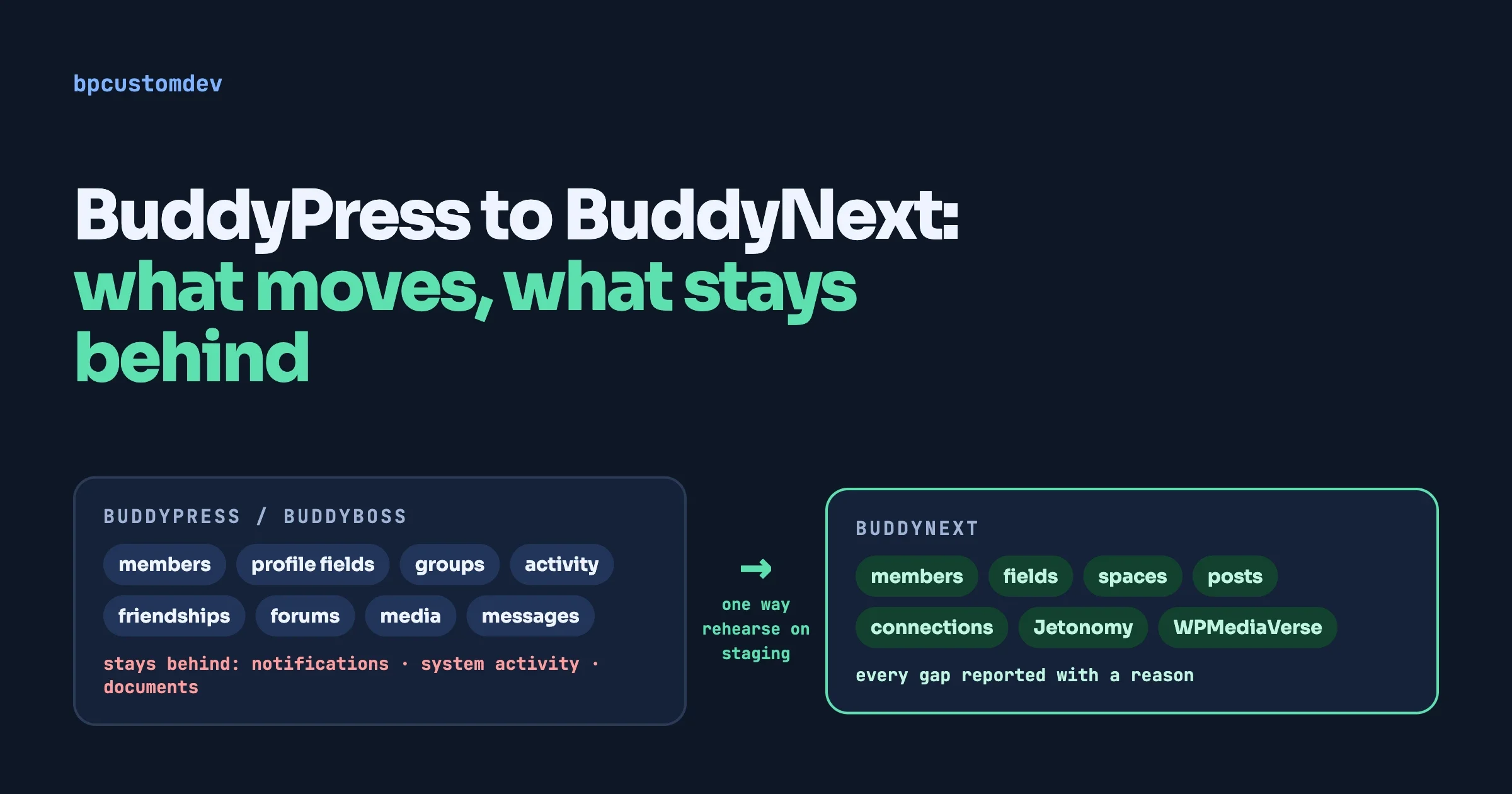
If community is the piece you’re missing, BuddyNext is worth a look. It’s a free, standalone community plugin for WordPress, not an add-on bolted onto BuddyPress, so it works whether your site currently runs BuddyPress or nothing at all. Profiles and activity feeds come built in, along with groups and direct messaging.
If the missing piece is forums or Q&A instead, Jetonomy covers that ground on its own and connects automatically to BuddyNext if you decide to add community features down the line. Neither requires the other to function, which matters if you’re only solving one problem right now and might solve the second one later.
Quick Comparison
Format | Primary Goal | Fails When |
|---|---|---|
Community | Belonging and engagement | Nobody has a reason to open it twice |
Forum | Peer Q&A, searchable answers | Search is weak and duplicates pile up |
Portal | Gated access to tools and resources | It’s just a login wall with nothing to return for |
Knowledge base | Self-serve documentation | Articles exist but the right one can’t be found fast |
Frequently Asked Questions
Can one plugin do all four things at once?
Not well. A plugin that promises to be all four formats at once usually ends up shallow in every one of them. Purpose-built tools connected to each other tend to outperform an all-in-one that treats every format as an afterthought.
Which format should a small site build first?
Whichever one matches the actual behavior you’re trying to create. If support tickets are the pain point, start with a knowledge base. If members keep emailing each other outside the platform to ask questions, that’s a signal they want a forum or community and are already improvising one badly.
Does a forum count as a community?
Not really. A forum can build community as a side effect, but its structure is organized around threads and answers rather than people and relationships. You can tell the difference by asking whether members visit to check on a specific thread or to see what’s new with people they follow. Those are different habits.
Is a portal worth building if the site is small?
Usually not yet. Portals earn their complexity when there’s enough content, enough users, or enough gated material that a plain page can’t organize it clearly anymore. A small site with a handful of resources is better served by a simple members-only page than a full portal build.
Pick the Format That Matches the Behavior You Want
The format isn’t the goal. The behavior is. A community succeeds when people return to see each other, not when the feature list is impressive. A forum succeeds when the same question never has to be answered twice. A portal succeeds when it disappears into the background of someone’s workflow. A knowledge base succeeds when the person reading it never has to open a support ticket at all.
Build for the behavior first, and the format choice mostly makes itself.