Why Your Online Community Stopped Growing After 500 Members (And How to Fix It)

You hit 500 members and something changed. The graph that used to climb every week went flat. New join requests slowed. Long-time members started going quiet. Posts that used to get ten replies now get two. You refreshed your analytics, ran a giveaway, even tried posting more yourself, but nothing moved the needle. If this sounds familiar, you are not dealing with bad luck. You are dealing with a structural problem that nearly every online community hits at the same scale, and it has a name: the 500-member plateau.
This article gives you a diagnostic framework for finding the exact leak in your community, then five specific fixes you can apply this week. We will also cover where to look inside Circle, Skool, and BuddyPress to surface the data that tells you what is really happening.
Why 500 Members Is a Specific Inflection Point
The 500-member mark is not a coincidence. Below 150 members, Dunbar’s number applies loosely; people can maintain personal connections with most of the group. Between 150 and 500, the community runs on reputation and familiarity. Members still recognize each other’s names. The founder is still visible to nearly everyone. Energy feels high because the community is growing fast relative to its base.
Past 500, the math changes. Members can no longer keep track of who is who. New people arrive into a crowd where they do not know anyone. Veterans stop feeling like insiders because the group no longer feels personal. The founder, who used to be the connective tissue, cannot personally reply to everyone anymore. What held the community together at 200 people breaks down at 600.
This is not a content problem or a posting frequency problem. It is a social architecture problem. And diagnosing it correctly is the only way to fix it.
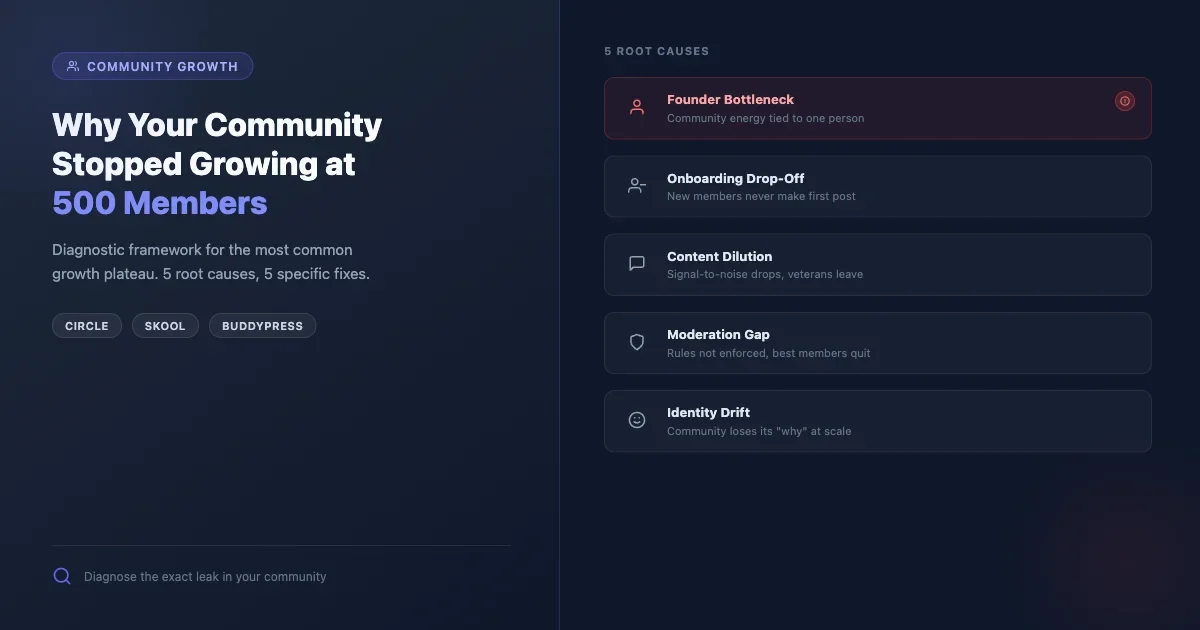
The Five Root Causes of the Plateau
In most communities that stall around 500, the problem traces back to one or more of five structural causes. They often overlap, which is why generic fixes (post more, run a challenge, add a welcome sequence) rarely work. You need to find which one is bleeding you out.
1. Founder Bottleneck
The founder is the most common single point of failure. In the early days, the founder’s energy IS the community. Members joined because of you, including your ideas, your voice, and your direct engagement. That worked fine at 80 members. At 500, you physically cannot sustain it. You post less. You reply slower. The community senses the drop-off before you do.
The fix is not to post more. It is to build distributed ownership so the community’s energy does not depend on your calendar.
2. Onboarding Drop-Off
Most communities lose 40-60% of new members in the first seven days. Members join, look around, feel awkward, and never post. They become passive subscribers who drag engagement rate down without contributing anything. If you are not actively moving new members from “lurker” to “participant” inside the first week, your net active membership is much lower than your total count suggests.
3. Content Dilution
When a community grows, content quantity goes up. Quality and relevance do not always follow. Early communities often have dense, high-value discussions because every post is from someone with real skin in the game. At 500 members, you start getting surface-level posts, off-topic threads, and low-effort questions that veterans have answered twelve times before. Veterans disengage because the signal-to-noise ratio dropped. New members cannot find the good stuff because it is buried.
4. Moderation Gap
Small communities are self-moderating. Social pressure keeps behavior in check. Past 500, that breaks down. You start seeing spam, self-promotion threads that should have been caught, heated arguments that went unresolved, and rules that existed but were never enforced consistently. When the community does not feel safe or fair, your best members leave quietly. They never announce it. They just stop showing up.
5. Identity Drift
This one is the hardest to see from the inside. As a community grows, it attracts people at the edges of the original niche. Gradually the community’s identity shifts. What it stands for becomes blurry. Long-time members notice that the vibe has changed. New members cannot articulate what the community is actually about. Growth accelerates dilution of identity, which slows future growth, a self-reinforcing cycle.
How to Diagnose Your Specific Leak
Before you start fixing things, spend 30 minutes running this diagnostic. The answers tell you which of the five causes is primary.
Engagement Rate by Cohort
Pull your members into three groups: joined 0-30 days ago, 31-90 days ago, and 90+ days ago. What percentage of each group posted or commented at least once in the last 30 days? If the oldest cohort has the lowest engagement rate, you have a content dilution or identity drift problem. If the newest cohort is the most disengaged, your onboarding is broken. If engagement is flat across all cohorts but declining month over month, you likely have a founder bottleneck or moderation gap.
First-Post Rate
Out of every 100 people who joined in the last 90 days, how many have ever posted anything? If that number is below 25, you have an onboarding problem. If it is above 50, your onboarding is healthy and the issue is retention of already-engaged members.
Churn Rate on Your Top 10% Contributors
Identify your 10% most active members from six months ago. How many are still active today? If more than a third have gone quiet, you have a moderation gap or identity drift issue. Engaged members do not usually leave because of onboarding problems. They leave because the community stopped feeling like their kind of place.
Content Age Distribution
Look at your most-viewed or most-commented posts from the last 90 days. Are they mostly new posts or mostly old posts that are getting pulled up in search? If old content dominates, your new content pipeline is weak. If new posts dominate but engagement per post is declining, the quality or relevance of new content has dropped.
Running the Diagnostic on Circle
Circle gives you member analytics under the Members tab. Filter by “Last Active” and set it to the last 30 days. This shows you who is actually engaged versus who just exists in your database. Export this list and compare it against your join date cohorts manually (Circle does not yet build cohort views natively, so a spreadsheet is the fastest path).
For first-post rate, use the Activity feed filtered by post type “New Discussion” or “Comment” and sort by member. You can see quickly which members have zero contributions. The Space analytics tab shows engagement per space over time. If one space is consistently dominating all activity, the rest of your spaces may be ghost towns pulling energy away from where your members actually want to be.
Circle’s “Members Who Haven’t Posted” filter (in Bulk Actions under Members) is the fastest way to find your lurker population. Export it, segment by join date, and you have your onboarding funnel data without any third-party tools.
Running the Diagnostic on Skool
Skool’s Classroom tab shows member activity scores, which are a proxy for engagement but not a direct measurement of posting behavior. The Leaderboard is more useful for diagnostic purposes. It surfaces who is driving discussion versus who is silent. If your leaderboard top 10 looks the same as it did three months ago, with no new names breaking in, you have a founder-bottleneck or onboarding problem (new members are not finding their footing).
Skool does not expose raw cohort data in its default dashboard. The workaround is to filter Members by join date using the date range selector, then note average level and comment count for each date range group. Members who joined more than 60 days ago and still have a level below 3 are almost certainly lurkers who never converted to participants.
For content quality diagnostics, sort posts by “Most Liked” and look at the date distribution. If all your top posts are six months old, your recent content is not resonating, which often signals identity drift or content dilution.
Running the Diagnostic on BuddyPress
BuddyPress gives community managers the most raw access to data of the three platforms, at the cost of requiring more manual work (or custom queries). In the WordPress admin, navigate to Users and sort by “Last Activity.” Users who joined more than 30 days ago and have no activity date set have almost certainly never posted anything. This is your lurker population.
For engagement cohort analysis, the Activity component stores a complete log. You can query the bp_activity table with a simple join to wp_users to get post counts by member and registration cohort. A query like this gives you the core data:
SELECT DATE_FORMAT(u.user_registered, '%Y-%m') as cohort,
       COUNT(DISTINCT a.user_id) as active_members,
       COUNT(a.id) as total_actions
FROM wp_users u
LEFT JOIN wp_bp_activity a
  ON u.ID = a.user_id
  AND a.date_recorded >= DATE_SUB(NOW(), INTERVAL 30 DAY)
GROUP BY cohort
ORDER BY cohort;
If you are running BuddyPress with BuddyPress Moderation, the moderation log is your fastest path to diagnosing a moderation gap. It shows reported content, blocked members, and unresolved flags in a single view. High numbers of unresolved flags is almost always a leading indicator that engaged members are about to disengage.
For groups specifically, the Groups component admin shows member counts and last activity per group. Groups with no activity in 30 days that still have members are dead weight. Members are subscribed but not visiting, which suppresses your engagement rate and sends misleading signals to your overall metrics.
Five Specific Fixes (Matched to the Root Cause)
Each fix below maps to a specific root cause. Do not apply all five at once. Pick the one that matches your diagnostic result and run it for four weeks before adding another.
Fix 1: Community Moderator Program (Founder Bottleneck)
Identify your top three to five most consistently engaged members. Reach out privately, acknowledge their contribution, and invite them into a small Moderator or Leader group. Give them a specific role with a specific scope, not just “help me out,” but “you own the weekly thread, I want you to reply to every new post within the first four hours.” You are distributing the connective-tissue function you used to perform alone.
The key is making the role feel meaningful, not just labor. Give moderators early access to content, a private channel with you, or a visible badge. The status signal matters as much as the responsibility.
Fix 2: 72-Hour Onboarding Window (Onboarding Drop-Off)
New members need to be pushed to make one contribution within 72 hours of joining, because data consistently shows that members who post in the first three days have dramatically higher 90-day retention than those who do not. The mechanism does not matter as much as the trigger.
Concretely: send a DM or welcome email 24 hours after join that asks a single, low-stakes question. Not “introduce yourself” (too vague) but something specific to your community’s niche: “What’s one thing you’ve tried in the last 30 days that didn’t work?” Then have a moderator or you reply to every single response within 24 hours. That reply is the hook that turns a passive member into a participant.
Fix 3: Content Curation Layer (Content Dilution)
Stop trying to fix content quality by asking members to post better content. Instead, add a curation layer. On Circle, this means pinning weekly “best of” posts in each space. On Skool, it means moderators marking specific posts as Featured. On BuddyPress, it means using activity favorites and an admin-curated “Staff Picks” feed if your theme supports it.
The goal is not to suppress low-quality content (that creates more problems than it solves) but to make the high-quality content more visible. Veterans stay because they can still find the good stuff. New members get oriented to what “good” looks like in your community faster.
Fix 4: Moderation Cadence (Moderation Gap)
Consistent, visible moderation is more important than strict moderation. Members need to see that rules are enforced, not harshly, but reliably. Pick one moderation action to make visible every week: a pinned “Community Standards” reminder, a gentle public redirect when someone posts off-topic, or a monthly “housekeeping” post that acknowledges the health of the community.
Hidden moderation (silently removing content, DMing rule-breakers without public acknowledgment) lets problems accumulate invisibly. Visible moderation signals to your best members that you are maintaining the space for them.
Fix 5: Identity Anchor Posts (Identity Drift)
Once a month, publish a post that forces the community to re-articulate its identity. Not “welcome to the community” boilerplate, but a genuinely specific question that only your exact audience can answer well. Something like: “Name one community tool you wish existed but does not” or “What’s the single biggest mistake you made in your first 100 members?”
These posts do two things. They filter. People who cannot answer meaningfully self-select toward the edges. And they remind long-time members why they joined in the first place, which reduces quiet churn from veterans who felt the identity slipping.
What Not to Do at the Plateau
A few tactics are common responses to the 500-member stall that make things worse.
Do not run a paid acquisition campaign. Buying members into a community that is already structurally broken accelerates all five problems. More members means more noise, more onboarding failures, and faster identity dilution. Fix the structure first.
Do not reduce the price. Cheaper access attracts lower-commitment members, which makes engagement metrics look worse, not better. The 500-member plateau is almost never a price problem.
Do not add more content or more spaces. More spaces mean more places for members to be absent. More content from the founder accelerates the founder bottleneck. The instinct to “do more” is wrong here. The fix is almost always to do less, better.
Do not ignore the data. “My community has good vibes” is not a diagnostic. Pull the numbers. Engagement rate by cohort, first-post rate, churn on top contributors. These three metrics tell you more about community health than any qualitative sense of the vibe.
The Metrics to Track After You Intervene
Once you apply a fix, you need a four-week measurement window before drawing conclusions. Track these three numbers weekly:
Weekly Active Members (WAM): the count of members who posted, commented, or reacted at least once in the last seven days. This is your primary health metric. If WAM is growing, you are moving in the right direction regardless of what total membership count is doing.
New Member First-Post Rate: out of members who joined in the last 30 days, what percentage has posted at least once? Track this weekly. A fix to onboarding should move this within two weeks.
Veteran Retention Rate: out of your top 20% contributors from 90 days ago, how many are still active? This is your canary in the coal mine for identity drift and moderation gap. If it drops below 60%, something structural is wrong regardless of what your total numbers show.
Platform Comparison: Where Each Tool Makes Diagnostics Easier
Different platforms make different parts of the diagnostic easier.
Circle is strongest for new-member diagnostics. The “Members Who Haven’t Posted” filter and the activity feed make onboarding analysis fast. It is weakest for long-term cohort retention analysis. You will need a spreadsheet or an external tool.
Skool is strongest for engagement-rate diagnostics at a glance. The Leaderboard and level system give you a quick view of who is and is not contributing. It is weakest for content quality analysis. There is no easy way to filter posts by engagement quality without sorting manually.
BuddyPress is strongest for raw data access. If you are willing to run a SQL query or install an analytics plugin, you can answer any diagnostic question you want. It is weakest out of the box. The default admin gives you the least actionable engagement data of the three. Plugins like BuddyPress Hashtags for content discoverability or external tools like Matomo can close this gap significantly.
The right platform for your community is not necessarily the one with the best analytics dashboard. It is the one whose engagement model matches your community’s growth pattern. A course-based community with clear milestone progression fits Skool’s level system well. An open peer-to-peer network for professionals fits Circle’s space structure. A deeply customized community tied to an existing WordPress site fits BuddyPress’s flexibility.
If data ownership is the deciding factor, BuddyNext is a free, standalone community platform worth a look, an activity feed, member profiles, Spaces (groups), and deep moderation in one plugin, built as its own modern architecture rather than on top of BuddyPress (so it isn’t a BuddyPress add-on and existing BuddyPress plugins won’t run on it). Because it runs on your own site you keep full ownership of member data, and its Pro tier adds native Stripe memberships when you’re ready to monetize.
Knowing When the Plateau Is Actually a Ceiling
One honest conversation to have with yourself: sometimes a community stops growing because it has reached its natural size. A community for left-handed calligraphers who prefer a specific nib type will never have 10,000 members. That is fine. The goal is not scale for its own sake. The goal is a healthy, engaged group of people who find value in being there.
If you have run the diagnostic, applied two or three fixes over eight weeks, and the numbers still have not moved, consider whether the market you are serving is simply fully penetrated at your current scale. At that point, the right move is to double down on depth over width: make the existing 500 members so deeply engaged and so well-served that retention approaches 90% and word-of-mouth grows the community slowly but organically.
A 500-member community with 60% weekly active rate is healthier and more valuable than a 5,000-member community with 6% weekly active rate. The plateau is only a problem if you are building a business that requires scale. If you are building a community that requires depth, the plateau may be your destination, not your problem.
Putting It All Together
The 500-member plateau almost always comes from one of five structural causes: founder bottleneck, onboarding drop-off, content dilution, moderation gap, or identity drift. The mistake most community builders make is jumping to a fix before running the diagnostic. They post more, run a challenge, or recruit aggressively, and none of it moves the number because none of it addresses the actual leak.
Spend 30 minutes with your data first. Engagement by cohort, first-post rate, veteran churn. Those three numbers will tell you which of the five causes is driving your plateau. Then pick one fix, apply it consistently for four weeks, and measure against weekly active members, first-post rate, and veteran retention.
The communities that break through the 500-member plateau are not the ones that work harder. They are the ones that diagnose accurately and fix precisely. The data is already in your platform. You just need to know where to look.