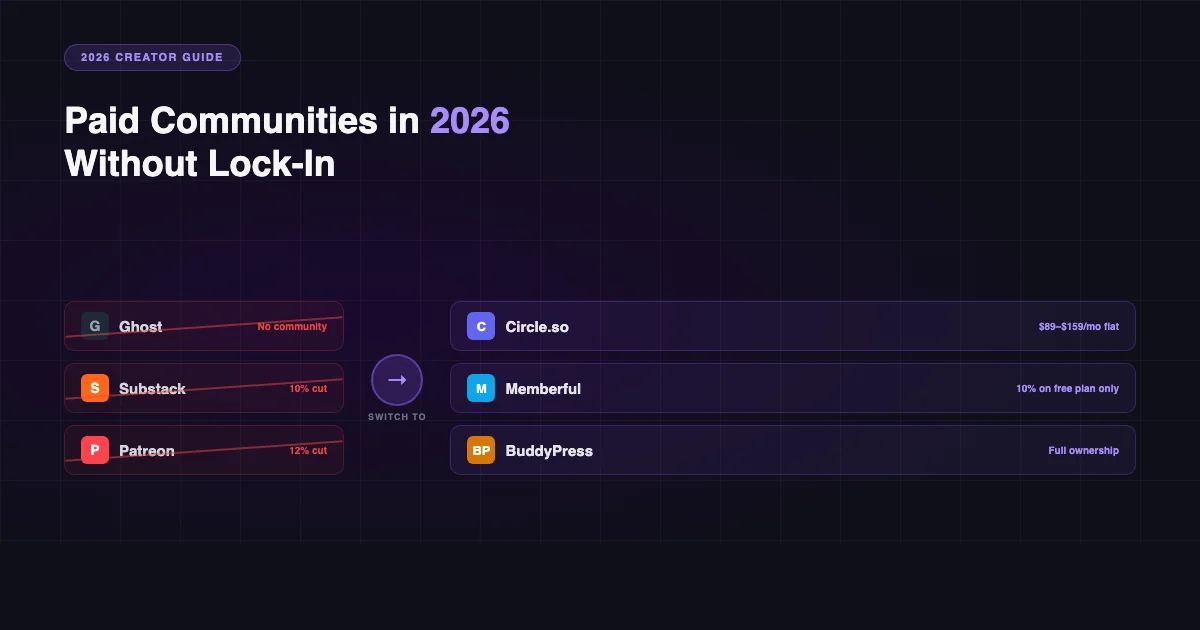
The creator economy spent five years convincing creators to build on platforms they do not own. Ghost, Substack, and Patreon each made compelling arguments for their approach. In 2026, the creators who built significant businesses on those platforms are dealing with the consequences: pricing changes they did not choose, feature limitations that constrain how they can serve their communities, and the persistent anxiety that the platform could change its terms in ways that hurt their business. The creators avoiding those problems started with a different question: who owns the community if the platform closes tomorrow?
This is not a blanket argument against Ghost, Substack, or Patreon. Each platform has genuine strengths that explain why serious creators choose them. But this guide is for creators who have already identified data ownership and platform independence as non-negotiable requirements for their community business, and who want to understand what their practical alternatives look like in 2026.
Why Lock-In Matters More Than the Platform Fee
Platform fees get most of the attention in creator economy discussions, but the more significant risk is lock-in. Lock-in means that switching platforms in the future will be expensive, disruptive, or both. Understanding where each platform creates lock-in helps you make a more informed decision about where to build.
Where Substack Creates Lock-In
Substack’s lock-in is primarily around subscriber relationships. When a reader subscribes to your Substack, they are trusting Substack’s infrastructure as much as they are trusting you. Your paid subscriber list lives in Substack’s database. You can export it as a CSV, but the payment relationships are managed by Substack, not by you. If you move to a different email platform, your paid subscribers need to re-subscribe and re-enter payment details. A meaningful percentage will not complete that process, and you will lose revenue in transition.
Substack also takes 10% of revenue plus payment processing fees. That percentage feels small on a $1,000/month business and significant on a $20,000/month business. The lock-in risk grows as revenue grows, because the migration cost in lost subscribers becomes more expensive at scale exactly when the platform fee justifies the friction of moving most strongly.
Where Ghost Creates Lock-In
Ghost’s lock-in is more technical than Substack’s. Ghost (Ghost.org, the hosted version) has no transaction fee and offers excellent newsletter infrastructure, but the community features are limited. Ghost does not have a native forum, member directory, or discussion space beyond post comments. Creators who need genuine community interaction alongside newsletters end up integrating Ghost with a separate community platform, creating a split infrastructure that compounds over time.
Ghost Pro (their hosted service) starts at $9/month and scales to $99/month at higher membership tiers. Ghost is open source, so self-hosted Ghost is theoretically free, but the hosting, maintenance, and development cost of self-hosted Ghost for a production newsletter business quickly exceeds the Ghost Pro subscription cost for most creators. The portability story is better than Substack’s (you own your Ghost data completely on a self-hosted instance), but the community limitation means you will need a second platform regardless.
Where Patreon Creates Lock-In
Patreon’s lock-in is brand and payment relationship lock-in. Your patrons are accustomed to logging into Patreon, seeing their pledges, and receiving content through Patreon’s interface. Patreon takes between 5% and 12% of revenue depending on your plan, plus payment processing fees. The lock-in risk is that Patreon’s community features are weak (their community posts are essentially a simplified social feed), so creators who want real community interaction end up with Patreon for payments and Discord, Circle, or another platform for community, doubling their infrastructure.
Patreon also periodically changes its fee structure and content policies in ways that creators cannot easily anticipate. The 2022 fee change controversy, where Patreon tried to shift payment processing fees to patrons rather than creators, illustrated how the platform’s interests and creator interests can diverge sharply.
The Alternatives: What Creators Are Using Instead
Circle with Your Own Email Infrastructure
The Circle + email provider stack is the most common alternative to Substack among newsletter creators who want both a newsletter and a community. Circle ($89-$360/month) handles paid community access and structured discussion. An email provider (ConvertKit, Beehiiv, or your own Postmark/SendGrid setup) handles the newsletter. Stripe handles payment processing directly.
The advantages: no per-transaction platform fee (Circle’s pricing is flat, and you negotiate directly with Stripe for processing rates). You own your email list completely in your email provider. If you leave Circle, you keep your list and your Stripe customer relationships. The community moves, but the subscriber asset stays with you.
The disadvantages: more moving parts than Substack’s all-in-one approach. You pay for two services instead of one. The setup takes longer. For creators who are early in their journey and optimizing for simplicity, Circle + email provider adds complexity that Substack’s free plan removes.
Memberful for Payment, Any Community Platform for Discussion
Memberful (owned by Patreon but operating independently) is a membership payment layer that sits on top of any community platform. You handle payment collection through Memberful (which integrates directly with Stripe and gives you the subscriber relationship), and then use Discord, Circle, a custom BuddyPress community, or any other platform for the actual community experience.
Memberful takes between 0% and 10% depending on your plan. The $25/month Pro plan (at time of writing) takes 4.9% plus payment processing. The $100/month Premium plan takes 0% plus payment processing. At scale, the Premium plan saves money compared to Patreon’s 8% cut at comparable revenue levels.
The key advantage: your subscriber data lives in your own Memberful account and in Stripe, not in a platform that controls both the payment and the content. If you want to leave Memberful, you export your Stripe customer IDs and build a direct billing relationship. Your members do not need to re-subscribe.
Whop for the Full Creator Stack
Whop is a newer entrant in the creator commerce space that handles digital products, community access, Discord role management, and payment collection in a single interface. Whop’s community features are basic (essentially a simple forum and member directory), but it excels at selling access bundles that include Discord community access, digital downloads, live calls, and courses under a single purchase.
Whop takes 3% of revenue plus payment processing fees. For creators building a community primarily delivered through Discord, Whop is often the simplest payment and access management layer that avoids Patreon’s higher fee and weaker Discord integration. The lock-in risk with Whop is moderate: your customer relationships are in Stripe, and your community content is in Discord, so the exit path is cleaner than leaving Patreon.
Self-Hosted BuddyPress + MemberPress: The Maximum Ownership Approach
A self-hosted BuddyPress community on WordPress, with MemberPress handling payment collection and access control, is the platform-independent option with the most complete data ownership. Your member accounts, their payment history, their forum posts, and their profile data all live on your own server in a database you control completely.
MemberPress takes no percentage of revenue. You pay a flat annual fee ($179-$599/year depending on tier) plus Stripe’s payment processing fees (2.9% + $0.30 per transaction). At $5,000/month in community revenue, MemberPress + Stripe costs roughly $145-$180/month versus Patreon’s 8% which costs $400/month. The savings compound significantly at higher revenue levels.
The BuddyPress community layer handles member profiles, activity streams, groups (useful for cohort-based programs), and community discussion. Adding Jetonomy gives you a structured forum and Q&A layer. Adding WPMediaVerse gives you member media sharing. The complete stack, including BuddyX Pro theme, runs $200-$400/year in plugin costs plus $50-$100/month in hosting. Total infrastructure cost is significantly lower than any SaaS platform at comparable member counts.
The tradeoff is technical setup and ongoing maintenance. If your exit from Ghost or Substack is motivated by data ownership, the self-hosted BuddyPress approach is the most complete answer to that concern. Understanding how the BuddyPress modular stack compares to BuddyBoss is a useful starting point if you are evaluating self-hosted community options.
Migration Playbook: Moving Away from Ghost, Substack, or Patreon
Leaving Substack
Export your subscriber list (Settings → Exports in the Substack dashboard). Both free and paid subscriber emails export in CSV format. Import this list into your email provider (ConvertKit, Beehiiv, Mailchimp, or your own infrastructure). For paid subscribers, Substack does not export payment relationships. You will need to email your paid subscribers directly and ask them to re-subscribe through your new platform. A personal email explaining why you are moving, what they will get on the new platform, and a direct link to re-subscribe converts better than any automated sequence. Plan for 40-70% of paid subscribers to re-subscribe when the offer and communication is done well.
Leaving Patreon
Patreon allows you to export patron email addresses from the Creator Dashboard. Payment relationships stay on Patreon’s side, your patrons will need to cancel their Patreon pledge and sign up through your new platform. Use Memberful or Stripe directly for the new subscription. The personal outreach approach works better than bulk announcement: email your top-tier patrons first, individually, explaining the move and giving them a founding-member offer on the new platform. Let those relationships seed the new community before announcing the migration publicly.
Leaving Ghost
Ghost has the cleanest export options of the three. Ghost Pro allows full content export (all posts) and member export (all subscribers with their status and tiers). The payment relationships with Stripe are directly accessible through your Ghost Pro account settings. Migrating to a self-hosted Ghost instance or to another platform preserves more of the subscriber relationship than Substack migrations because Ghost can share the underlying Stripe customer data with your new platform. If you are moving from Ghost Pro to a self-hosted BuddyPress community, the member export gives you the list you need for direct outreach.
The Real Cost Comparison
| Platform | Fee Structure | Cost at $5K/mo Revenue | Data Portability |
|---|---|---|---|
| Substack | 10% + processing | ~$640/mo | Email list only |
| Patreon (Pro) | 8% + processing | ~$545/mo | Email list only |
| Ghost Pro | $99/mo flat (no %) | $99/mo | Full content + subscriber export |
| Circle | $89-$360/mo flat | $89-$360/mo | Member export available |
| Memberful Premium + Stripe | 0% + 2.9% processing | ~$145/mo | Full (Stripe relationships) |
| BuddyPress + MemberPress + Stripe | 0% + 2.9% processing | ~$150/mo | Complete (own server) |
At $5,000/month in community revenue, moving from Substack to a Memberful + BuddyPress stack saves roughly $6,000 per year. At $10,000/month, those savings double.
What Creators Who Have Made the Move Report
The pattern among creators who have migrated away from Ghost, Substack, or Patreon to independent infrastructure is consistent: the migration is harder than expected and worth it. The reasons it is harder than expected are mostly subscriber conversion rates in the 50-70% range (you lose 30-50% of paid subscribers in transition, at least temporarily). The reasons it is worth it are the permanent savings on percentage fees and the relief of owning your subscriber relationships outright.
For a broader view of how the major creator community platforms compare in 2026, including platforms like Whop, Circle, Skool, and Mighty Networks, see our complete creator platform showdown. For the specific question of how Discord and Circle work together as a two-platform creator stack, our Discord vs Circle guide covers the integration patterns in detail.
The Bottom Line
The creators building durable community businesses in 2026 are not avoiding Ghost, Substack, and Patreon because those platforms are bad. They are choosing alternatives because the question of who owns the community matters more than the question of which platform is easiest to use.
If you are generating $2,000/month or less from your creator community, the platform fee and lock-in arguments are less urgent. The convenience of Substack or Ghost outweighs the cost differential at that scale. If you are generating $5,000/month or more, the fee savings from a Memberful or BuddyPress approach are substantial, and the subscriber data you own outright becomes an increasingly valuable asset that justifies the migration complexity.
The right time to make the move is before you have 2,000 paid subscribers, not after. The migration cost grows with the size of your subscriber base. Building on independent infrastructure from the start is simpler than migrating an established community, but the math also justifies the effort at any significant revenue level.
Which platform are you currently using, and what is driving your interest in alternatives? Leave a comment and we will try to point you toward the right solution for your specific situation.