Best Community Platform for Coaches in 2026: Circle, Skool, Kajabi Community, or BuddyPress
Coaches need cohorts, accountability check-ins, homework submission, live call integration, and a community that keeps clients engaged between sessions. We compared Circle, Skool, Kajabi Community, and self-hosted BuddyPress with BuddyX on every coach-specific need.

Coaches have specific community requirements that general-purpose platforms handle poorly. You need cohorts (groups of clients moving through a program together), accountability check-ins that create commitment, somewhere for clients to submit homework and get feedback, live call scheduling and recording, and a community that keeps clients engaged between your sessions rather than going quiet until the next call. Most community platforms are built for general discussion. Very few are built for the coach-client relationship and the program structure that makes coaching effective.
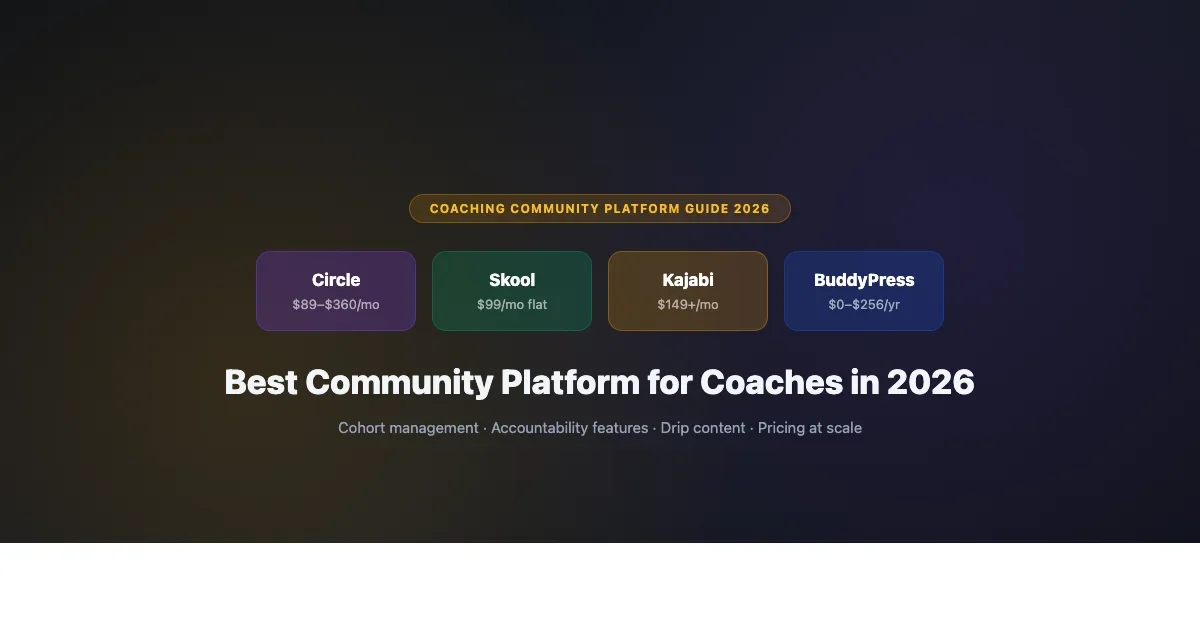
This comparison focuses on four platforms that coaches are actively using in 2026: Circle, Skool, Kajabi Community, and self-hosted BuddyPress with BuddyX Pro. We evaluate each on coach-specific criteria including cohort management, accountability features, live call integration, pricing per client, and the kind of community culture each platform tends to produce.
What Coaches Actually Need from a Community Platform
Before comparing platforms, it is worth being explicit about which features matter most for coaching businesses specifically. Generic community platform reviews often miss these requirements because they are designed for communities where the creator is a content publisher rather than a coach with ongoing client relationships.
- Cohort management: The ability to create time-limited groups of clients moving through a program together, separate from your ongoing community. A cohort that started in January should have its own space, its own discussions, and its own timeline separate from the cohort that started in March.
- Accountability features: Daily or weekly check-in mechanisms where clients report progress, state intentions, or complete prompts. The visibility of these check-ins to peers creates social accountability that one-on-one check-ins cannot replicate.
- Content delivery with gating: The ability to release program modules, worksheets, and videos on a schedule (drip content) rather than all at once, which reduces overwhelm and keeps clients progressing through the material at a pace that matches your coaching calls.
- Live call integration: Scheduling, recording, and sharing live coaching calls in a way that integrates with the community rather than requiring clients to navigate to a separate Zoom link management system.
- Homework submission and feedback: A structured way for clients to submit work (reflections, exercises, business plans) and for you or assistant coaches to provide feedback, visible to the client and optionally to the cohort.
- Pricing flexibility: The ability to run one-time program sales, monthly retainers, and annual memberships through the same platform without needing separate payment infrastructure for each model.
Circle for Coaches
Circle ($89-$360/month) is the most widely used platform among coaches in 2026, primarily because it combines a polished community interface with native course functionality and reasonable payment tools. The Spaces structure maps well to coaching program architecture: you can have a general community space, cohort-specific spaces gated by membership tier, and a resources space with program materials.
What Circle Does Well for Coaches
- Courses and content delivery: Circle’s native course builder allows you to create structured modules with video, text, and assignments. You can drip content on a schedule or unlock it based on progress. This is the feature most coaches cite as the reason they chose Circle over Skool.
- Cohort spaces: You can create separate Spaces for each cohort and restrict access by membership tier or manual assignment. A January cohort and a March cohort can have separate discussion boards, separate resource libraries, and separate event schedules within the same Circle community.
- Events and live calls: Circle’s native events feature allows you to schedule live calls with RSVP, Zoom or other video integration, and automatic recording sharing. The event history stays in the community for members who miss live calls.
- Workflows for accountability: Circle’s Workflows feature (Business plan, $360/month) allows automated prompt posts, member check-in reminders, and progress-triggered content unlocking. This is not a native daily check-in module, but it approximates one with some setup.
- Professional interface: For coaches working with business professionals, executives, or high-income clients, Circle’s interface communicates investment-level quality better than most alternatives. The aesthetic is polished without feeling corporate.
Circle’s Gaps for Coaches
- No native daily check-in or accountability post format. You have to build check-in culture manually or via Workflows.
- Homework submission has no dedicated interface. Members post submissions as discussion threads, which works but lacks the structure of a true assignment submission tool.
- Workflows require the Business plan ($360/month), which is a significant jump from the Professional plan ($199/month).
- Analytics are improving but still insufficient for tracking individual client progress across a cohort at a glance.
Skool for Coaches
Skool ($99/month flat) has grown rapidly in the coaching market because of its combination of simplicity, a built-in classroom, and a gamification system that drives the daily engagement that coaching programs need. The flat pricing regardless of member count makes the economics predictable in a way that Circle’s tiered pricing does not.
What Skool Does Well for Coaches
- Gamification for accountability: Skool’s points and leaderboard system is native and well-implemented. Clients earn points for posting, commenting, completing modules, and participating in events. The leaderboard creates competitive accountability that drives daily engagement without requiring the coach to manually prompt it.
- Simple classroom: Skool’s built-in classroom handles course delivery with modules, lessons, and a simple completion tracking system. It is less feature-rich than Circle’s course builder but adequate for most coaching program content delivery.
- Community feed: Skool’s main feed structure is simple and clean. Posts get visibility based on engagement, which surfaces the most active discussions naturally without requiring coaches to manage what members see.
- Flat pricing: $99/month regardless of whether you have 10 members or 1,000. For coaches with growing programs, this becomes more economical than Circle as membership scales.
- Calendar and events: Skool includes a community calendar for live events and calls. Not as polished as Circle’s events feature but functional for scheduling cohort calls and office hours.
Skool’s Gaps for Coaches
- No native cohort management. All members see all community content. Running separate cohorts requires separate Skool communities, each at $99/month.
- Drip content is not natively supported. All course modules are available immediately after enrollment, which creates the overwhelm problem that drip content is designed to prevent.
- No native payment processing. Coaches typically sell access via an external checkout (Stripe, ThriveCart, or similar) and then manually add or remove members from the Skool community.
- Limited customization. You cannot significantly change the look or feel of a Skool community. Every Skool community looks similar, which can feel limiting for coaches who want their brand to dominate the experience.
Kajabi Community for Coaches
Kajabi ($149-$399/month for plans that include the community feature) is an all-in-one platform for creators and coaches that includes a website builder, email marketing, course delivery, landing pages, checkout, and a community feature. The community feature is not as strong as Circle’s or Skool’s, but the all-in-one value proposition is compelling for coaches who want to manage their entire coaching business infrastructure in one place.
What Kajabi Does Well for Coaches
- All-in-one infrastructure: If you are already using Kajabi for your courses and email marketing, adding the community to your existing Kajabi account is significantly less expensive than paying for a separate Circle or Skool subscription. The $149/month Growth plan includes communities, courses, email, and landing pages.
- Native payment processing: Kajabi handles checkout for courses, memberships, and coaching packages within the same platform. No third-party checkout integration required.
- Course + community integration: Students who purchase a Kajabi course are automatically added to the associated Kajabi community. The integration between course progress and community access is tighter than any third-party integration between separate platforms can achieve.
- Coaching product type: Kajabi has a dedicated “Coaching” product type that allows one-on-one session scheduling, package sales with session tracking, and session notes storage. No other platform in this comparison has this feature.
Kajabi’s Gaps for Coaches
- The community feature is significantly weaker than Circle or Skool as a standalone community product. It handles basic discussion but lacks gamification, sophisticated cohort management, and the member directory quality that makes peer-to-peer connection valuable.
- No native cohort or group management within the community feature at the Growth plan level. Circles (Kajabi’s group feature) require the higher plan tiers.
- Kajabi’s pricing makes less sense if you are not also using the course, email, and website features. At $149/month purely for community functionality, Circle or Skool deliver significantly more community-specific value per dollar.
BuddyPress with BuddyX Pro for Coaches
A self-hosted BuddyPress community running BuddyX Pro theme with a membership plugin like MemberPress or Paid Memberships Pro gives coaches the most flexibility and the lowest ongoing cost at scale. Total plugin cost runs $200-$400 per year, plus hosting. There are no per-member fees and no transaction percentages taken by the platform.
What BuddyPress Does Well for Coaches
- Complete cohort control: BuddyPress groups can be configured as private, hidden, or public with fine-grained membership control. Each cohort gets its own BuddyPress group with its own discussion forum (via Jetonomy), its own activity stream, and its own member roster. You control exactly who sees what.
- Unlimited customization: You own the WordPress site. Every visual element, every email, every URL, and every feature can be customized. Coaches who want their brand to dominate the client experience, or who need to integrate the community with custom CRM or scheduling tools, have no constraints beyond development time.
- MemberPress integration: MemberPress handles cohort-based access, time-limited memberships, course drip content via MemberPress Courses, homework submission via AccessAlly or similar, and payment processing with full control over pricing structure. This replicates most of what Circle and Skool provide in a self-hosted environment.
- Cost at scale: A BuddyPress community with 1,000 active coaching clients costs roughly $400/year in plugins plus $50-$100/month in hosting. Circle at the Business plan with 1,000 members costs $4,320/year. The BuddyPress approach saves $3,000-$4,000/year at that scale.
BuddyPress’s Gaps for Coaches
- Technical setup is significantly more involved than SaaS alternatives. A coach without WordPress experience or a developer on their team should not attempt BuddyPress as a first community platform.
- No native gamification comparable to Skool’s leaderboard. GamiPress can be configured for coaching-specific achievement events, but it requires more setup than Skool’s out-of-the-box gamification.
- Live event management requires third-party plugins (events calendar plus Zoom integration). Circle and Skool handle this more smoothly within their native interfaces.
For coaches considering BuddyPress, understanding the difference between BuddyPress and BuddyBoss is important. Our BuddyPress stack vs BuddyBoss comparison covers the cost scenarios and developer flexibility differences in detail.
Platform Comparison for Coaching Use Cases
Feature | Circle | Skool | Kajabi | BuddyPress |
|---|---|---|---|---|
Cohort management | Yes (Spaces) | No (separate communities) | Partial (higher plans) | Yes (BuddyPress groups) |
Drip content | Yes (native) | No | Yes (native) | Yes (MemberPress) |
Gamification | Limited | Strong (native) | None | Strong (GamiPress) |
Live event integration | Strong | Moderate | Moderate | Via plugins |
Payment processing | Native | External required | Native | Via MemberPress |
All-in-one (course + email + community) | Partial | Partial | Yes | Via WP plugins |
Annual cost (100 members) | $1,068-$4,320 | $1,188 | $1,788-$4,788 | $400-$600 |
Technical setup required | Low | Very low | Low | High |
Which Platform Should Coaches Choose?
- Choose Circle if your coaching model centers on group programs with structured content delivery, you need cohort spaces that feel separate from the main community, your clients are professionals who need a polished brand experience, and you are comfortable with $89-$360/month platform cost.
- Choose Skool if your coaching model is high-engagement and community-driven, gamification and leaderboards fit your program culture, you have a single cohort running at any time (not multiple simultaneous cohorts), and you want the simplest possible setup at a predictable flat price.
- Choose Kajabi if you are already on Kajabi for course delivery and email marketing, and the community is supplementary to those core tools rather than the central product. Kajabi is the wrong choice if community is your primary offering.
- Choose BuddyPress if you have WordPress expertise on your team, you are running large cohorts where platform fee savings matter significantly, you need complete control over client data and branding, and you are willing to invest in initial setup for long-term cost efficiency.
For coaches building communities that will grow beyond 500 members and expect to operate for multiple years, the BuddyPress route saves enough money to justify the setup investment. For coaches launching their first paid community and optimizing for speed, Circle is the most reliable choice with the best support community for learning how to use it effectively. For a broader view of how these platforms compare against other creator platforms in 2026, see our complete creator community platform comparison.
The Bottom Line
The best community platform for coaches in 2026 is the one that matches your program structure, your client base’s technical sophistication, your budget at your current and projected scale, and your team’s ability to set up and maintain the platform. There is no universal winner because coaching businesses operate on fundamentally different models.
Coaches running high-touch group programs with multiple simultaneous cohorts and structured content delivery will find Circle most capable. Coaches running single high-engagement programs where gamification drives accountability will find Skool simplest and most effective. Coaches already invested in Kajabi infrastructure should use Kajabi’s community rather than paying for a separate platform. Coaches with technical resources who are optimizing for long-term economics should consider BuddyPress with BuddyX Pro and MemberPress.
What coaching community platform are you currently using, and what is the one feature you wish it handled better? Leave a comment and we will try to help you find a solution or a better platform fit.