Using Claude and ChatGPT to Moderate Communities: Where AI Helps and Where It Fails

Community managers are experimenting with Claude and ChatGPT to handle moderation workloads that used to eat half their day. Some of it works well. Some of it fails in ways that are genuinely hard to predict until it happens to your community. This post breaks down exactly where AI moderation adds value, where it falls flat, how to build a tiered setup that keeps humans in the loop, and the prompt patterns that actually produce useful output.
What “AI Moderation” Actually Means in Practice
When people say they are using Claude or ChatGPT for moderation, they usually mean one of three things: automated flagging of content before a human sees it, classifying incoming reports so mods can prioritize, or giving mods a policy chatbot they can query instead of digging through a wiki.
All three are real use cases. None of them replace human judgment. The gap between those two statements is what this post is about.
The tools available today sit in the “language model” category, not the “trained content moderator” category. They understand text statistically. They can match patterns across millions of examples. They cannot read the room in your specific community, and they do not know the three users who have been feuding since the January incident that nobody documented.
Where AI Genuinely Helps: First-Pass Spam
Spam detection is the clearest win. Large language models are genuinely good at spotting the following without any fine-tuning:
- Affiliate link dumps disguised as replies
- Crypto giveaway bait (“Send 0.1 ETH and receive 0.3 back”)
- Copy-pasted promotional text posted across multiple threads
- New-account posts with commercial intent that do not match the thread topic
- Low-effort “great post!” replies with an appended promotional link
In a BuddyPress or Discourse community where a spam wave hits overnight, a prompt-based classifier running on the moderation queue can surface the obvious offenders before your first mod logs in. That is real time saved. The classifier does not have to be right 100% of the time. If it correctly flags 85% of the junk and places it in a pending queue for human review, you have already cut the manual work significantly.
The prompt pattern that works for this is simple:
You are reviewing a forum post for spam.

Post content: {post_content}
User account age: {days}
Prior posts by this user: {count}

Classify as: SPAM, SUSPICIOUS, or CLEAN.
If SPAM or SUSPICIOUS, list the specific signals you observed.
Do not guess. If you cannot determine, return UNSURE.
The key additions are: asking for specific signals, explicitly allowing “UNSURE”, and including account metadata. Without account age and post history, the model treats every post in isolation, which misses the “suspicious new account posting promotional content” pattern entirely.
Where AI Helps: Message Tone Classification
Another area where LLMs add consistent value is tone triage. When your moderation queue has 40 flagged posts and you need to decide which ones a senior moderator sees first, an AI classifier can order them by severity.
The categories that work well in practice:
- Clear policy violation: slurs, threats, doxxing attempts, explicit content where it is prohibited
- Heated but ambiguous: strong language, accusations, personal criticism that may or may not cross the line
- False positive: user-reported content that appears fine on review
- Needs context: content where the policy question depends on thread history, group rules, or user relationship
The model is reliable on the first and third categories. The second and fourth categories are where it starts to struggle, which leads into the failure section.
For tone classification, the prompt structure that reduces false positives is to provide the community’s specific rules, not just generic “be nice” language:
You are reviewing a flagged community post.

Community rules summary:
- No personal attacks targeting appearance, health, or family
- Political debate is allowed; personal political attacks are not
- Profanity is permitted in context; directed at a specific user is not

Flagged post: {post_content}
Thread context (last 3 messages): {thread_excerpt}

Classify: CLEAR_VIOLATION | AMBIGUOUS | LIKELY_OK | FALSE_POSITIVE
Explain your reasoning in one sentence. Do not speculate about user intent.
Where AI Helps: Policy Q&A for New Moderators
This one is underused and underrated. New mods in any community spend months developing judgment about edge cases. They ask veterans “is this okay?” constantly. AI can absorb your full rules document and serve as a 24/7 first-opinion source.
The setup: feed your community guidelines, your past moderation decisions log (anonymized), and your FAQ into a document the model can reference. Then your mods can query it before escalating.
What this solves: the 2am edge case when your senior mod is offline and a new mod is staring at something they have never seen before. A well-constructed policy bot will not give them the answer, but it will give them the relevant rule citations and the closest analogous precedents, which is often enough to make a defensible decision.
What it does not solve: anything that requires community-specific context, relationship history, or tone interpretation. The bot does not know that User A and User B have a history that makes this exchange mean something different from what the words suggest.
Where AI Fails: Context-Heavy Member Disputes
This is the most common and most expensive failure mode. Two members have a conflict. The current post, read in isolation, looks like a mild jab. In context of the last three weeks, it is the culmination of an escalating harassment campaign that your senior mods have been watching.
An AI classifier reading that post in isolation will classify it as borderline or clean. It has no way to pull the relationship history. It does not understand the significance of specific references that are inside jokes turned weapons. It cannot tell that the word “interesting” in this specific context, between these specific two users, is a coded insult that your community members will immediately recognize.
Any moderation workflow that auto-acts on AI output without human review of the thread context will make the wrong call on exactly these cases, which tend to be the ones that matter most to your community’s health.
Where AI Fails: Sarcasm and Irony
Language models have gotten better at detecting obvious sarcasm, but they still fail reliably on community-specific ironic registers. Every active community develops its own sarcastic shorthand. “Yeah, that’ll work great” means one thing in a general forum and something completely different in a community where that phrase is a well-known running joke about a failed experiment from 2023.
The failure goes in both directions. The model may flag genuine sarcasm as a sincere statement and miss the violation. Or it may read sincere praise as sarcasm and flag it as dismissive. Both produce bad moderation calls.
The practical implication: for content where sarcasm and irony are common communication styles, such as developer communities, gaming communities, or any community with a strong in-group culture, AI tone classification should be treated as a weak signal, not a strong one.
Where AI Fails: Cultural Nuance
Training data shapes the model’s cultural reference points. Claude and ChatGPT are primarily trained on English-language data with heavy representation from North American and Western European contexts. They handle moderation for communities operating in those contexts reasonably well. They do not handle moderation well for communities where the primary cultural context is different.
Specific failure patterns include:
- Missing offensive connotations of terms that are derogatory in specific regional dialects but not flagged in the training data
- Misreading directness norms (some cultures communicate criticism very directly in ways that read as hostile to the model)
- Failing to recognize religious references that are respectful in context but may appear problematic out of context
- Missing coded language that functions as harassment in specific demographic communities but is unrecognized in general training data
If your community is primarily non-English or operates in a specific cultural context that differs significantly from mainstream English-language online discourse, you need cultural insiders reviewing AI moderation outputs before any action is taken.
Where AI Fails: In-Group History and Community Memory
Communities accumulate memory. Events from two years ago shape how current conversations are read by members who were there. An old conflict between two factions colors every interaction between their current representatives. A past incident with a specific user means that certain patterns get read very differently by long-term members.
AI has no community memory. It reads each post cold. This is fine for spam detection where history is irrelevant. It is a significant problem for any moderation decision that requires understanding the social dynamics of your specific community.
The workaround is to include relevant context explicitly in the prompt when escalating cases. Your moderation team should document patterns, and those summaries can be fed to the model. But this requires the human to already know the context exists, which means the AI is not doing the hardest part of the work.
Where AI Fails: Bias Propagation
This one deserves direct attention. Language models trained on internet-scale data carry the biases present in that data. When you use them to flag content, they will flag some content types more reliably than others, and some communities more heavily than others.
Documented patterns in AI content moderation research include: over-flagging of African American Vernacular English (AAVE) as aggressive, under-flagging of subtle misogynistic content that does not contain obvious slurs, and inconsistent handling of political content depending on the framing.
This does not mean you should not use AI moderation. It means you should audit your moderation queue data. If you see patterns where content from specific demographic groups is being flagged at higher rates than the content itself warrants, your AI classifier is surfacing a bias. That bias will manifest in how your community feels to those members. If they start feeling over-policed relative to others, they leave.
Regular audits of flagged content distributions are not optional if you are using AI as a first-pass filter at any scale.
Building a Tiered Moderation Setup
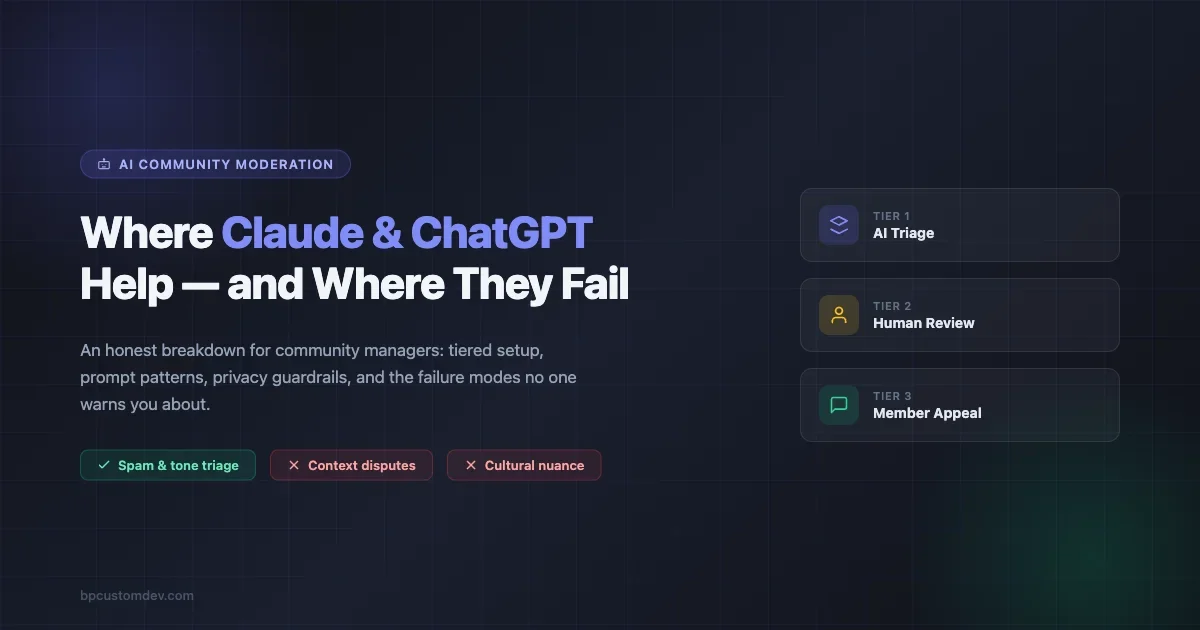
The setup that works for most communities with 500+ active members and limited mod team capacity is a three-tier system:
Tier 1: AI Triage
Automated classification runs on all incoming content. Clear spam goes to a pending queue (not deleted, pending human confirmation). Clear policy violations get flagged with high priority. Everything else passes through to the community.
The AI does not take action. It annotates. Mods see the queue sorted by AI confidence score, with the most likely violations at the top.
Tier 2: Human Review
A moderator reviews everything in the flagged queue. For clear spam from the pending queue, they confirm or release. For flagged content, they read the thread context, check the user’s history, and make the call.
The AI annotation serves as a starting point, not a verdict. The mod should be able to override without friction. Track overrides. If a mod is consistently overriding AI flags in the same direction, that is signal that your prompt or classification threshold needs adjustment.
Tier 3: Appeal
Any user whose content is actioned gets a clear appeal path. Appeals go to a senior moderator who was not involved in the original decision. The appeal record includes both the original AI annotation and the mod’s reasoning.
Appeals serve two functions: they catch errors, and they build community trust. Members who feel unfairly moderated are more likely to stay if they have a credible appeal path with transparent reasoning. “The AI flagged it and we agreed” is not transparent reasoning. The mod’s actual interpretation of the specific rule violation is the reasoning.
Prompt Patterns for Moderation Classifiers
The prompts above covered spam and tone classification. Here are additional patterns that work in production:
Report Triage Classifier
You are processing a user-submitted content report.

Reported content: {content}
Reason given by reporter: {report_reason}
User history summary: {user_history_brief}

Assess this report on two dimensions:
1. Policy risk: HIGH | MEDIUM | LOW | NONE
2. Reporter reliability signal: LIKELY_GOOD_FAITH | UNCLEAR | POSSIBLE_RETALIATORY

Provide one sentence of reasoning for each.
Do not recommend action. A human moderator will decide.
Community Rules Advisor (for moderators)
You are a community policy assistant. You have access to the following community guidelines:
{guidelines_text}

A moderator is asking: {moderator_question}

Provide the relevant rule citations. If there are precedents in the guidelines, cite them.
If the situation is not clearly covered, say so explicitly.
Do not give a final answer on whether to take action. That is the moderator's decision.
Escalation Prioritizer
You are helping a moderation team prioritize their queue.

The following reports have been waiting for human review:
{report_list_with_summaries}

Sort them by urgency, where urgency considers:
- Potential for immediate harm (threats, doxxing)
- Content visibility (high-traffic thread vs low-traffic)
- Time sensitivity (ongoing incident vs old post)

Return a numbered list from most to least urgent, with one-line reasoning per item.
Privacy: What Not to Send to the Model
This is non-negotiable. Community moderation involves personal information about real people. When you send content to Claude or ChatGPT via API, you are sending it to a third-party service.
Never send:
- Real names associated with reported content (refer to users as “User A” and “User B”)
- Email addresses, IP addresses, or location data
- Private messages unless the user explicitly consented to moderation review of private content (and this is in your Terms of Service)
- Sensitive personal disclosures members made in the context of a support subcommunity
Always send:
- Post content with identifiers replaced by anonymous labels
- Account metadata that is not personally identifiable (account age, post count, previous flags count)
- Thread context with names replaced
Your Terms of Service and Privacy Policy should be clear about your use of AI tools in moderation. If a member asks whether AI is used in moderation decisions, “no, never” is the wrong answer if it is not true. Members deserve to know this.
Choosing Between Claude and ChatGPT for Moderation
Both models work for the use cases described above. The practical differences for moderation work:
Claude tends to be more conservative in tone classification and produces longer reasoning outputs. This makes it better suited for the policy advisor role where you want explicit rule citations, and for audit trails where you need the model’s reasoning documented. It also has a longer context window, which helps when you need to include substantial thread history.
ChatGPT (GPT-4o) tends to be faster on high-volume classification tasks and is better integrated into no-code automation tools like Zapier and Make, which matters if you are building a moderation pipeline without developer resources. The API pricing is also more predictable at scale for simple classification tasks.
For most community teams, the choice comes down to what you can actually integrate into your existing stack. Both are capable. Neither is so superior that it should be the deciding factor if the other fits your tooling better.
For BuddyPress communities specifically, moderation tools like BuddyPress Moderation Pro handle the block, suspend, and report infrastructure that AI classifiers can feed into. AI classification of a flagged post only helps if you have a reliable queue and action system underneath it. The native BuddyPress moderation tools, or the extended plugin, are that foundation. AI sits on top.
If the community runs on WordPress and moderation is the priority, BuddyNext is a free, standalone community platform worth a look, an activity feed, member profiles, Spaces (groups), and deep moderation in one plugin, built as its own modern architecture rather than on top of BuddyPress (so it isn’t a BuddyPress add-on and existing BuddyPress plugins won’t run on it). Because it runs on your own site you keep full ownership of member data, and its Pro tier adds native Stripe memberships when you’re ready to monetize.
When to Skip AI Moderation Entirely
AI moderation adds overhead. Setting it up takes time. Maintaining the prompts as your rules evolve takes time. Auditing the outputs takes time.
For small communities (under 200 active members), a well-organized mod team with good documentation and a clear escalation path will outperform an AI-augmented workflow that nobody has time to maintain. The overhead is not worth it below a certain volume threshold.
The signal that you have crossed that threshold: your mods are spending more than 30% of their volunteer time on moderation instead of community building. At that point, the AI triage layer pays for itself in reduced mod burnout and faster response times on high-priority violations.
Also skip it if your community is built around sensitive topics, support communities, mental health spaces, or any context where miscategorized content can cause direct harm. The stakes are too high for a classifier that will get it wrong on the edge cases, and the edge cases in sensitive topic communities are exactly the high-stakes ones.
Connecting AI Moderation to Your Broader Community Health Practices
AI moderation is one tool in a larger system. Communities that handle conflict and safety well share a few other characteristics that have nothing to do with AI: clear published rules that members actually read, onboarding that sets expectations, a mod team that represents the diversity of the community it governs, and a culture where members report problems rather than leaving silently.
If those foundations are not in place, AI moderation will classify violations faster, but the violations will keep coming at the same rate. The detection layer is downstream of the culture layer.
For communities building on BuddyPress, maintaining discipline and decorum starts with the profanity filtering and content controls that handle the obvious automated violations, then adds human-plus-AI review for the cases that require judgment. That layering is what makes the system sustainable as the community scales.
The Honest Summary
AI community moderation using Claude or ChatGPT is real, practical, and worth implementing for communities at scale with the right scope. It handles spam well, sorts queues usefully, and gives new mods a policy reference they can actually use at 2am.
It does not understand your community. It does not know your members. It will miss the context-heavy disputes that matter most. It carries biases you need to audit for. It should never take action without a human in the loop.
The tiered setup, the privacy guardrails, and the audit habit are not optional add-ons. They are the difference between an AI moderation tool that helps your community and one that quietly makes it worse for specific members while making the metrics look clean.
Build it right and it will save your mods significant time. Skip the foundations and it will create problems that are harder to fix than the ones it solved.