6 Encrypted Discord Alternatives That Actually Protect Your Community in 2026

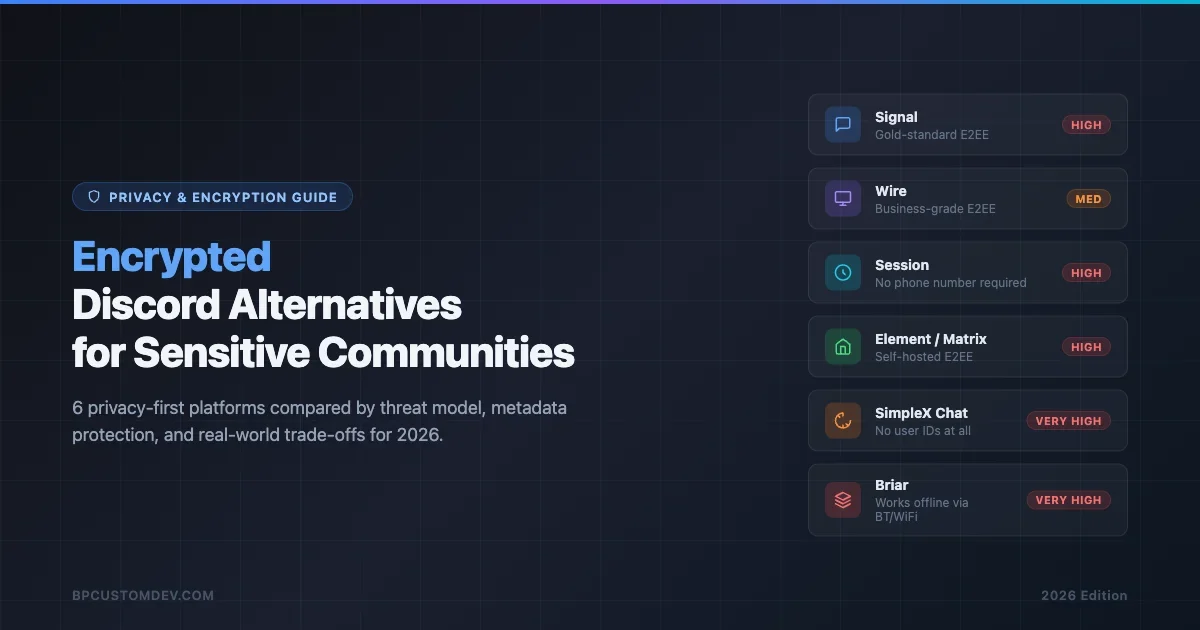
When your community handles sensitive conversations, Discord’s default settings are not your friend. It logs metadata, stores message history on US servers, and has complied with law enforcement requests. For security researchers sharing zero-day findings, activists coordinating in authoritarian contexts, whistleblowers communicating with journalists, or medical and legal teams discussing client matters, that threat model is unacceptable. This guide covers six platforms that take encryption seriously, what each one actually protects, and where each one falls short.
Why Discord’s Privacy Falls Short for Sensitive Communities
Discord encrypts traffic in transit (TLS) but stores messages in plaintext on its servers. The company can read your community’s conversations, and law enforcement can subpoena them. In 2023 and 2024 alone, Discord responded to hundreds of government data requests. Beyond content, Discord collects IP addresses, device identifiers, and detailed usage metadata. For most gaming communities, that’s fine. For a group of investigative journalists or a legal defense team, it’s a serious exposure.
The right question before picking a platform is not “is it encrypted?” but “what specifically does encryption protect, and who is my threat model?” End-to-end encryption (E2EE) means only sender and recipient can read messages. Transport encryption means the server can still read them. Metadata protection means the platform doesn’t log who talks to whom and when. Few platforms deliver all three.
Threat Model: Matching the Tool to the Risk
Before comparing platforms, map your actual threat:
- Low threat: You want privacy from advertisers and data brokers. You’re not a political target. Any E2EE messaging app will do.
- Medium threat: Corporate espionage risk, journalist-source communications, activist organizing in a democratic country. You need E2EE plus server-side message deletion and minimal metadata retention.
- High threat: Operating under authoritarian surveillance, whistleblowing to media, handling classified or legally privileged information. You need E2EE, no server logs, no phone-number registration, ideally decentralized infrastructure, and offline-capable options.
Each platform below is rated against these three tiers. A low-threat tool used for a high-threat situation is a security failure waiting to happen.
1. Signal Groups: The Gold Standard, With Real Trade-Offs
What it does well: Signal’s E2EE protocol is the gold standard in the industry. Every message, call, and file is encrypted client-side. Signal collects almost no metadata: it knows your phone number and the last date you connected, nothing else. Messages can be set to disappear automatically. The codebase is open-source and has been audited multiple times.
Threat model fit: Medium to high. Journalists protecting sources, legal teams, medical professionals, activist organizers in democratic contexts. The Signal Foundation is a US non-profit with a strong legal track record of refusing to comply with data requests beyond what technically exists (almost nothing).
The trade-offs:
- Requires a phone number to register. That’s a real-name linkage point if your phone number is known.
- Groups max out at 1,000 members. Not suitable for large communities.
- No community features: no channels, no topic threads, no moderation tools. It’s a group chat, not a community platform.
- Member onboarding friction is high. Every person needs Signal installed and must accept the invite.
- Search across message history is limited by design.
Bottom line: Best for small, tight-knit groups with high trust. Not a Discord replacement in terms of features, but the most trustworthy option for sensitive 1:many messaging.
2. Wire: E2EE With Business-Grade Features
What it does well: Wire offers E2EE for all messages and calls, supports up to 500 participants per group call, and allows email-based registration (no phone number required). Wire for Business includes admin controls, guest access, and compliance archiving that can be disabled for sensitive deployments. The app is open-source.
Threat model fit: Low to medium. Legal firms, medical practices, corporate security teams. Wire’s Swiss-based Wire Swiss GmbH is subject to Swiss privacy law, which is stricter than US law but not immune to international legal pressure. Wire was acquired by a US private equity firm in 2019, which complicates its privacy story somewhat.
The trade-offs:
- Wire servers can see metadata (who communicates with whom) even if they can’t read content. The company policy is to minimize this, but it’s not a technical guarantee.
- The free tier stores messages on Wire servers. Self-hosting Wire Server (open-source) removes this risk but requires real infrastructure to maintain.
- The 2019 acquisition introduced legitimate questions about data governance. Review the current privacy policy before committing.
- Mobile UX is less polished than Signal or Discord.
Bottom line: A practical middle ground for organizations that need group features and business controls, and where the threat model is corporate rather than state-level surveillance.
3. Session: No Phone Number, No Central Server
What it does well: Session is built on a decentralized network (the Oxen Service Node Network, based on the Loki blockchain project). It requires no phone number, no email, and no identifying information to register. You get a Session ID, a random string. Messages are routed through the decentralized network, which means there’s no single server that can be subpoenaed or shut down. The client is open-source.
Threat model fit: High. Activists in authoritarian countries, whistleblowers, anyone who needs strong anonymity at the registration level. The lack of phone-number requirement is a significant advantage over Signal for anonymity.
The trade-offs:
- Groups (Communities) support up to 100 members with E2EE. Larger open groups use a community server model that does not have E2EE at the group level (though 1:1 messages do).
- The decentralized network introduces latency. Messages can take seconds to deliver.
- The mobile app has had stability issues reported by users on older hardware.
- The project is maintained by the OPTF (a non-profit based in Australia). Australia has mandatory data retention laws and “assistance and access” legislation (TOLA) that could theoretically compel the OPTF. The decentralized architecture limits what the OPTF could actually produce if compelled, but this is worth understanding.
- Community features are limited compared to Discord. No voice channels in E2EE groups.
Bottom line: The strongest anonymity option for small groups with high-threat needs. Worth the UX trade-offs if phone-number-free registration is non-negotiable.
4. Element / Matrix: Self-Hosted E2EE With Real Community Features
What it does well: Matrix is an open, federated communication protocol. Element is the flagship client. You can self-host a Matrix homeserver (Synapse or Dendrite), which means your messages never touch a third-party server. E2EE is available via the Megolm protocol (based on Signal’s Double Ratchet). Matrix supports rooms (channels), spaces (server-equivalents), threading, voice, video, file sharing, and granular moderation. If you want the closest privacy-respecting equivalent to Discord’s feature set, this is it.
Threat model fit: Medium to high, depending on deployment. If you self-host, the threat model is limited to your own server security. The public Matrix.org server should be treated as low-trust (it can read unencrypted rooms and sees federation metadata).
The trade-offs:
- E2EE is not on by default for all rooms. Room admins must enable it, and once enabled, it cannot be disabled. Key verification between members is required for E2EE to be meaningful, and many users skip it.
- Self-hosting requires technical competence. Synapse (the reference homeserver) is resource-intensive. Plan for at least 2GB RAM and ongoing maintenance.
- Cross-signing and key backup setup is confusing for non-technical users. Onboarding friction is real.
- Federation means your server can communicate with other Matrix servers, which is a feature but also a metadata surface. Disable federation if you need a closed community.
- Message search over E2EE rooms requires client-side indexing, which is slow on mobile.
For communities already on self-hosted WordPress, pairing a self-hosted Matrix server with a BuddyPress-based social layer gives you both structured discussions and private encrypted channels. If you are evaluating community platforms broadly, the comparison in our guide to Discord alternatives for community builders covers the feature trade-offs across general-purpose tools.
Bottom line: The best option for technically capable teams that need Discord-like features with genuine E2EE control. The overhead is real; plan for it.
5. SimpleX Chat: No User IDs, Strongest Metadata Protection
What it does well: SimpleX is architecturally different from every other platform on this list. There are no user IDs at all. Not a phone number, not an email, not a random string tied to your identity. Communication happens through simplex message queues: you generate a one-time link and share it with someone. The receiver connects via that link. No persistent identifier is stored server-side. This makes metadata analysis essentially impossible: there is no graph of who communicates with whom.
Threat model fit: High. Researchers handling classified or legally privileged material, activists with concrete surveillance risks, anyone for whom “who you talk to” is as sensitive as “what you say.”
The trade-offs:
- Groups exist but are small (recommended under 20 members for E2EE groups). Larger groups use a different relay-based model.
- Onboarding is the hardest on this list. Sharing a new contact link for every relationship, explaining the model to non-technical members, is a real operational burden.
- No desktop client was available until recently; the web interface is still maturing.
- Discoverability is zero by design. You cannot search for people or communities on SimpleX. Every connection is manual.
- The project is UK-based, open-source, and funded by non-profit grants. Small team size means slower feature development.
Bottom line: The right tool for 1:1 and very small group communication where metadata protection is the primary concern. Not a community platform in the Discord sense, but unmatched for source-journalist contact or high-sensitivity legal consultations.
6. Briar: Offline-Capable, Peer-to-Peer
What it does well: Briar is the most unusual option here. It works without internet access: messages can be transmitted via Bluetooth, local Wi-Fi, or Tor. When internet is available, all traffic is routed through Tor by default, masking IP addresses. There are no central servers at all. Every device stores its own messages. Briar is designed specifically for high-risk scenarios: protest situations, communities in countries with intermittent internet access, and contexts where network infrastructure itself may be compromised.
Threat model fit: Very high. Activism in repressive regimes, disaster-preparedness communities, security research in isolated or adversarial environments. Briar is one of the few tools specifically recommended by digital security trainers for frontline activists.
The trade-offs:
- Android only (no iOS client). This is a hard blocker for many communities.
- No cloud backup. If you lose your device, you lose your messages and contacts. No recovery path.
- Group size is limited (forums support more members, private groups are small).
- Tor routing introduces significant latency. Not suitable for real-time conversation.
- The UX is functional but dated. Non-technical users find it confusing.
- No voice or video.
Bottom line: A specialized tool for specialized situations. Not a general-purpose Discord replacement. If your community faces the threat model Briar is designed for, nothing else on this list is equivalent. For everyone else, it’s overkill.
Metadata Leaks: The Risk Everyone Ignores
A recurring theme across all six platforms: message content encryption is the easy part. Metadata is harder. Even with E2EE, most platforms know:
- Who you are (phone number, email, IP address)
- Who you communicate with
- When you communicate and how often
- The size of messages (which can reveal document transfers)
For a medium-threat model, content encryption is often sufficient. For high-threat situations, metadata leaks can be as damaging as content disclosure. Signal, Session, SimpleX, and Briar each address metadata differently. Signal minimizes what it collects. Session distributes it across nodes. SimpleX eliminates persistent identifiers entirely. Briar routes through Tor and uses local transmission. Know which threat you’re solving.
Onboarding Friction Is a Security Control, Not a Bug
Every platform on this list is harder to join than Discord. This is partly intentional. The friction filters for users willing to install a dedicated app, verify identities, or accept an invitation. That filtering is part of the security model. A community platform anyone can join with a Google account is a community platform anyone can infiltrate.
Practical onboarding strategies that work across these tools:
- Staged invites: Issue invites in batches after vetting. Don’t post a public join link.
- Verification calls: For high-sensitivity communities, verify new members via a separate channel before granting full access.
- Written onboarding guide: A one-page guide covering app installation, key verification steps, and community norms reduces support burden dramatically.
- Separate low-sensitivity entry point: Some communities use a public Discord or Slack for general discussion, and one of these tools for sensitive subgroups. The two-tier model is widely used by investigative journalism organizations.
Pick-by-Use-Case Framework
Here is how to match the tool to the situation:
- Security researchers, small trusted team: Signal or SimpleX. Signal if convenience matters; SimpleX if metadata protection is paramount.
- Whistleblower-to-journalist contact: Signal (widely used by journalists) or SimpleX. SecureDrop is also purpose-built for this and should be considered alongside these.
- Activists in democratic countries: Signal or Element (self-hosted). Signal for simplicity; Element if you need channels and moderation.
- Activists in authoritarian contexts: Session or Briar. Session for internet-available environments; Briar when internet access is unreliable or monitored at infrastructure level.
- Medical or legal teams handling privileged communications: Wire (for business compliance controls) or Element (self-hosted, with E2EE rooms). Verify with your jurisdiction’s data protection requirements before committing.
- Technically capable teams wanting full control: Element with a self-hosted Matrix server. The most Discord-like experience with genuine E2EE.
What You Give Up Compared to Discord
Honest accounting of the trade-offs:
- Discoverability: Discord has public server directories. None of the platforms above do, by design. Your community is invite-only.
- Bot ecosystem: Discord has thousands of bots for moderation, games, and automation. These platforms have limited or no bot support.
- Voice and video quality: Discord’s voice infrastructure is mature and reliable. Signal voice is good; Element voice is variable; the others have limited voice support.
- Mobile UX: Discord’s mobile app is polished. Most privacy-first apps are functional but not as refined.
- Scale: Discord handles millions-member servers. These tools top out at hundreds to low thousands for E2EE groups.
For communities where privacy and security are operational requirements, these trade-offs are worth accepting. For communities where privacy is a preference rather than a necessity, the standard Discord alternatives article covers options that balance features and privacy without the same overhead. The BuddyPress + Jetonomy approach discussed in our post on modern community forum alternatives is worth considering if you want a self-hosted community that keeps your data fully under your control.
If you’d rather own your platform than rent a SaaS like Circle, Skool, or Discord, BuddyNext is a free, standalone community platform worth a look, an activity feed, member profiles, Spaces (groups), and deep moderation in one plugin, built as its own modern architecture rather than on top of BuddyPress (so it isn’t a BuddyPress add-on and existing BuddyPress plugins won’t run on it). Because it runs on your own site you keep full ownership of member data, and its Pro tier adds native Stripe memberships when you’re ready to monetize.
Comparing the Six: Quick Reference Table
A side-by-side view of the key variables across all six platforms:
- Signal: E2EE (yes), metadata protection (high), phone number required (yes), max group size (1,000), voice (yes), self-host option (no)
- Wire: E2EE (yes), metadata protection (medium), phone number required (no), max group size (500 voice / unlimited text), voice (yes), self-host option (yes)
- Session: E2EE (yes for small groups), metadata protection (high), phone number required (no), max group size (100 E2EE / larger open), voice (limited), self-host option (no, decentralized)
- Element/Matrix: E2EE (yes, when enabled), metadata protection (medium to high depending on deployment), phone number required (no), max group size (theoretically unlimited), voice (yes), self-host option (yes)
- SimpleX: E2EE (yes), metadata protection (very high), phone number required (no), max group size (20 recommended), voice (yes, 1:1), self-host option (yes for relays)
- Briar: E2EE (yes), metadata protection (very high), phone number required (no), max group size (small), voice (no), self-host option (N/A, fully P2P)
The right column to focus on depends entirely on your threat. If you’re building a legal defense community, the self-host column matters most. If you’re building a journalist-source network, the metadata protection column is the one that matters.
Key Verification: The Step Most Communities Skip
Several of these platforms use key-based encryption where message security depends on your correspondent’s device actually holding the key you think it does. On Signal, Wire, and Element, you can verify a contact’s safety numbers or key fingerprint through a separate, secure channel (an in-person meeting or a voice call). Most community members never do this.
Skipping key verification means you are trusting the platform’s key distribution infrastructure. For most medium-threat scenarios, that trust is reasonable. For high-threat situations, it is a meaningful gap. A state-level adversary or a compromised platform server could theoretically substitute a key during a man-in-the-middle attack before verification occurs.
Practical guidance: for small, high-trust groups (under 10 people), do the key verification. For larger communities where full verification is impractical, at minimum verify the identities of your admins and moderators, and use disappearing messages to limit the exposure window if a key is ever compromised.
Community Operations Security: Beyond the Platform Choice
Choosing the right platform is necessary but not sufficient. Operational security (opsec) for sensitive communities also requires:
- Device security: An encrypted platform on a compromised device is not secure. Full-disk encryption, screen locks, and up-to-date OS patches are prerequisites.
- Account separation: Use a separate device or profile for sensitive community activity where possible. Don’t mix sensitive communications with accounts tied to your real identity.
- Exit procedures: Define what happens when a member leaves or is removed. On platforms without E2EE, old messages remain visible. On E2EE platforms, key rotation after member removal varies by platform.
- Backup policy: Cloud backups of E2EE conversations can defeat the encryption if the backup is not also encrypted. Signal’s iCloud backup option, for example, can expose messages if the iCloud account is compromised.
- Network-level protection: Using a VPN or Tor when connecting to even a secure platform adds a layer of IP-address protection, particularly relevant on platforms that log connection metadata.
Final Verdict: No Perfect Answer
There is no platform that perfectly replicates Discord’s feature set while also providing high-assurance E2EE, metadata protection, and zero data collection. The closer you get to Discord’s usability, the more trade-offs you accept on the privacy side. The closer you get to Briar’s security guarantees, the further you get from a functional community platform.
The practical path for most sensitive communities is a layered approach: a self-hosted Element instance for structured community discussion with E2EE rooms, plus Signal for high-sensitivity small-group communication. That combination covers most medium-to-high threat models while remaining usable enough for non-technical members.
Whatever you choose, run a threat model first. Write down who you’re protecting against, what data they could access, and what harm that access would cause. Then match the tool to the threat. A community that picks Signal because it sounds secure, without understanding that group size caps at 1,000 or that phone numbers create linkage, has not actually solved its security problem. The platform is a starting point. The ongoing discipline of opsec is what keeps a sensitive community safe.