
Running a Shopify store used to mean either writing every product description yourself at 11pm or paying a copywriter by the word for a catalog that keeps growing. AI tools changed that math for a specific slice of store operations: product copy, customer support responses, SEO content, and increasingly the recommendation logic that decides what shows up in a “you might also like” block. None of these replace the strategic decisions, pricing, positioning, what to actually sell, but they take a real chunk of the repetitive production work off a solo store owner’s plate. Below are ten tools Shopify sellers actually use, organized by what job each one solves rather than by hype.

Where AI Actually Helps a Shopify Store
It’s worth being specific about the categories here, since “AI for Shopify” covers genuinely different jobs. Content tools write or improve product descriptions and marketing copy. Support tools answer customer questions and reduce ticket volume. SEO tools analyze what’s ranking and suggest improvements to existing pages. Recommendation tools use purchase behavior to surface relevant products. A store rarely needs all four at once, most owners start with whichever bottleneck is actually costing them time or sales, then add tools as the store grows.
It’s also worth noting that these categories overlap in practice more than the marketing pages suggest. A tool billed primarily as a writing assistant often has SEO features bolted on, and a support chatbot frequently doubles as a lightweight recommendation engine by suggesting products during a conversation. Read past the headline feature to what a tool actually does across its full feature set before assuming you need a separate app for each function.
1. Jasper AI
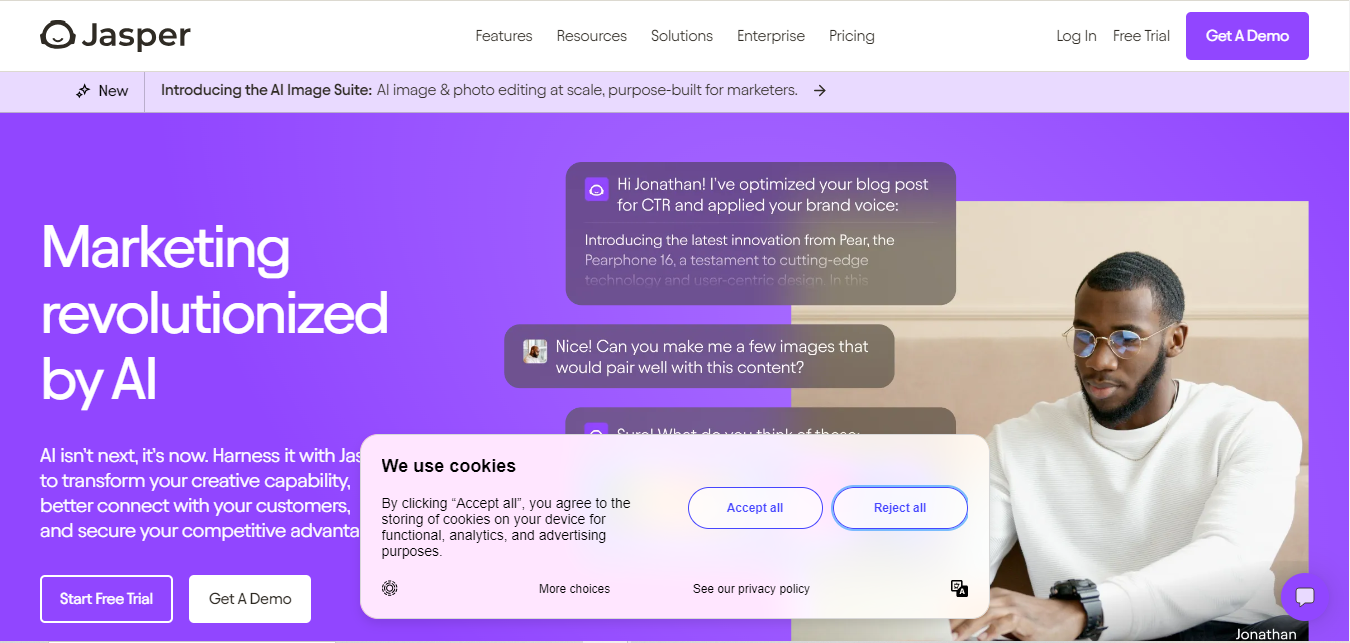
Jasper is built for volume, generating a first-draft product description, ad variation, or email subject line in seconds rather than minutes. For a store with a catalog running into the hundreds of SKUs, that speed is the entire value proposition, writing 300 individual product descriptions by hand simply doesn’t happen, and generic copy-pasted descriptions hurt both SEO and conversion. The output still needs a human editing pass to sound like your brand rather than a generic template, but as a first draft generator for a large catalog, it earns its place at the top of this list.
Key Features:
- Content Generation: Creates product descriptions and marketing copy quickly, at catalog scale.
- SEO Optimization: Helps craft content structured around target keywords.
- Templates: Pre-built structures for blog posts, email marketing, and product pages.
2. Copy.ai
Copy.ai overlaps with Jasper in purpose but leans toward shorter-form output, ad copy, social captions, quick product blurbs, rather than long-form content. Its multi-language support matters specifically for stores selling internationally, generating a first-pass translation of marketing copy that a native speaker can then refine, rather than starting from a completely blank page in a language you don’t speak fluently.
Key Features:
- Speedy Content Creation: Generates short-form marketing copy quickly.
- Versatile Templates: Covers product descriptions, social posts, and ad copy.
- Language Support: Multiple languages, useful for stores selling across regions.
3. ChatGPT
Plenty of Shopify stores now route a first-line customer support layer through a ChatGPT-based integration, handling the repetitive questions, shipping timelines, sizing, return policy, that eat up an owner’s time without needing a human. The honest caveat: it needs to be fed your actual store policies and product details to answer accurately, an out-of-the-box setup that hasn’t been configured with your specific information will confidently give wrong answers, which is worse than no automation at all. Set it up carefully and test it against real customer questions before trusting it live.
Key Features:
- Conversational Support: Handles routine customer questions around the clock when properly configured.
- Integration Options: Can be connected to a Shopify store’s chat widget.
- Improves With Use: Response quality improves as you refine its instructions and knowledge base over time.
4. MarketMuse
MarketMuse is less about generating new content and more about diagnosing what’s wrong with content you already have. Point it at an existing product or blog page and it flags gaps against what’s actually ranking for the same topic, missing subtopics, thin sections, competitor angles you haven’t covered. For a store that’s already built out a blog or extensive collection pages and wants to improve existing SEO rather than write from scratch, that diagnostic function is more useful than another generation tool would be.
Key Features:
- Content Strategy Analysis: Analyzes existing content and flags gaps against competing pages.
- Topic Discovery: Surfaces relevant keywords and subtopics for your niche.
- SEO Focused: Concrete recommendations for improving search visibility.
5. Canva Magic Write
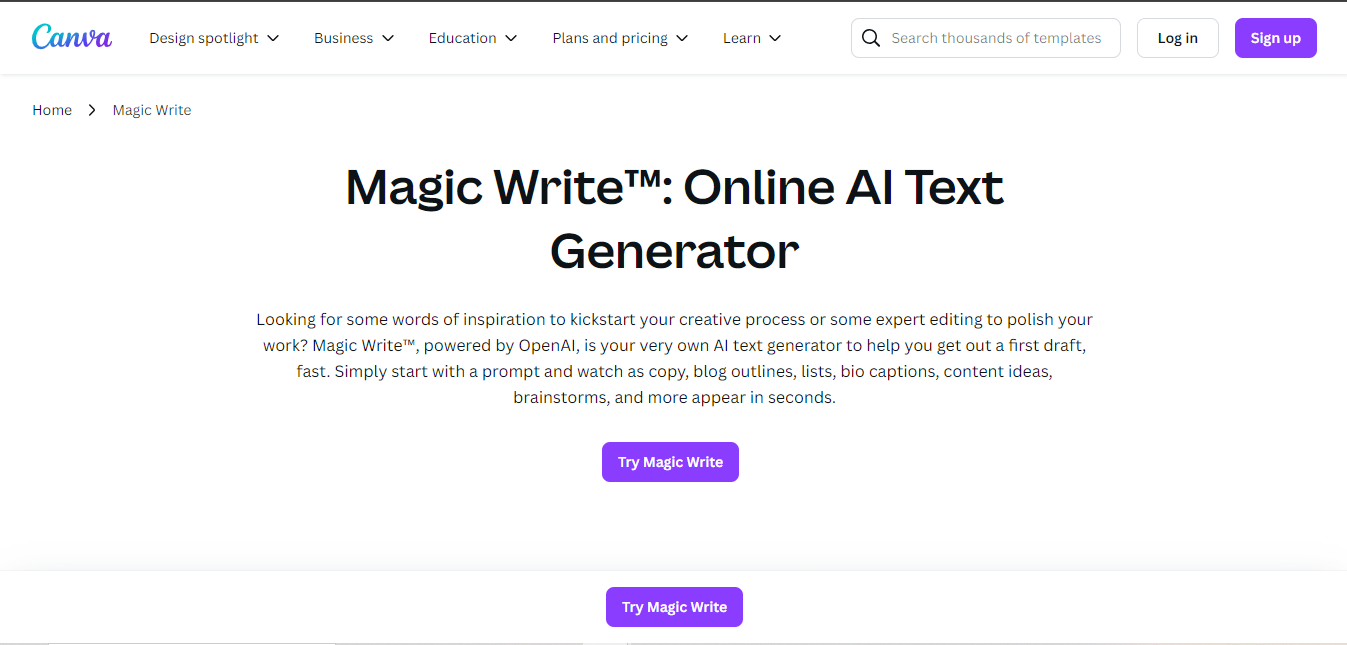
If your store’s marketing needs are mostly social graphics and simple email banners rather than long-form copy, Canva’s writing assistant sitting inside the same tool you already use for design closes a real workflow gap. Write the caption and design the graphic in one tab instead of switching between a writing tool and a design tool, which matters more than it sounds like for a solo owner juggling every part of the business.
Key Features:
- Content and Design Together: Combines writing with graphic design in one workspace.
- User-Friendly Interface: Approachable regardless of design or writing experience.
- Template Variety: Numerous design templates to pair with generated copy.
6. Shopify’s Built-In Product Recommendations
Before reaching for a third-party tool, it’s worth knowing Shopify’s own recommendation engine already analyzes purchase and browsing behavior to suggest complementary products, no separate app or subscription required for the basic version. For a store just getting started, this built-in option is the lowest-friction way to add “customers also bought” style upsells without adding another app to manage and pay for.
Key Features:
- Customer Behavior Analysis: Personalized product suggestions based on shopping behavior.
- Seamless Integration: Built directly into Shopify, no separate setup required.
- Increases Average Order Value: Surfaces complementary products at the right moment.
7. Writesonic
Writesonic positions itself specifically around conversion-focused copy, ad headlines, landing page sections, checkout page microcopy, rather than general content. The multiple-variation feature is genuinely useful here: generate three or four versions of a product headline and A/B test them against real traffic rather than guessing which one performs better, which turns copywriting into something you can actually measure instead of a subjective call.
Key Features:
- High-Converting Copy: Focused on marketing materials that drive action.
- Multiple Variations: Generates several versions to test against each other.
- Team Collaboration: Supports review and approval workflows for larger teams.
8. Kuki Chatbot
Kuki takes a more conversational, personality-driven approach to customer chat than a purely transactional support bot, which suits stores where brand voice matters as much as answering the question correctly. It handles order status and product questions competently, though like any chatbot it needs a clear escalation path to a human for anything outside its training, a frustrated customer stuck in a bot loop does more damage than no chatbot at all.
Key Features:
- Interactive Support: Engages customers with a more conversational tone than typical support bots.
- Order Assistance: Helps with order inquiries and product information.
- Approachable Interface: Designed to feel less robotic than a scripted FAQ bot.
9. Surfer SEO
Surfer’s specific value is analyzing what’s actually ranking for a target keyword and translating that into concrete structural guidance, word count ranges, subheading topics, keyword density, rather than vague SEO advice. For collection and category pages specifically, which often get neglected compared to individual product pages, running them through Surfer’s analysis surfaces easy wins that a store owner without SEO training would likely miss entirely.
Key Features:
- SEO Insights: Detailed analysis and recommendations for improving content ranking.
- Keyword Suggestions: Identifies relevant keywords worth targeting.
- Content Structure Analysis: Evaluates structure against what’s currently ranking.
10. Anywood AI
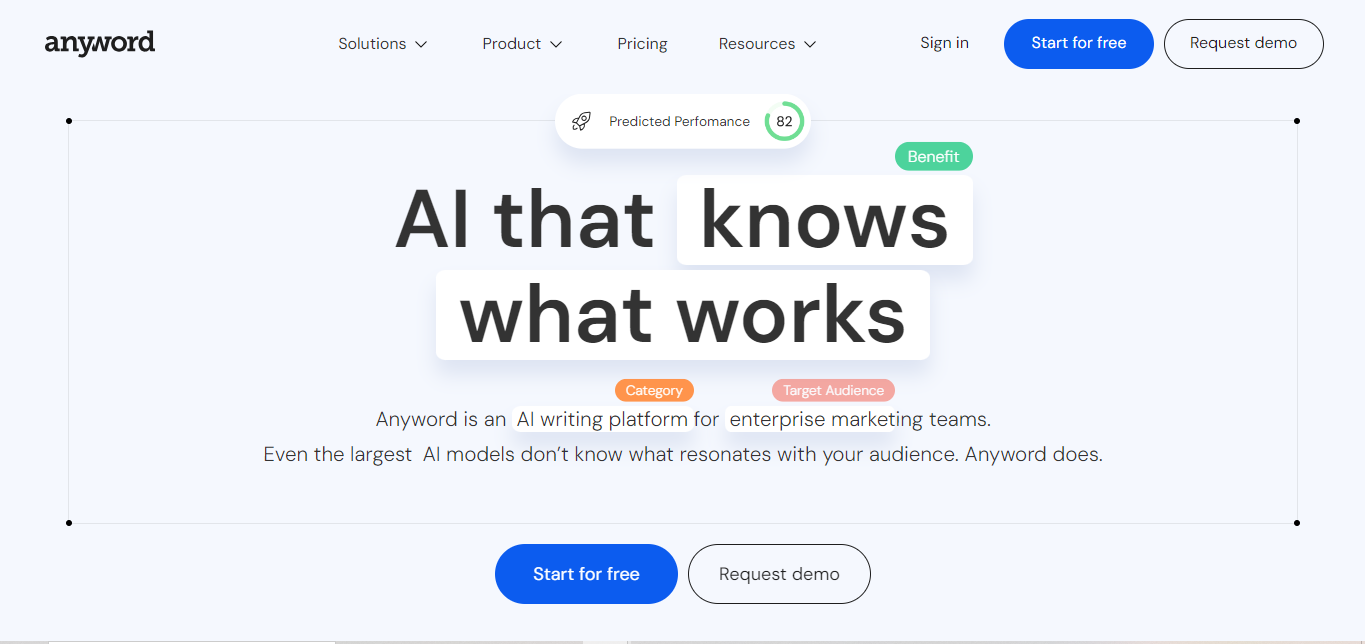
Anywood bundles content generation, basic marketing automation, and customer analytics into a single subscription rather than requiring separate tools for each function. That consolidation suits a growing store that’s outgrown a single-purpose free tool but isn’t ready to manage four or five separate AI subscriptions and their individual learning curves. The tradeoff of any all-in-one tool applies here too, it’s rarely the single best option in any one category, but it’s a reasonable middle ground for a team that values simplicity over best-in-class depth.
Key Features:
- Comprehensive AI Solutions: Content generation, marketing automation, and analytics in one platform.
- Data-Driven Insights: Analyzes customer data to inform marketing decisions.
- Scalability: Suited to stores from early-stage to established.
Comparison Table
| Name of Tool | Best For | Standout Feature | Pricing |
|---|---|---|---|
| Jasper AI | Content creation for marketing | SEO-friendly content generation with various templates | Free trial, then subscription-based |
| Copy.ai | Speedy marketing copy creation | Versatile templates for various content types | Free trial, then subscription-based |
| ChatGPT | 24/7 customer support | Seamless integration for real-time customer interaction | Free with premium options |
| MarketMuse | Content strategy analysis | Data-driven content improvement recommendations | Free trial, then subscription-based |
| Canva Magic Write | Combining writing and graphic design | User-friendly interface with diverse templates | Free with premium options |
| Shopify’s Product Recommendations | Personalized shopping experiences | Customer behavior analysis for recommendations | Included with Shopify subscription |
| Writesonic | Conversion-focused copywriting | Multiple variations for optimization | Free trial, then subscription-based |
| Kuki Chatbot | Interactive customer support | Engaging order assistance and product info | Free with premium options |
| Surfer SEO | SEO content optimization | Detailed SEO analysis and keyword suggestions | Free trial, then subscription-based |
| Anywood AI | Comprehensive marketing solutions | All-in-one approach for content and analytics | Free trial, then subscription-based |
Building a Realistic Stack Instead of Buying Everything
The mistake most new store owners make is trying to adopt all ten of these at once. A more realistic approach: pick one content tool for product descriptions, one support tool if ticket volume is already a problem, and hold off on SEO-analysis and recommendation tools until you have enough traffic and catalog size for their insights to be statistically meaningful. A five-product store doesn’t need MarketMuse’s competitive gap analysis yet, it needs product pages that exist and read clearly. Layer in the more advanced tools as the store actually grows past what a single owner can manage manually.
It also helps to track whether a tool is actually earning its subscription cost rather than assuming it is because it feels productive. A simple monthly check, did this tool save more time or generate more revenue than it cost, catches subscriptions that quietly become dead weight. It’s easy to accumulate five AI tool subscriptions over a year of trying new things and never audit whether all five are still pulling their weight three months later.
A Realistic Example
Picture a store selling handmade home goods with around 40 products, run by one person. That owner’s actual bottleneck is usually product description writing, forty listings is enough that manual writing takes a real weekend, but not so many that a content tool’s monthly cost is hard to justify against the time saved. A sensible first move is running the existing catalog through Jasper or Copy.ai for first drafts, editing each one personally to keep the brand voice consistent, and holding off on a chatbot until order volume actually generates enough repetitive support questions to justify automating them. Adding Surfer SEO or MarketMuse before the store has meaningful organic traffic to analyze is premature, those tools need existing ranking data to produce useful recommendations.
Data Privacy Considerations
Several of these tools, particularly chat-based support tools like ChatGPT integrations and Kuki, process real customer conversations, which may include names, order details, and sometimes payment-adjacent information depending on how the integration is configured. Before connecting any AI tool to live customer data, check what the vendor’s data retention and training policy actually says, some tools use conversation data to improve their models by default, which may not fit every store’s privacy commitments to customers, especially for stores serving regions with strict data protection requirements like the EU’s GDPR.
What AI Tools Won’t Fix
None of these tools substitute for a product people actually want to buy, priced correctly, photographed well, and backed by real customer service when something goes wrong. AI-generated copy on a weak product listing still sells a weak product listing, just with better grammar. The stores that get real value from this category are the ones that already had a working store and used AI to remove production bottlenecks, not stores hoping automation will fix a fundamentally unproven product-market fit.
The same logic applies to customer trust. A chatbot that answers questions quickly but gives wrong information about shipping or returns does more damage to a store’s reputation than a slower human response that’s actually correct. Speed is only a genuine improvement when accuracy holds up, which is why every automated support setup deserves a testing period against real questions before it goes live unsupervised.
Frequently Asked Questions
Do I need a developer to set any of these up?
Most integrate through the Shopify App Store or a straightforward browser extension, no coding required for standard setups. Custom integrations, like deeply customizing a chatbot’s knowledge base, benefit from some technical comfort but aren’t strictly developer-only tasks.
Will AI-generated product descriptions hurt my SEO?
Not inherently, search engines evaluate content quality and usefulness, not whether a human or AI wrote the first draft. What hurts SEO is thin, generic, unedited AI output that reads identically across every competitor’s store using the same tool, always add specific, accurate details about your actual product rather than publishing raw AI output unchanged.
How do I know which category of tool to start with?
Look at where you’re actually losing time or money right now. If you’re spending hours writing descriptions, start with a content tool. If support tickets pile up, start with a chat tool. If your pages exist but don’t rank, start with an SEO tool. Match the tool to the specific bottleneck rather than adopting whatever’s trending.
Can these tools work alongside a Shopify theme built for a specific niche or community?
Yes, none of these are theme-dependent, they integrate at the app or content level rather than requiring a specific theme structure. A store built around a niche community or membership model can layer any of these on top without conflicts, since the AI tools operate on product and customer data rather than theme templates.
Should I mention that a product description was AI-assisted?
There’s no legal requirement to disclose this for standard product copy in most jurisdictions, but many stores choose transparency as a trust-building practice, particularly in niches like handmade goods where customers specifically value human involvement. Decide based on what matters to your specific customer base rather than assuming one answer fits every store.

Maximizing Your Shopify Potential with AI
Choosing the right AI tools for a Shopify store comes down to matching the tool to a real, current bottleneck rather than collecting every option on this list. Whether that’s Jasper’s writing speed, ChatGPT’s support coverage, or Shopify’s own built-in recommendations, start with one, measure whether it actually saves time or moves a metric, then expand from there rather than all at once.
Pricing across every tool on this list changes fairly often, treat the comparison table above as a rough starting point for evaluation rather than a locked-in quote, and confirm current pricing on each vendor’s own site before subscribing.