At some point, every growing SaaS company or enterprise IT team hits the same wall. The community platform that worked fine at 500 members starts showing cracks at 5,000. Slack channels get noisy and unsearchable. Circle’s member limit feels tight. Skool’s gamification doesn’t map to enterprise procurement workflows. And suddenly you’re in procurement conversations about platforms that cost more per year than some people’s salaries. We covered this exact inflection point in our guide on moving from Slack to a dedicated community platform for SaaS teams.
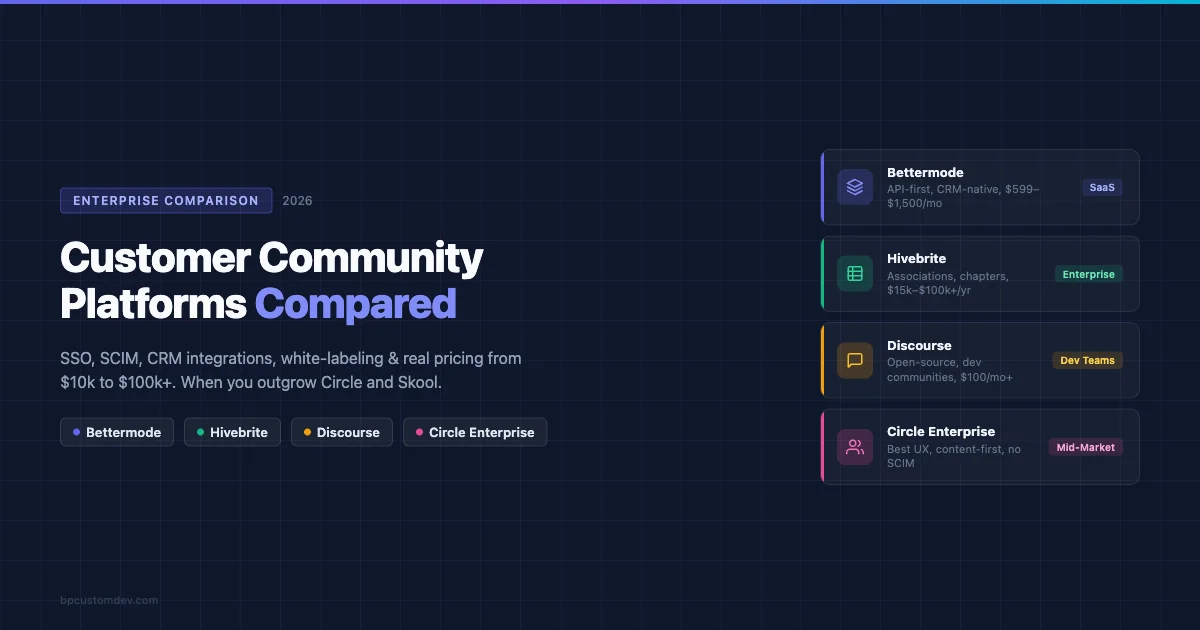
This is the tier where Bettermode, Hivebrite, Discourse, and Circle Enterprise compete. These are not the same as the self-serve community tools most people start with. The feature gap is real, the pricing is real, and the implementation complexity is real. This guide breaks down each platform honestly, covers the features that matter at scale (SSO, SCIM, analytics, integrations, white-labeling, SLA), and gives you a decision matrix based on actual use cases.
If you are evaluating an enterprise community platform comparison for your SaaS or B2B business in 2026, read this before signing anything.
Why SMB Community Platforms Break at Scale
The failure mode is predictable. You start on Circle or Mighty Networks because onboarding is fast and pricing is transparent. Then one of three things happens:
- Your legal team asks about SSO and you find out the platform only supports it on enterprise tiers that cost 3x what you budgeted
- Your CRM team wants community engagement data in Salesforce and the only integration is a Zapier workaround that breaks every time the API changes
- Your IT security team asks for SCIM provisioning to automate user lifecycle management and the platform has no answer
None of these are edge cases. They are standard requirements for any organization running a customer community at 2,000+ members where the community is tied to product adoption, support deflection, or revenue.
The platforms in this comparison exist specifically to handle those requirements. They are priced accordingly, starting at roughly $10,000 per year and running to $100,000+ for large deployments.
Feature Comparison Table
The table below covers the features that separate enterprise-tier platforms from SMB tools. Pricing is indicative and based on publicly available information and vendor conversations as of early 2026.
| Feature | Bettermode | Hivebrite | Discourse | Circle Enterprise |
|---|---|---|---|---|
| SSO (SAML / OAuth) | Yes, all plans | Yes, enterprise plans | Yes, self-hosted and Business+ | Yes, Enterprise only |
| SCIM Provisioning | Yes (Enterprise) | Yes (Enterprise) | Limited (via plugin) | No |
| Custom Domain + White-label | Yes | Yes, full white-label | Yes (self-hosted), partial SaaS | Yes (Enterprise) |
| Analytics Dashboard | Built-in + custom reports | Advanced with CRM sync | Built-in, limited exports | Built-in, basic |
| Salesforce Integration | Native (Enterprise) | Native | Via API / third-party | Via Zapier |
| HubSpot Integration | Native | Native | Via API | Native (Enterprise) |
| Zendesk Integration | Native | Via API | Native (Discourse plugin) | Via Zapier |
| API Access | REST API, full | REST API, full | REST API, very mature | REST API, limited |
| SLA | 99.9% uptime SLA (Enterprise) | 99.9% uptime SLA | Self-hosted: yours; Hosted: 99.9% | 99.9% (Enterprise) |
| Pricing Range | $599/mo – $1,500+/mo | $15,000 – $100,000+/yr | $100/mo (hosted) to free (self-hosted) | $99/mo – custom enterprise |
| Minimum Commitment | Monthly available | Annual contract | Monthly available | Monthly available |
| Data Residency | US / EU | US / EU | Choose your host (self-hosted) | US only |
Bettermode: The Developer-Friendly Customer Community Platform
Bettermode (formerly Tribe) is the platform most SaaS companies land on when they need a community that integrates with their existing tech stack without a six-month implementation project. The platform has been through a meaningful product evolution since the Tribe rebrand, and the current version is significantly more capable than what most people remember from 2021-2022.
What Bettermode Does Well
Integration depth: Bettermode’s native integrations with Salesforce, HubSpot, Intercom, and Zendesk are genuinely useful, not just badge connections. Community activity data can push into Salesforce as contact activity, which means customer success teams can see whether a user is active in the community before a renewal call. That is worth real money to CS-led growth organizations.
API and customization: The REST API is well-documented and the GraphQL API gives developers flexible querying. If you want to embed community features into your product UI rather than redirecting users to a separate domain, Bettermode’s embed options are the most practical at this price point. The SDK and widget-based embedding is genuinely production-ready.
SSO and SCIM: SSO is available on Business and Enterprise plans. SCIM provisioning (for automated user onboarding and offboarding via your identity provider like Okta or Azure AD) is Enterprise-only. If SCIM is a hard requirement from your IT team, budget for the Enterprise tier.
White-label: Full custom domain support and white-labeling on paid plans. You can remove all Bettermode branding. The design system is flexible enough that most communities can match their brand without custom development.
Where Bettermode Falls Short
Forum/discussion depth: Bettermode’s discussion threads work fine for Q&A and announcement formats, but they are not a replacement for Discourse if you want a high-volume technical forum with granular moderation, trust levels, and mature threading. Power users in developer communities tend to notice the gaps.
Analytics: The built-in analytics cover the basics well but custom report building is limited compared to Hivebrite. If your VP of Customer Success wants a custom dashboard showing community engagement correlation with product health scores, you will likely need to pipe data to an external BI tool.
Best for: B2B SaaS companies with 1,000-20,000 community members who need clean CRM integration and want a product-embedded community experience. Budget: $599-$1,500/month depending on members and features.
Hivebrite: The Enterprise-First Community Platform
Hivebrite is the platform you end up at when your community has real organizational complexity: multiple sub-groups with different permissions, chapters or regional nodes, alumni networks, or association membership models where different tiers of members see different content and pay different dues.
The platform was built from the ground up for enterprise and association use cases. It is not a startup product that added enterprise features later. That shows in the feature set and in the sales process (expect a demo, a legal review, and an annual contract).
What Hivebrite Does Well
Member management: Hivebrite has the most sophisticated member management of any platform in this comparison. You can create complex membership tiers, automate renewals, gate content by membership level, and manage sub-groups with separate permissions and administrators. This is critical for associations, alumni networks, and multi-chapter communities.
Analytics and reporting: The analytics suite is genuinely enterprise-grade. Custom reports, scheduled exports, and CRM sync mean your community data can feed into your BI stack. The Salesforce and HubSpot integrations are native and bidirectional, which matters if you want community engagement scores affecting lead scoring in your CRM.
SSO and SCIM: Full SAML SSO and SCIM support on enterprise plans. Data residency options for EU-based organizations (relevant for GDPR compliance). Hivebrite has done the compliance work that procurement teams at large enterprises need.
White-label: Hivebrite offers the most complete white-label experience in this comparison. Custom domain, custom mobile app (iOS and Android), and full branding control. If you need to put your company’s logo and colors on a native mobile app without mentioning the underlying platform, Hivebrite is one of the few that can actually deliver this.
Events: Built-in event management with ticketing, RSVP, and virtual event integration is significantly more advanced than competing platforms. For communities where in-person or hybrid events are central to the member experience, this matters.
Where Hivebrite Falls Short
Price: Hivebrite starts at approximately $15,000 per year and scales to $100,000+ for large deployments. There is no self-serve sign-up and no monthly billing. If you are not ready to commit to an annual contract, this is not your platform.
Developer experience: The API exists but is not as developer-friendly as Bettermode or Discourse. Custom integrations outside the native connector list require more work. If your engineering team needs to build deeply custom experiences on top of the platform, factor in that development time.
Discussion quality: Like Bettermode, Hivebrite’s discussion and forum capabilities are not a match for Discourse. The platform is designed around member directories, events, and content distribution rather than threaded technical discussion.
Best for: Associations, alumni networks, and enterprise companies with complex membership tiers, multi-chapter structures, or branded mobile app requirements. Budget: $15,000-$100,000+/year, annual contract required.
Discourse: The Open-Source Community Platform for Technical Teams
Discourse is the platform that developer communities, open-source projects, and technical product teams land on when they need serious forum functionality and do not want to pay the Hivebrite tax. The platform is open-source, well-maintained, and has been the backbone of communities like Cloudflare’s developer forum, Figma’s community, and hundreds of SaaS customer communities.
The key decision with Discourse is always self-hosted versus the hosted service (Discourse.org). Self-hosted gives you complete control and is free for the software itself, but you are responsible for infrastructure, updates, backups, and performance. The hosted service starts at $100/month for the Standard plan and goes up to Business ($300/month) and Enterprise (custom pricing).
What Discourse Does Well
Forum quality: No platform in this comparison comes close to Discourse for threaded discussion quality. The trust level system (TL0-TL4) automatically elevates engaged members and reduces moderation burden. Topic threading, quoting, reactions, and search work exactly as you expect for a high-volume technical community.
Plugin ecosystem: The Discourse plugin ecosystem is extensive. The Zendesk plugin creates a two-way sync between support tickets and forum topics. The Data Explorer plugin lets you run custom SQL queries against community data. The Solved plugin turns any category into a Q&A format with accepted answers. These are not half-finished extensions – they are production tools used by thousands of communities.
API: Discourse’s REST API is the most mature of any platform in this comparison. It has been around since the early days of the platform and has complete coverage. If you need to build custom integrations, automate community management tasks, or pull data for analysis, the Discourse API is a genuine pleasure compared to the alternatives.
SSO: Discourse supports SAML, OAuth, and its own DiscourseConnect SSO protocol. Self-hosted instances can use any identity provider. The Business tier of hosted Discourse includes SSO. SCIM support is limited and requires a plugin; it is not native the way Bettermode or Hivebrite handle it.
Cost efficiency: A self-hosted Discourse instance on a $20/month VPS can handle tens of thousands of members with millions of posts. For organizations with engineering capacity to manage infrastructure, the total cost of ownership is dramatically lower than any other platform in this comparison.
Where Discourse Falls Short
Not a member directory platform: If you need member profiles with rich data, searchable directories, or association-style membership management, Discourse is not built for that use case. It is a discussion platform, not a community platform in the Hivebrite sense.
White-label is limited on hosted: Self-hosted Discourse can be fully customized. The hosted service allows custom domain and theme customization, but the Discourse branding is harder to remove completely on lower tiers.
Self-hosted operational burden: If you go self-hosted, someone on your team needs to own Discourse administration. Upgrades, backups, performance tuning, plugin compatibility – these are real tasks that require technical skill. Budget for it.
CRM integrations: Native Salesforce or HubSpot integrations do not exist in the same way as Bettermode or Hivebrite. You can build them via API or use third-party connectors, but it is not plug-and-play.
Best for: Developer communities, open-source projects, SaaS companies with a technical user base who need serious forum quality. Also the best choice for cost-conscious teams with engineering capacity to self-host. Budget: $100-$300/month (hosted) or infrastructure cost only (self-hosted).
Circle Enterprise: The Creator-to-Enterprise Pivot
Circle started as a creator community platform and has been pushing toward enterprise customers for the past two years. The Enterprise tier adds SSO, custom domains, priority support, and higher member limits. The product has improved significantly and is now a legitimate option for mid-market companies, though it still carries some of its creator-focused DNA in ways that can feel odd in a pure B2B customer community context. For a direct look at how Circle compares in non-enterprise contexts, see our comparison of community platforms for coaches and course creators.
What Circle Enterprise Does Well
User experience: Circle has the best out-of-the-box member experience of any platform in this comparison. The UI is clean, the mobile apps are well-built, and the onboarding flow for new members is the least confusing of the group. If member adoption is your biggest risk, Circle is easier to sell to your users than the alternatives.
Courses and content: If your community includes learning components, Circle’s built-in course functionality is genuinely useful. It handles drip content, progress tracking, and cohort-based learning without requiring a separate LMS integration.
Live events and spaces: Circle’s Spaces concept organizes community content into channels (like Slack) combined with feeds (like a social platform). Live rooms are built in. The format is intuitive for users coming from social media or Slack, which reduces the onboarding friction that can kill community adoption.
HubSpot integration: The native HubSpot integration on Enterprise plans is solid. Member activity syncs to HubSpot contacts, which is useful for marketing and CS workflows.
Where Circle Enterprise Falls Short
No SCIM: As of 2026, Circle does not offer SCIM provisioning. This is a real gap for enterprise IT teams who need automated user lifecycle management. If a user leaves your company, you need to manually deactivate their community account or rely on a webhook workaround.
Limited Salesforce integration: Salesforce integration on Circle is primarily through Zapier rather than a native connector. For organizations that need reliable, real-time CRM sync, this is a significant limitation.
Data residency: Circle’s infrastructure is US-based. If your organization has GDPR data residency requirements that mandate EU hosting, Circle cannot currently satisfy them.
SLA: Enterprise-tier SLA exists but the specifics require a conversation with sales rather than being published clearly. Compare this to Bettermode and Hivebrite, which publish their uptime SLA terms more openly.
Best for: Mid-market SaaS companies with content-heavy communities, course components, or a user base that is more consumer-oriented than enterprise IT. Budget: $99-$399/month self-serve, enterprise pricing custom.
Enterprise Community Platform Comparison: Decision Matrix by Use Case
Choosing the right platform depends on your specific situation. Here is a direct decision guide based on the most common enterprise community scenarios.
You need SCIM and enterprise SSO as hard requirements
Go with Bettermode Enterprise or Hivebrite. Both have native SCIM support. Discourse can approximate it with plugins but is not truly native. Circle does not have it.
You have complex membership tiers, chapters, or an association model
Go with Hivebrite. No other platform in this comparison handles multi-tier membership, chapter management, and association-style dues with the same depth. The price is high but so is the capability gap.
You run a developer community or technical product
Go with Discourse. The forum quality, trust level system, and plugin ecosystem are built for exactly this use case. If your developers are going to be your most active community members, they will be happier on Discourse than anywhere else.
You need Salesforce as the center of your community data strategy
Go with Bettermode Enterprise or Hivebrite. Both have native Salesforce connectors that sync community engagement data bidirectionally. Circle and Discourse require custom integration work.
Member adoption and UX are your primary risk
Go with Circle Enterprise. The member-facing UX is the strongest in this group. If your users are not especially technical and need a platform that feels familiar, Circle reduces the adoption risk the most.
You need a branded mobile app
Go with Hivebrite. The only platform in this comparison that offers a fully white-labeled native mobile app (iOS and Android) without the Hivebrite name on it.
You want maximum control and lowest long-term cost
Go with Discourse self-hosted. If your team has the engineering capacity to run it, nothing else in this comparison comes close on cost efficiency. The software is free, the API is excellent, and the community of administrators is large and helpful.
What “Enterprise” Actually Means in Pricing Terms
One thing buyers consistently underestimate is how quickly the total cost of these platforms scales beyond the base price. Here is what to budget for beyond the platform license:
- Implementation: Hivebrite and Bettermode Enterprise both typically require an implementation engagement. Budget $5,000-$25,000 depending on data migration, SSO configuration, and CRM integration complexity.
- Community manager: An active enterprise community needs dedicated management. That is either a full-time hire or a consultant. At scale, this dwarfs the platform cost.
- Data migration: Moving member data, content, and historical activity from your old platform is always harder than the vendor says. Budget time and money for it, especially with Hivebrite where the data model is complex.
- Custom development: If you need custom integrations or UI work beyond the platform defaults, add engineering time. Bettermode and Discourse are the most developer-friendly for this.
The Bettermode vs Hivebrite Decision in Plain Terms
The bettermode vs hivebrite comparison is the one most mid-market and enterprise buyers end up needing to make after they rule out Circle (not enough enterprise features) and Discourse (not the right format for their use case). Here is the short version:
Choose Bettermode if you are a product-led SaaS company that wants community embedded in or adjacent to your product, needs clean API and CRM integrations, and prefers monthly billing flexibility or a lower entry price point.
Choose Hivebrite if your community has genuine organizational complexity (tiers, chapters, associations), you need a branded mobile app, your compliance team requires EU data residency, or your annual budget for the platform is $25,000+.
They are not competing for the same exact buyer. Most organizations that fit the Hivebrite profile will find Bettermode’s membership management too lightweight. Most organizations that fit the Bettermode profile will find Hivebrite over-engineered and over-priced for their needs.
Questions to Ask Vendors Before Signing
Every sales team will tell you their platform does everything. These questions cut through that:
- Show me the SCIM configuration documentation. If it does not exist or requires a support ticket to set up, factor that into your evaluation.
- What is the API rate limit on the plan I am evaluating? For high-volume integrations, this matters. Get it in writing.
- Can you give me a reference customer with a similar use case who has been on the platform for more than 18 months? New features are often less stable than features that have had time to mature.
- What does the SLA cover and what are the exclusions? Most SLAs cover uptime but exclude scheduled maintenance and some categories of incidents. Read the actual document, not the marketing summary.
- What is the data export format and process if I need to leave? Every enterprise community platform should have a complete data export. If the vendor is vague about this, treat it as a red flag.
- Who owns the relationship after implementation? Customer success coverage, escalation paths, and support SLA tiers vary significantly. Hivebrite and Bettermode Enterprise typically include dedicated CSM coverage; lower tiers on Circle and Discourse do not.
Customer Community Platform Enterprise 2026: What Has Changed
The customer community platform enterprise 2026 landscape looks different from 2024 in a few ways worth noting:
AI content moderation is now standard: All four platforms have added or are adding AI-assisted moderation. The quality varies significantly. Discourse’s Akismet integration and native AI features are mature. Bettermode and Circle have added AI content suggestions and moderation assist. Hivebrite is furthest behind on AI features.
Pricing compression at the lower end: Circle’s price increases over the past two years pushed some buyers back toward Discourse or toward Bettermode’s lower tiers. The self-serve community platform market is more price-sensitive than vendors would like.
CRM integration has become a baseline expectation: Two years ago, a community platform that synced to Salesforce was differentiated. Today, B2B buyers expect it as a baseline. Platforms without strong CRM connectors are losing deals at the enterprise level.
Consolidation risk is real: The community platform space has been through consolidation. Khoros acquired Lithium, Verint acquired Telligent, Discourse raised and deployed significant capital. Smaller platforms get acquired. When evaluating a vendor, ask about their funding status and investor backing. Hivebrite raised Series B funding, which provides some runway certainty. Bettermode has been venture-backed. Circle has raised substantial capital. Discourse operates with a different model (revenue-first, self-hosted community).
Making the Decision
There is no universally correct platform in this comparison. Each one has a genuine use case where it is the best choice. The mistake most buyers make is optimizing for one dimension (price, UX, or brand name) without pressure-testing the requirements that actually matter in their organization.
Start with your hard requirements. If your IT team has SCIM as a non-negotiable, you are choosing between Bettermode Enterprise and Hivebrite. If your legal team has EU data residency as non-negotiable, Circle is out. If your engineering team wants to build on top of the platform API extensively, Discourse or Bettermode are the better foundations.
Then look at your budget reality. A $15,000 annual commitment is very different from a $1,200/month commitment even when the annualized cost is similar, because annual contracts require a different procurement process and a higher confidence threshold.
Finally, consider where your community manager’s time will go. The platform that minimizes moderation overhead and maximizes member engagement is usually more valuable than the platform with the longest feature list. A community that actually works is worth more than a community platform that theoretically supports every use case.
If you are unsure which direction to take, or if your requirements span multiple platforms (for example, you need Discourse-quality discussion with Bettermode-quality CRM integration), a custom community platform built on open-source foundations might be worth exploring. We work with organizations that have outgrown standard platforms and need something purpose-built for their specific community model. You may also want to read our breakdown of building paid communities without platform lock-in for context on how ownership and portability factor into long-term platform decisions.