Every community builder hits the same wall eventually: you have an engaged audience, real momentum, and then someone asks the obvious question: how do you actually make money from this? The honest answer is that no single model works for every community at every stage. The right choice depends on your member count, your niche, your audience’s willingness to pay, and how much operational complexity you can handle. This guide breaks down the five most common community monetization models in 2026, gives you real revenue math for each, and ends with a stage-based matrix so you know which to start with and when to layer in the next one.
Why Most Monetization Advice Gets It Wrong
Most monetization guides treat revenue models as a menu you pick from on day one. In practice, the model you choose at 200 members is almost certainly wrong for 5,000 members. Ads do not work at small scale. Subscriptions need enough members to sustain churn. Tips depend on individual emotional attachment. Tokens require a marketplace to have any value. The sequence matters as much as the model itself.
There is also a common trap where community builders pick the model that feels easiest to explain rather than the one that fits their audience’s actual behavior. A developer community where people spend hours a day exchanging knowledge will respond very differently to a paywall than a casual hobby community where members drop in once a week. Knowing your audience’s engagement pattern is prerequisite to picking any model at all.
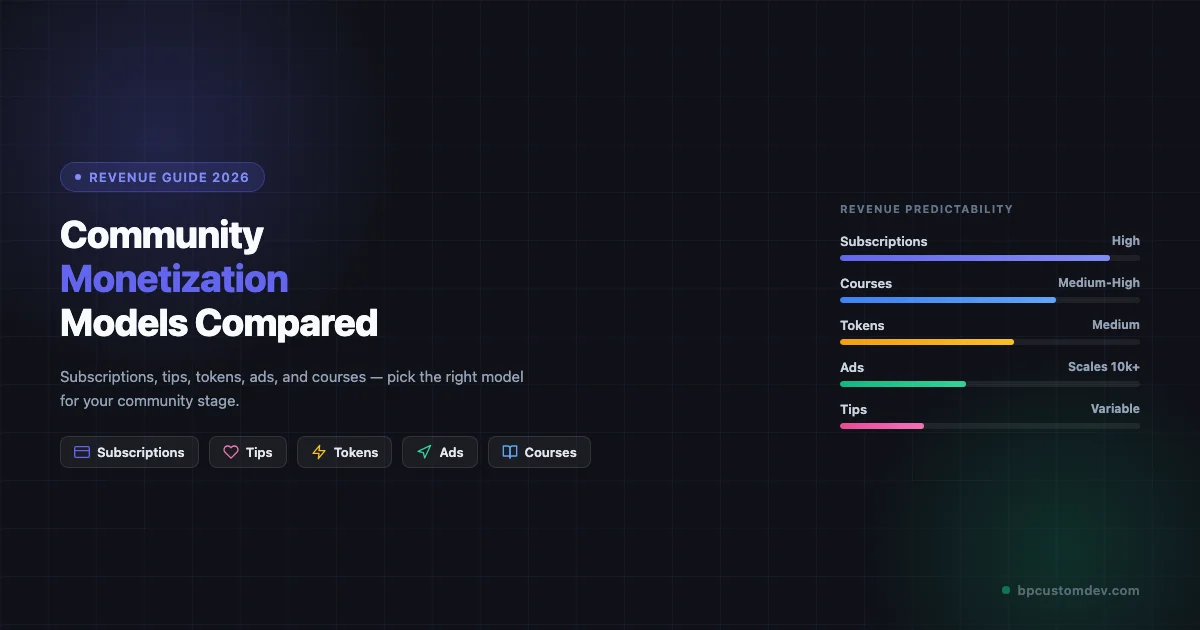
Quick Comparison: All Five Models at a Glance
| Model | Revenue Type | Min Members | Complexity | Best For |
|---|---|---|---|---|
| Subscriptions | Recurring | 200+ | Medium | Engaged daily communities |
| Tips | Variable | Any | Low | Creator-led communities |
| Tokens / Points | Hybrid | 500+ | High | Participation-driven forums |
| Advertising | Traffic-based | 10,000 MAU | Low-Medium | High-traffic free communities |
| Courses | One-time + recurring | 500+ | High | Outcome-driven learning communities |
Model 1: Subscriptions (Stripe, Paddle, Memberful)
How It Works
Members pay a recurring fee, typically monthly or annually, for access to the community, premium content, or both. The infrastructure is mature: Stripe, Paddle, Memberful, and WooCommerce Subscriptions all handle recurring billing, dunning, and cancellation flows. Integration with community platforms like BuddyPress, Circle, or Discourse is straightforward through existing plugins or webhook-based middleware.
Revenue Math
This is the only model with genuinely predictable monthly revenue. At $15/month and 200 paying members, you gross $3,000/month. At $29/month and 400 members, you gross $11,600/month. The key variable is churn: a community with 4% monthly churn has an average member lifetime of 25 months; one with 8% monthly churn has a lifetime of 12.5 months. The difference in lifetime value is enormous.
- $29/month member at 4% churn = $725 lifetime value
- $29/month member at 8% churn = $362 lifetime value
- Annual billing typically reduces churn by 30-50% vs monthly
- Switching to monthly+annual billing increases average revenue per user by 18-22% within six months (Paddle 2025 SaaS benchmark data)
Reducing churn by even two percentage points often matters more than acquiring new members. Annual billing is worth testing early. Offering an annual plan at a 20% discount (e.g., $144/year vs $180 for 12 months of monthly billing) creates a meaningful incentive for the members most likely to stay long-term, which is precisely the cohort you want to lock in at the lowest churn risk.
When It Fits
Subscriptions work when members get ongoing, repeating value from being in the community, not just from a one-time resource. If your community’s value is the people and the daily conversation, subscriptions are natural. If the value is a one-time library of tutorials, a course model fits better. Subscriptions also require a clear answer to “what does a member lose if they cancel?” If the answer is vague, conversion rates will suffer and you will find yourself spending more on acquisition than your lifetime value can justify.
Platforms That Support It
On WordPress, WooCommerce Subscriptions paired with a membership plugin (MemberPress, Paid Memberships Pro) is the standard stack. Circle and Mighty Networks have native subscription billing built in. For BuddyPress-based communities, WooCommerce + PMPro is the most tested combination. If you are evaluating which platform fits your community structure before committing to a billing model, see our breakdown of the best community platform for coaches in 2026. Paddle is worth considering if your audience is globally distributed, because it handles VAT and sales tax compliance as the merchant of record, which removes a significant compliance burden from your team.
Model 2: Tips (Buy Me a Coffee, Ko-fi, Patreon)
How It Works
Members make voluntary one-time or recurring contributions, typically in small amounts, to support a creator or community they value. Platforms like Buy Me a Coffee, Ko-fi, and Patreon provide the payment infrastructure, a public profile page, and basic membership tiers. The social signal (“I support this community”) often matters as much as the financial transaction to the member who tips.
Revenue Math
Tips are inherently variable and difficult to forecast. A community of 1,000 active members with a 2% tip rate and an average contribution of $8 generates $160/month. That is not a business; it is coffee money. To make tips meaningful, you generally need either a large audience (10,000+ engaged members) or a highly dedicated niche where emotional connection is strong enough to drive a higher contribution rate (5-8%). Ko-fi’s published creator data from 2025 gives a realistic picture:
- Median monthly revenue for creators with 500-2,000 followers: $47/month
- Top 10% in that cohort: $420+/month
- Distribution is extremely skewed: a small number earn meaningful income while the majority earn under $50/month
- Creator communities built around a specific person, where the human relationship is the product, tend to see the highest tip rates
When It Fits
Tips work well in two scenarios. First, as a supplemental layer on top of a free community: you keep the community open and accessible, and a subset of members who feel strongly about supporting it choose to pay. Second, in creator-led communities where there is a strong personal brand attached to the community host. If the community’s identity is tightly coupled to a specific person’s work (a newsletter, a podcast, open-source software), tips feel natural because members are supporting a person, not just accessing a service. Many creators are also building paid communities without platform lock-in so they keep full control of member relationships as they grow.
Tips are a poor primary revenue model for communities built around a topic or utility rather than a personality. They also require very little from you operationally, which is why they are often the first monetization attempt for early-stage communities, even when subscriptions or tokens would ultimately be a better fit.
Platforms That Support It
Buy Me a Coffee and Ko-fi are easiest to set up: account creation to active profile takes under ten minutes. Both embed cleanly into WordPress sidebars or post footers via simple embed codes. Patreon offers more sophisticated membership tiers and has a larger existing audience browsing for creators to support, which can provide some organic discovery. All three take a platform fee of 0-8% depending on plan tier, with payment processor fees on top.
Model 3: Tokens and Points (Jetonomy, Web3 Options)
How It Works
Token-based monetization gives members a currency native to your community. Members earn tokens through participation (posting, answering questions, attending events) and spend them on perks, access upgrades, physical merchandise, or real-world experiences. Unlike subscriptions, which charge for ongoing access, tokens create an internal economy where engagement directly drives value.
On WordPress-based communities, Jetonomy is the plugin built specifically for this. Members earn points for actions you define, points are stored per user, and you configure what those points can be redeemed for: digital badges, premium forum access, discount codes, physical items, or even real-world event tickets. The plugin handles the full lifecycle: earning rules, balance display, redemption catalog, and admin reporting. For communities that want to go further into Web3, token models can be implemented with ERC-20 tokens on Ethereum or lower-cost chains like Polygon, though this adds significant technical and regulatory complexity that most community operators are not ready for.
Revenue Math
Token systems generate revenue in two ways. The direct path is selling token packs: members can earn tokens through participation or purchase them. The indirect path is retention improvement, which is typically more valuable than direct token sales:
- Direct: At $10 for 500 tokens and a 15% purchase rate among 300 active members, you generate $450/month in direct token sales
- Indirect: Dropping monthly churn from 8% to 5% via a token layer typically generates more revenue than the direct token sales themselves
- Real-world redemptions: Points redeemable for gear discounts or partner experiences (e.g., outdoor adventure sports community) create a value loop money alone cannot replicate
The real-world redemption angle is worth highlighting because it is underused. This is where Jetonomy’s redemption catalog functionality earns its keep: it lets you configure partnerships and physical rewards without building custom redemption logic from scratch.
When It Fits
Token systems fit communities where participation is the core value driver: Q&A forums, knowledge-sharing networks, peer support communities, and professional learning spaces. They are less appropriate for communities where the value is primarily content consumption rather than participation, because passive readers accumulate no points and therefore feel excluded from the system.
Most community operators in 2026 are choosing off-chain point systems with fixed internal values over on-chain tokens, reserving blockchain infrastructure for use cases where provable ownership genuinely matters (event tickets, digital collectibles with resale value).
Web3 token models (on-chain tokens with market prices) add speculative dynamics that can be destabilizing. If token price drops, community sentiment can turn negative regardless of the community’s actual health. This is why most operators are staying off-chain in 2026.
Platforms That Support It
For WordPress communities, Jetonomy is the most complete solution: it integrates with BuddyPress activity feeds, WooCommerce purchases, and custom triggers. myCred is a lighter-weight alternative with a large add-on ecosystem. On non-WordPress platforms, Circle added a native credits system in late 2025, and Disco has experimental token gating features. Full Web3 implementations typically require custom development with wallet connection libraries (wagmi, ConnectKit) and a smart contract on your chosen chain.
Model 4: Advertising (Display, Sponsorships, Newsletter Ads)
How It Works
Advertisers pay to reach your community’s audience, either through programmatic display ads (Google AdSense, Ezoic, Raptive), direct sponsorships where a brand pays a fixed fee for placement, or sponsored content in a newsletter or email digest. The model requires minimal setup friction but has meaningful prerequisites: you need enough traffic or engaged subscribers to be attractive to advertisers, and you need to manage the relationship between ad revenue and member experience carefully.
Revenue Math
- Programmatic display: CPMs range $2-$18 for niche community content. 50,000 monthly page views at $6 CPM = $300/month. Below 10,000 monthly active users, revenue rarely justifies the degraded member experience.
- Direct B2B sponsorships: A community of 800 security professionals can command $500-$5,000/month for a dedicated placement. The negotiation is manual and relationship-driven, which is both its weakness and its strength (premium pricing).
- Newsletter sponsorships: 8,000 niche subscribers = $300-$800 per dedicated sponsor slot per send. Two sends/month = $600-$1,600/month. Subscriber count matters less than open rate and niche specificity when setting pricing.
When It Fits
Ads work well after you have passed 10,000 monthly active users, or in niche professional communities where even small audience sizes command premium CPMs. They work poorly in early-stage communities because the revenue is too small to justify the UX cost, and because displaying ads while simultaneously asking members to pay for a subscription creates a confusing value signal.
The most common successful pattern is using ads as a revenue layer in a free tier while keeping a paid tier ad-free. This gives the ad-supported tier a purpose beyond just being free: members on the free tier fund the community through attention, while paid members fund it through subscription fees and get a cleaner experience in return.
Platforms That Support It
For WordPress communities, Advanced Ads and Ad Inserter handle placement logic. Raptive (formerly AdThrive) requires minimum 100,000 monthly page views; Ezoic’s AI-optimized placements accept sites from 10,000 pageviews/month. For direct sponsorships, no software is required: a simple sponsorship page and a rate card are enough to start. Beehiiv and Substack have built-in newsletter ad networks if you want programmatic fill for email sponsorships without managing individual relationships.
Model 5: Courses Attached to Community
How It Works
You sell structured learning (video lessons, written curriculum, downloadable resources) as a one-time purchase or included in a membership tier, with the community serving as the ongoing support and accountability layer. The course sells the transformation; the community provides the environment where that transformation actually happens. This is one of the most defensible revenue models because it combines a high-value product (the course) with a retention mechanism (the community) that keeps members paying after the initial purchase.
Revenue Math
- $297 course at 15 sales/month = $4,455/month gross
- 40% of course buyers joining $29/month membership and staying 6+ months adds $26,082 LTV from the same cohort over the first year
- The $497 course + $29/month membership structure is a standard 2026 combination in professional learning communities
- Course-linked membership retention typically runs 30-40% better than standalone membership communities because the initial course investment creates commitment bias
When It Fits
Courses work when your community has a clear learning outcome: members want to achieve a specific result, not just connect with like-minded people. Professional skills, fitness goals, creative disciplines, and business growth communities all fit this pattern. Purely social or interest-based communities (fans of a TV show, local neighborhood groups) rarely have the outcome-driven motivation needed to support course sales.
Building the course before the community is a viable sequence: the course validates audience interest and generates early revenue, and you build the community as a product extension afterward. Building the community before the course is also valid, and gives you a ready audience to launch the course to, which improves launch-week revenue significantly.
Platforms That Support It
LearnDash, LifterLMS, and Tutor LMS all integrate with BuddyPress and WooCommerce on WordPress, enabling a fully self-hosted course + community stack. Teachable and Thinkific are hosted alternatives that sacrifice some flexibility for simpler setup. For communities already on Circle or Mighty Networks, both platforms have native course builders included. The self-hosted WordPress stack is more work to set up but gives you full data ownership and no per-transaction platform fees beyond the payment processor.
Stage-Based Recommendation Matrix
The single most useful frame for picking a monetization model is your current member count and engagement level. Here is a practical guide by stage.
0-500 Members: Validate Before You Monetize
At this stage, your primary goal is proving that people want to be part of this community, not maximizing revenue. Aggressive monetization before you have established value will accelerate churn and damage early momentum. That said, you do need to start building toward a revenue model, because launching a community with no monetization plan and then introducing one later is harder than having it in place from the start.
- Best first move: Tips or a low-friction founding member subscription ($5-$10/month). The goal is not revenue; it is identifying who cares enough to pay anything. Early paying members give you a revenue signal and a learning cohort to refine what the paid tier should offer at scale.
- Avoid: Ads (too little traffic to matter), complex token systems (too much operational overhead before product-market fit), high-priced courses (your audience does not yet trust you enough to spend $300+).
500-5,000 Members: Subscriptions as the Foundation
At this stage, you have enough members to sustain meaningful subscription revenue and enough data to define what a premium tier genuinely offers. If you have a course idea, this is the right time to build and launch it to your community before opening it up to cold audiences.
- Best moves: Tiered subscription structure (free access to basic community + paid access to premium spaces, direct Q&A, or extended content archives). Add a Jetonomy token layer to reward top contributors and reduce churn among most active members.
- Watch: Churn rate by cohort. Members cancelling faster at 90 days than at 30 days signals a broken onboarding or early member experience. Fix that before adding new revenue layers.
- Avoid: Programmatic ads if you have a paid tier. Showing ads to paying members kills perceived value.
5,000+ Members: Layer Multiple Models
At this scale, you have enough data to know which revenue models are working and enough traffic to make ads viable on a free tier. The most durable revenue structure for communities at this stage combines three layers: a subscription as the base, a token system to drive engagement and reduce churn, and sponsored content (newsletter or direct) as supplemental income that does not require paying members to see ads.
- Best structure: Free tier (with newsletter sponsorships if 3,000+ email subscribers) + $15-$49/month paid subscription tier + token system for engagement + periodic course launches. At 5,000+ members with 10% paid at $25/month, you are at $12,500/month in subscription revenue alone.
- Growth unlock: Annual billing is typically the highest-ROI optimization at this stage. It reduces churn, increases cash flow, and raises LTV with no new acquisition cost. Teams moving from Slack to a dedicated community platform at this scale commonly find that the platform switch itself improves retention metrics before any monetization changes take effect.
Layering Models: What to Stack and in What Order
The endgame for most successful community businesses is multiple revenue streams running simultaneously, each with a different risk profile. Subscriptions provide predictable baseline revenue. Courses provide periodic high-revenue events. Tokens improve retention metrics that make the subscription numbers look better. Sponsorships add income from the free tier without compromising the paid experience.
The right stacking order matters more than which models you choose. Starting with subscriptions before you have enough members to sustain churn will create a treadmill effect where you are constantly replacing cancelled members rather than growing the base. Starting with ads before you have traffic will generate so little revenue that you will question why you bothered. Starting with tips before establishing enough trust will return numbers too small to read as signal.
The sequence that works most consistently across community types:
- Tips or founding memberships to validate willingness to pay (0-500 members)
- Subscriptions as the core model (500-5,000 members)
- Course launches layered alongside subscriptions (1,000+ members)
- Tokens for engagement optimization (2,000+ members)
- Sponsorships and ads on the free tier when traffic is substantial (5,000+ monthly active users)
This is not a rigid formula; it is a starting point to adjust based on your specific audience’s behavior and your operational capacity. A professional community with high commercial intent might jump directly to direct sponsorships earlier than the sequence suggests. A hobbyist community with deeply loyal members might find tips sustain the operation longer than expected before subscriptions become necessary.
Common Mistakes to Skip
- Paywalling too much too fast. Locking 80% of the community behind a paywall before members have experienced the free tier’s value results in low conversion rates and a weak free community that does not attract new members. A healthy free-to-paid ratio is roughly 70-80% of content free, with the paid tier offering something meaningfully better, not just “more of the same but paid.”
- Ignoring annual billing. Most community operators launch with monthly billing only because it is simpler. Annual billing is more complex to explain but the revenue impact is significant: reduced churn, better cash flow, and higher LTV. Add it within the first six months.
- Over-indexing on launch events. Course launches and one-time campaigns generate big revenue spikes that can feel better than the slow growth of subscriptions. Launch events create feast-or-famine revenue; subscriptions create a floor. Build the subscription base first, then launch to your existing audience rather than starting from zero each time.
- Choosing tokens because they sound innovative. Token systems require ongoing maintenance: someone has to define earning rules, configure redemption options, and adjust the economy over time. If nobody on your team is committed to actively managing the token economy, the system will decay into irrelevance. Only implement tokens if you have someone who will own it as a product.
Picking the Right Starting Point
The right community monetization model for 2026 is the one that matches your current member count, fits your audience’s engagement pattern, and you can actually operate given your team’s capacity. That is a different answer for every community, which is why generic “just do subscriptions” or “launch a course” advice misses most community builders where they actually are.
- Under 500 members: Validate with tips or a soft founding member offer
- 500 to 5,000 members: Build a subscription tier and consider a course
- Past 5,000 members: Layer in tokens for retention and sponsorships for free-tier revenue
At every stage, the rule is the same: start with one model, get it working, then add the next. Trying to launch subscriptions, a course, a token system, and ads simultaneously is a reliable way to execute none of them well.
The communities generating meaningful revenue in 2026 are not the ones that picked the cleverest monetization model. They are the ones that picked a model appropriate to their stage, executed it cleanly, and iterated based on actual member behavior rather than what worked for some other community in a different niche at a different scale.