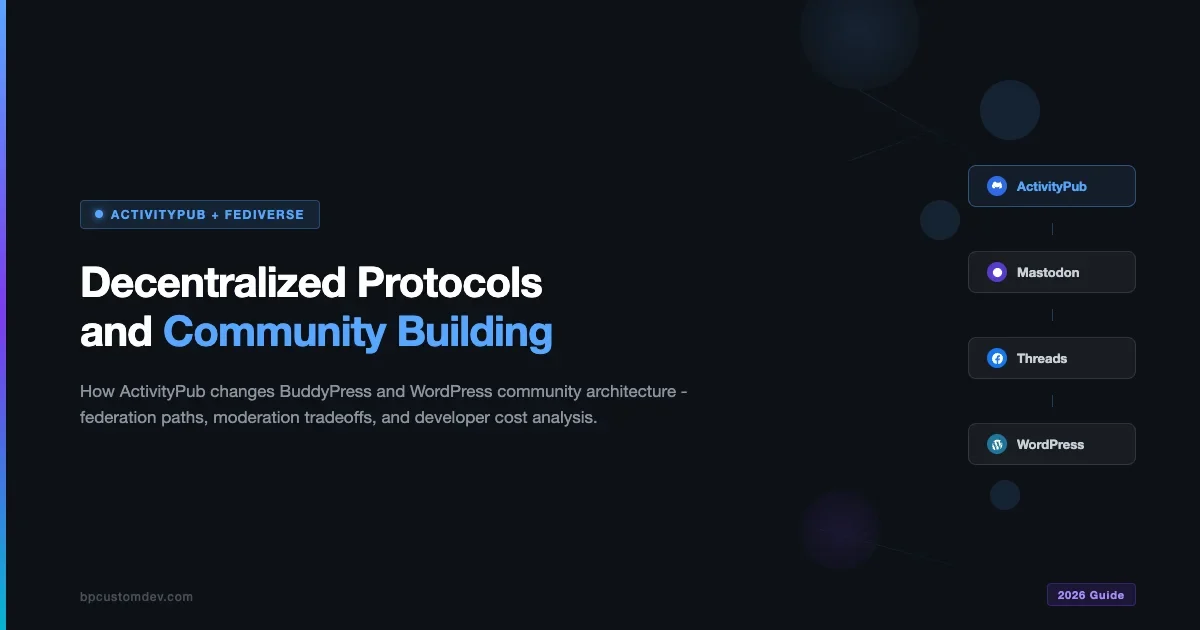
ActivityPub and Your Community: How Decentralized Protocols Change Community-Building in 2026

ActivityPub quietly crossed a threshold in 2026 that most community builders missed while watching Discord metrics and Circle conversion funnels. Threads, Flipboard, and Pixelfed now exchange posts natively. WordPress.com enables ActivityPub federation for millions of blogs. The protocol that once felt like a niche experiment for open-source purists now sits underneath platforms that collectively host hundreds of millions of users. If you are building or running a community on WordPress, BuddyPress, or any self-hosted stack, the question is no longer “what is ActivityPub?” It is “what does this change for me, right now?”
What ActivityPub Actually Is (and Is Not)
ActivityPub is a W3C-standardized protocol for decentralized social networking. It defines two things: a server-to-server federation protocol (how servers talk to each other) and a client-to-server protocol (how apps talk to servers). In practice, most implementations use only the federation side.
The core idea is simple: every user on an ActivityPub server has a globally addressable identity at a URL. When you post content, your server sends that activity to the inboxes of everyone following you, regardless of which server they use. Mastodon uses it. Pixelfed uses it. PeerTube uses it. Ghost uses it. WordPress uses it via the ActivityPub plugin. They all speak the same language, so a Mastodon user can follow a Ghost blog author and see new posts in their Mastodon feed without visiting the Ghost site.
ActivityPub does not replace your community platform. It extends your community’s reach across every platform that speaks the same protocol.
What ActivityPub is not: a replacement for your community platform, a hosting solution, or a guarantee of moderation-free growth. Federation is a communication layer, not a product strategy. The platforms on top of it still matter enormously.
The 2026 Federation Landscape: Where Things Actually Stand
Understanding the current state matters before you make architectural decisions. Here is what changed between 2024 and now:
- Threads (Meta): Meta completed its ActivityPub implementation in stages. As of early 2026, Threads users can follow accounts on Mastodon and other Fediverse platforms, and vice versa. This brought roughly 200 million Threads accounts into the Fediverse’s addressable reach. However, Threads does not surface incoming posts in the main feed by default - users must explicitly enable Fediverse visibility in settings. Reach is real but not automatic.
- Flipboard: Flipboard migrated its entire editorial platform to ActivityPub. Every Flipboard curated magazine is now a Fediverse-addressable publication. This made Flipboard one of the most significant ActivityPub publishers by content volume overnight.
- WordPress.com: Automattic ships the ActivityPub plugin maintained by Matthias Pfefferle as a first-class feature on WordPress.com. Sites on WordPress.com can now enable federation with a toggle. Self-hosted WordPress sites can use the same plugin.
- Ghost: Ghost 5.x ships native ActivityPub support. Ghost newsletters can federate to Fediverse followers who never signed up for email. This made Ghost a serious player in the creator-side of the Fediverse.
- Bluesky AT Protocol: Bluesky uses ATProto, not ActivityPub. They are separate ecosystems. Do not conflate them. Bridges between AT Protocol and ActivityPub exist (notably Bridgy Fed) but they are imperfect and not production-grade at scale.
For community developers, the practical takeaway is this: the Fediverse in 2026 is not a niche. It has critical mass on the publishing and reading side. Whether it has critical mass for your specific community’s niche is the real question to answer.
How Federation Changes Community Architecture
Traditional community platforms operate on a closed-garden model. Your members create accounts on your platform, post there, read there, and engage there. Content does not leave. New members must come to you. This model has clear advantages: tight control over moderation, clean analytics, predictable infrastructure costs.
Federation breaks the closed garden in specific ways that are worth understanding precisely:
Follower Portability
On federated platforms, a user’s follower graph is not owned by the platform. If a member of your BuddyPress community federates their profile, their followers can be on Mastodon, Pixelfed, or any other compatible server. If you shut down your community or migrate platforms, followers can be redirected to a new account via ActivityPub’s Move activity. This is genuinely different from any closed platform - your community members have real ownership of their social graph.
For community builders, this is a double-edged reality. You cannot hold follower relationships hostage to platform retention. But your members know that, and it makes them more willing to invest in building a presence on your platform. If you are still working on reaching that critical mass, see how to get your first 1,000 community members before adding federation overhead.
Cross-Instance Participation
A BuddyPress community that federates its activity stream can receive replies, likes, and boosts from users who never registered on your site. This is not the same as commenting - it is activity happening in the Fediverse that surfaces back to your platform. The ActivityPub plugin for WordPress handles this by mapping incoming activities to WordPress comments and reactions.
In practice this means your content can accumulate engagement from the Fediverse without those users touching your registration form. For growth, this is powerful. For moderation, it creates new surface area you need to plan for.
Content Distribution Without Algorithms
Federated posts distribute chronologically to followers’ inboxes. There is no algorithmic feed that your content must beat. If someone follows your community account on Mastodon, they see your posts when you post them. This is closer to RSS than to a social feed optimized for engagement. For communities where trust and signal-to-noise ratio matter, this is a feature, not a limitation.
BuddyPress and ActivityPub: Integration Options in 2026
BuddyPress does not ship ActivityPub support natively. You get there through one of three paths, each with different complexity and capability tradeoffs.
Path 1: WordPress ActivityPub Plugin (Simplest)
The ActivityPub plugin by Matthias Pfefferle federates standard WordPress posts and pages. On a BuddyPress site, this means your blog posts federate. BuddyPress activity stream items, member profiles, and group updates do not federate through this plugin alone - they are BuddyPress custom post types and custom database tables, not standard WordPress posts.
What you get: your site’s blog content becomes Fediverse-addressable. Authors get individual Fediverse handles (e.g., @username@yourdomain.com). The site itself can have a blog-level Fediverse account. Replies from the Fediverse map to WordPress comments.
What you do not get: BuddyPress activity federation, member profile discovery from Mastodon, or group-level Fediverse accounts.
This path makes sense if your BuddyPress site also runs a blog that you want to grow on the Fediverse. It is low-effort, well-maintained, and covers the highest-value use case for most sites.
Path 2: Custom Integration via ActivityPub Plugin Hooks
The ActivityPub plugin provides hooks and filters that let you extend federation to custom content types. A developer can hook into BuddyPress activity stream events and publish them as ActivityPub activities. This is not trivial - you need to map BuddyPress activity types (activity_update, new_blog_post, friendship_created, etc.) to ActivityPub activity types (Create, Note, Follow, etc.) and handle incoming activities appropriately.
The practical complexity is in handling incoming activities correctly. If a Mastodon user follows your BuddyPress member’s federated profile, you need to store that follower relationship and fan out new activities to their inbox. The ActivityPub plugin handles this for WordPress authors, but extending it to BuddyPress member profiles requires custom work.
This path is worth pursuing if your community’s value proposition is member-generated content - discussions, updates, knowledge sharing - that you want to distribute beyond your site. Expect 20-40 hours of custom development to do it well.
Path 3: Parallel Mastodon Instance
Run a separate Mastodon server alongside your BuddyPress community. Members who want Fediverse presence create accounts on your Mastodon instance. Your BuddyPress community handles private, structured interaction (groups, profiles, moderation tools) while the Mastodon instance handles public, federated broadcast.
This is operationally heavier but architecturally clean. Mastodon is purpose-built for ActivityPub. You get the full Fediverse integration without retrofitting a protocol onto a platform not designed for it. The cost is running two separate user databases and two authentication systems. Tools like BuddyPress OAuth integration can help, but seamless single-sign-on between BuddyPress and Mastodon requires custom work.
Path | Complexity | BP Content Federated | Best For |
|---|---|---|---|
WP ActivityPub Plugin | Low | Blog posts only | Content-focused sites |
Custom Hook Integration | High | Activity stream, profiles | Member-content communities |
Parallel Mastodon Instance | Medium-High | Manual crosspost or bridge | Developer/tech communities |
The Moderation Cost Nobody Talks About
Every serious discussion of ActivityPub integration eventually hits the moderation wall, and it is worth addressing directly rather than burying it in footnotes.
When you federate, you open your platform to incoming content from the entire Fediverse. On a BuddyPress community where every comment threads back to a member account you know, moderation is relatively contained. When Fediverse users can reply to your federated posts, those replies come from unknown accounts on servers you do not control, under moderation policies that vary wildly.
The ActivityPub plugin gives you tools to handle this. You can require manual approval for federated replies before they appear as WordPress comments. You can block specific domains. You can suspend incoming activities from problem servers. These are workable controls, but they require active maintenance. If you federate a high-volume content account and do not set up moderation workflows, you will regret it within weeks.
The Fediverse also has specific culture norms around content warnings, sensitive media labeling, and instance-level defederation. Communities that federate without understanding these norms tend to get defederated by large Mastodon servers quickly, which limits their reach. Spending time in Mastodon’s existing community landscape before federating your own platform is genuinely useful - not as tourism but as field research.
Data Ownership: The Real Argument for Federation
The practical arguments for ActivityPub integration - reach, distribution, follower portability - are real. But the deeper argument is about data ownership, and it is worth making explicitly.
When your community runs on Circle or Discord or Slack, the platform owns the social graph. They own who follows whom, what interactions happened, what content was posted. They can change their terms, their pricing, their API access, their moderation policies, and your community adapts or loses everything it built. We have seen this cycle play out repeatedly - Slack’s free message history limit, Discord’s moderation controversies, Reddit’s API pricing change that killed third-party clients and community tooling.
Self-hosted BuddyPress communities already solve the data ownership problem for content and membership. Federation via ActivityPub extends that ownership to the social graph itself. Your members’ followers are not stored in a proprietary database owned by a platform that can change terms tomorrow. They are distributed across an open protocol that no single company controls.
If data ownership is the deciding factor, BuddyNext is a free, standalone community platform worth a look, an activity feed, member profiles, Spaces (groups), and deep moderation in one plugin, built as its own modern architecture rather than on top of BuddyPress (so it isn’t a BuddyPress add-on and existing BuddyPress plugins won’t run on it). Because it runs on your own site you keep full ownership of member data, and its Pro tier adds native Stripe memberships when you’re ready to monetize.
For communities where data ownership and longevity are selling points - privacy-focused groups, developer communities, activist networks, professional associations - this argument resonates with members and can drive adoption. Leading with “we federate, you own your social graph” is a differentiated pitch that closed platforms cannot match.
Should You Federate? A Decision Framework
Not every community benefits from federation. Here is a practical framework for deciding. Many of the reasons an online community stops growing have nothing to do with distribution channels - solve those first, then layer federation on top.
Federate if:
- Your community’s value proposition includes data ownership or privacy
- Your target audience is already active on Mastodon or other Fediverse platforms (tech developers, journalists, academics, open-source contributors)
- You publish long-form content or editorial material that benefits from Fediverse distribution
- You want to attract members who are skeptical of centralized platforms
- Your moderation team can handle additional incoming content workflows
Wait or skip if:
- Your community is primarily private or members-only content where federation creates unwanted public exposure
- Your audience is not present on the Fediverse and has no reason to be (consumer brands, local communities, B2B enterprise groups)
- Your moderation capacity is already stretched - adding federated reply streams will worsen quality before it helps growth
- Your community’s content is highly specific and benefits from the network effects of a single concentrated platform (Discord’s per-topic server model, for instance)
Implementation Starting Points for Community Developers
If you have decided federation is worth pursuing for your BuddyPress or WordPress community, here is where to start without overcomplicating it.
Start with the ActivityPub plugin on your blog. Install it, configure author Fediverse handles, and spend three to four weeks publishing content and monitoring incoming engagement. You will learn how your specific audience interacts with federated content before committing to a larger integration.
Read the plugin’s documentation on object types. The plugin supports custom post types via the activitypub_object_type filter. If your BuddyPress site also runs a custom post type for resources, tutorials, or case studies, you can federate those without touching BuddyPress activity streams at all.
Set up domain-level blocks early. Before you have a moderation problem, configure the list of known problem Mastodon servers to block at the plugin level. The Fediverse community maintains shared block lists (most notably those maintained by instances with strong trust and safety teams) that you can use as a starting point.
Consider your handle strategy. The ActivityPub plugin creates handles in the format @username@yourdomain.com. If you have multiple BuddyPress member roles or specialized authors, think about whether you want a single community account (@community@yourdomain.com) or per-author handles. Both are valid; the decision affects how your Fediverse presence is perceived and how you manage it.
Monitor inbox sizes. If your content picks up significant Fediverse distribution, the inbox processing in the ActivityPub plugin can create WordPress cron backlog. Monitor your Action Scheduler queue (if you use it) or wp-cron execution times. High-traffic federated accounts sometimes need object cache and dedicated cron configuration to stay performant.
The Bigger Picture: Why This Matters for Community Platform Strategy
The reason ActivityPub matters for community builders is not primarily technical. It is strategic. The Fediverse represents a durable bet that the future of social infrastructure is decentralized and interoperable - not because any single company decided that, but because the protocol became a standard before any single company could capture it.
Community builders who orient their platforms toward open protocols now are building on infrastructure that cannot be held hostage by a single platform’s business model change. That is not a niche concern in 2026. After watching Twitter’s API pricing kill developer communities overnight, after watching Reddit’s changes fracture the communities that made it valuable, after watching Discord’s shifting moderation posture affect entire developer ecosystems - the argument for protocol-based infrastructure has moved from idealistic to practical.
BuddyPress has always represented the self-hosted, data-ownership side of community building. ActivityPub is the natural extension of that philosophy to the social graph itself. The integration is not yet seamless - the custom hook path requires real development investment and ongoing maintenance. But the direction is clear, the protocol is stable, and the major platforms are moving toward it, not away from it.
For community developers, the work is to understand the protocol well enough to make informed decisions for each client or project: when to use the simple plugin path, when to invest in deeper integration, when to run parallel infrastructure, and when to stay closed. There is no universal answer. The right answer depends on the community’s audience, content type, moderation capacity, and growth strategy.
Federation vs Closed Platforms: A Developer Cost Comparison
Community developers get asked this question constantly: is building on BuddyPress with federation support more expensive than building on Circle or Discord? The honest answer is that the comparison depends heavily on what you count as a cost.
Upfront Development Cost
A standard BuddyPress community with the ActivityPub plugin configured at the blog-post federation level costs roughly the same as a custom Circle or Discord setup. The WordPress plugin path is well-documented, the ActivityPub plugin is actively maintained, and the integration complexity is manageable for any developer familiar with WordPress hooks.
The cost differential appears when you move to Phase 2 or Phase 3 integration - custom hook integration for BuddyPress activity streams or a parallel Mastodon server. At that point, you are investing 20-80 hours of custom development that has no equivalent cost on a closed platform because closed platforms simply do not offer the same capability.
Ongoing Infrastructure Cost
This is where federation changes the equation significantly. A BuddyPress community with the ActivityPub plugin adds essentially zero infrastructure cost - you are running the plugin on existing WordPress hosting. A parallel Mastodon instance adds server costs, but those are transparent and predictable: a 4GB VPS from DigitalOcean or Hetzner runs -40/month for communities under 500 active members.
Compare that to platform costs on Circle: -360/month depending on tier, with pricing subject to change at any renewal. Discord is free for communities but charges for server boosts and offers no data export guarantees. The closed platforms charge for convenience - you pay a rent that can increase without your input.
Migration Risk and Exit Cost
This is the most underpriced cost in most platform evaluations. When a closed platform changes terms, increases pricing, or shuts down, the exit cost is all the content and social graph that cannot be ported. ActivityPub’s data model makes migration costs explicit and manageable: the Move activity lets accounts redirect followers to a new server, and Mastodon’s export tools bundle posts, followers, and following lists into standard formats.
The practical implication for community developers is that federation-based architecture has a lower tail risk. The expected cost might be similar or even higher than a closed platform, but the worst-case scenario - platform shutdown or policy change forcing emergency migration - is dramatically less catastrophic.
Developer Skill Requirements
Deploying and maintaining a federated community stack requires a higher technical baseline than deploying on Circle or Mighty. If your client does not have in-house developer capacity, that capability gap must be filled by ongoing maintenance contracts or managed hosting solutions. This is not a reason to avoid federation - it is a reason to factor support costs into project pricing and to recommend managed Mastodon hosting over self-hosting for clients without ops capacity.
The WordPress community has strong support for this stack. BuddyPress development expertise is available, the ActivityPub plugin has active maintainers and a clear upgrade path, and the Mastodon hosting market has matured. The risk profile of building on this stack in 2026 is significantly lower than it was in 2022 when Mastodon was still proving its infrastructure at scale.
Next Steps
- Install the ActivityPub plugin and configure your first Fediverse handle at
@yourdomain@yourdomain.com - Search Mastodon for your community’s topic keywords to find the existing Fediverse communities in your niche
- Review the plugin’s
activitypub_outbox_activityaction if you want to extend federation to custom post types - If you are evaluating a parallel Mastodon instance, start with a managed Mastodon host (masto.host, Cloudplane, or Weingärtner) before committing to self-hosting
ActivityPub is not a silver bullet for community growth. It is a protocol that gives community builders more architectural options and more negotiating leverage against platform lock-in. In 2026, that is worth understanding and worth building toward.