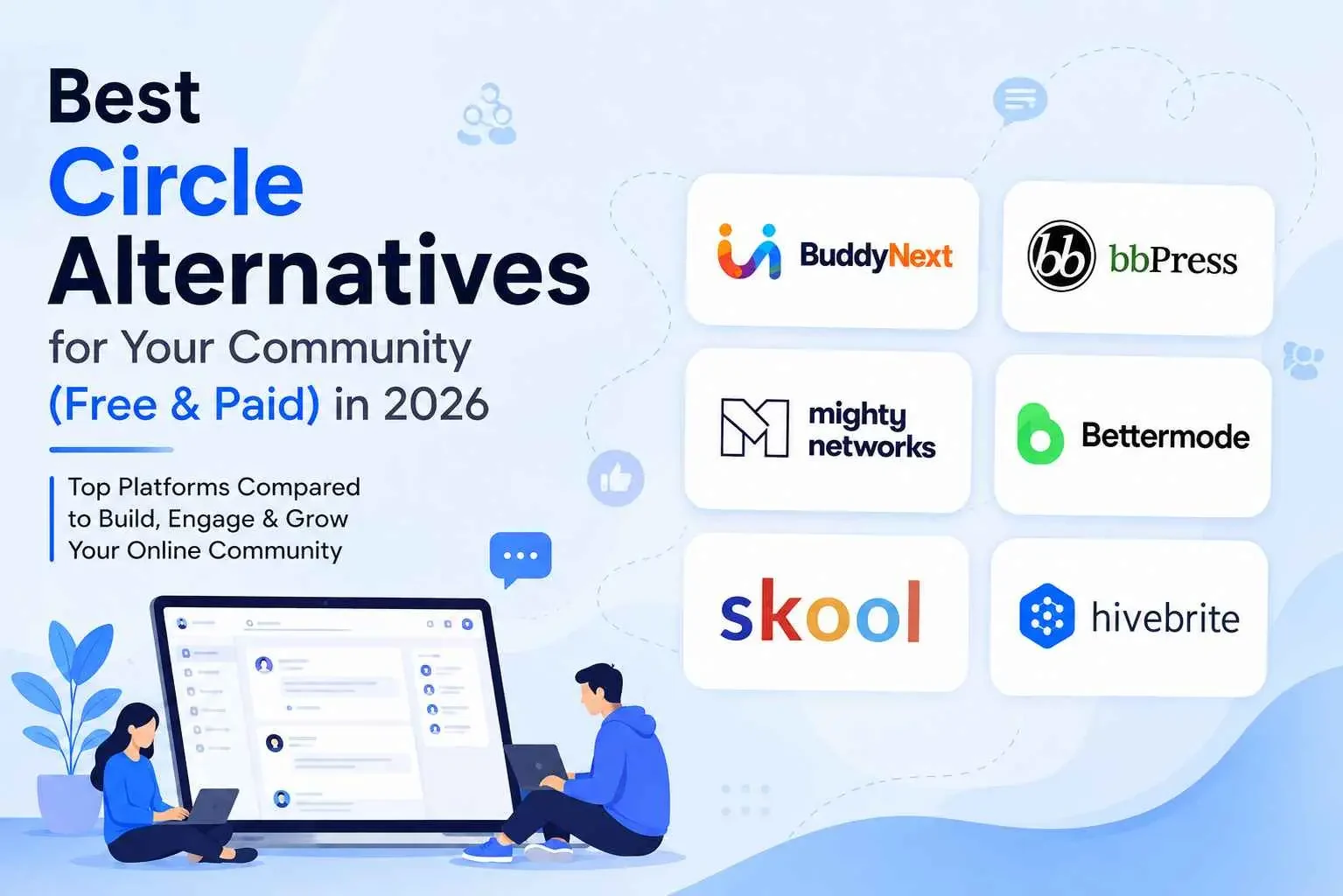
Best Circle Alternatives for Your Community (Free & Paid) in 2026
Building an online community today requires more than just a discussion forum. Modern platforms need features like activity feeds, member profiles, messaging, groups, events, moderation, memberships, and monetization tools.
While Circle is a popular choice for creators and businesses, it may not suit everyone due to limitations around customization, ownership, and long-term costs. Many users now look for alternatives that offer more flexibility, self-hosting, and better control.In this guide, we’ll compare the best Circle alternatives in 2026, covering their features, pricing, and ideal use cases to help you find the right community platform.
Why Look for a Circle Alternative?
Circle is an excellent hosted platform, but it’s not the perfect solution for every organization. Depending on your goals, you may need greater flexibility, additional integrations, or complete ownership of your community.
Here are some of the most common reasons people switch from Circle.
1. Recurring Subscription Costs
Circle operates on a monthly subscription model. While this works well for many creators, costs can increase as your community expands or when you require more advanced features.
Some businesses prefer investing in a platform they fully own rather than paying ongoing SaaS fees.
2. Complete Ownership of Your Community
With self-hosted platforms, your website, community data, member information, and content remain under your control.
For businesses that prioritize privacy, branding, and long-term scalability, owning the entire platform can be an important advantage.
3. Greater Customization
Hosted platforms typically limit how much you can customize layouts, workflows, integrations, and functionality.
If your community has unique requirements, a self-hosted solution often provides much greater flexibility through themes, plugins, APIs, and developer tools.
4. Better WordPress Integration
Many businesses already use WordPress for their website.
Choosing a WordPress-native community platform allows your community to work alongside your existing:
- WooCommerce store
- LMS plugins
- Membership plugins
- Marketing tools
- Custom themes
- SEO plugins
instead of managing multiple disconnected platforms.
5. More Monetization Options
Many community owners eventually expand beyond memberships.
They may want to offer:
- Online courses
- Digital products
- Job boards
- Service marketplaces
- Paid communities
- Advertisements
- Premium content
Choosing a flexible community platform makes it easier to introduce these revenue streams as your business grows.
6. Self-Hosted vs Hosted Flexibility
Some organizations prefer a fully managed platform like Circle because it requires minimal maintenance.
Others prefer self-hosting because it gives them:
- Complete control
- Unlimited customization
- No vendor lock-in
- Freedom to choose hosting providers
- Easier integration with existing WordPress websites
The right choice depends on your business goals and technical requirements.
How We Chose These Circle Alternatives
Not every community platform is designed for the same audience.
Some focus on creators.
Others target enterprises.
Some specialize in forums.
Others provide complete social networking capabilities.
To keep this comparison fair, we evaluated every platform using the same criteria.
Community Experience
- Activity feeds
- Discussions
- Member engagement
- Notifications
- Reactions
- Search
Member Management
- Member profiles
- Directories
- Connections
- Groups or Spaces
- Privacy controls
Collaboration Features
- Private messaging
- Community moderation
- Events
- Announcements
- Content organization
Business Features
- Memberships
- Courses
- Monetization
- Integrations
- APIs
- Scalability
Ease of Use
- User interface
- Setup process
- Mobile experience
- Documentation
- Customization options
Watch the Video
Want a quick overview before reading the full comparison? Watch our video covering the best Circle alternatives in 2026.
https://www.youtube.com/watch?v=EJXGVNrwIqc
Quick Comparison Table
Platform | Best For | Self-Hosted | Free Version | Starting Price |
BuddyNext | WordPress communities | Yes | Yes | Free + Pro |
BuddyBoss | Membership communities | Yes | No | Premium |
Mighty Networks | Creators and coaches | No | No | Monthly plans |
Bettermode | Customer communities | No | Limited | Monthly plans |
Discourse | Discussion forums | Yes | Yes | Free (Self-hosted) / Hosted plans |
Hivebrite | Enterprises and associations | No | No | Custom pricing |
Skool | Courses and creator communities | No | No | Monthly plans |
If you’re looking for a self-hosted alternative to Circle, BuddyNext stands out as one of the most complete options available for WordPress.
Unlike platforms that focus solely on discussions or memberships, BuddyNext is designed as a complete community engine. It provides the core social experience, including feeds, member profiles, spaces, messaging, notifications, and moderation, and can be extended with additional apps such as forums, learning management systems, marketplaces, media sharing, job boards, and more, all built to work together within the same ecosystem.
Because it runs on your own WordPress website, you maintain full ownership of your community, members, and content while retaining the flexibility to customize the experience as your needs evolve.
Key Features of BuddyNext
Activity Feed
BuddyNext offers a modern community feed where members can create posts, comment, react, share, and bookmark content. It includes personalized feeds, public discovery, hashtags, announcements, privacy controls, and AI-powered feed recommendations in the Pro version.
Spaces
Create focused communities with Spaces for teams, interests, courses, or projects. Each Space includes its own feed, members, and moderation controls, with Open, Private, Secret, and paid Spaces available.
Rich Member Profiles
Members get customizable profiles with personal details, activity history, connections, and community participation, helping users discover and engage with others.
Community Moderation
Manage your community with built-in moderation tools for reports, member management, appeals, and content control. Pro features add AI moderation and automated rules.
Private Messaging
Members can chat directly through built-in private messaging, keeping conversations inside your own community platform with notifications for new messages.
Notifications
Keep members engaged with alerts for messages, comments, mentions, reactions, follows, and updates. Pro adds real-time and push notifications.
Community Insights Dashboard
Track community growth, engagement, activity trends, popular Spaces, and moderation data through an analytics dashboard inside WordPress.
AI-Powered Features (Pro)
BuddyNext Pro adds AI-powered feed personalization, smart replies, and content moderation tools to improve engagement and reduce manual management.
Memberships & Monetization (Pro)
Create paid communities with membership tiers, content restrictions, subscriptions, and payment integrations like Stripe and PayPal.
Extensive Integrations
Extend your community with WordPress tools and plugins for WooCommerce, LearnDash, Tutor LMS, forums, job boards, marketplaces, media sharing, gamification, events, and directories.
Developer-Friendly Platform
With REST API support, webhooks, and WordPress compatibility, developers can build custom apps, automate workflows, and create advanced community experiences.
Performance & Scalability
As a self-hosted WordPress solution, BuddyNext gives you full control over hosting, optimization, and scaling as your community grows.
Pros
- Self-hosted with complete ownership of your data.
- Comprehensive community features, including activity feeds, spaces, member profiles, messaging, and notifications.
- AI-powered feed ranking, moderation, and smart replies available in Pro.
- Built-in community moderation and reporting tools.
- Extensive integrations with WooCommerce, LMS plugins, forums, marketplaces, media sharing, and gamification.
- Developer-friendly REST API and webhooks for custom integrations.
- Highly customizable thanks to the WordPress ecosystem.
- Suitable for creators, businesses, membership sites, educational communities, and enterprise projects.
Cons
- Requires WordPress hosting and basic site management.
- Some advanced capabilities, including AI features, memberships, and real-time updates, are available only in the Pro version.
- Initial setup may take longer than fully hosted SaaS platforms like Circle, although the setup wizard simplifies the process.
Pricing
BuddyNext offers a free version that includes the essential community features needed to launch an online community. For users who need advanced capabilities such as AI-powered features, memberships, monetization, real-time updates, and enhanced moderation, BuddyNext Pro is available with premium plans. This gives users the flexibility to start for free and upgrade only when their community grows.
Best For
BuddyNext is an excellent choice for:
- Creators building paid communities.
- Membership websites.
- Educational communities using WordPress LMS plugins.
- Businesses creating customer communities.
- Associations and organizations.
- Employee or internal communities.
- Online learning platforms.
- Marketplace communities.
- Job boards with community features.
- Anyone looking for a self-hosted alternative to Circle that offers full ownership, deep customization, and the flexibility to expand with additional WordPress functionality.
2. BuddyBoss
Best for: Established membership websites and businesses that want a premium WordPress community solution.
BuddyBoss is one of the most recognized community platforms for WordPress and is often considered by businesses that want to create private communities, membership websites, online courses, and social networks. It builds upon BuddyPress and combines community features with integrations for popular LMS and membership plugins, making it a popular choice for educators and membership site owners.
Unlike Circle, BuddyBoss is self-hosted, which means you own your website and member data. It also offers a branded mobile app for organizations that need a native mobile experience. However, compared to some alternatives, BuddyBoss has a higher upfront cost and many advanced features rely on additional plugins or integrations.
Key Features
- Member profiles
- Activity feeds
- Groups
- Private messaging
- Notifications
- Member connections
- Discussion forums
- LearnDash and LifterLMS integration
- WooCommerce integration
- Membership plugin compatibility
- Mobile app support (additional cost)
- Theme customization options
Pros
- Mature and well-established platform.
- Complete ownership of your community.
- Excellent WordPress ecosystem.
- Works well for membership and eLearning websites.
- Large user community and extensive documentation.
- Supports branded mobile applications.
Cons
- Premium-only solution with no free version.
- Mobile apps require an additional subscription.
- Advanced functionality often depends on third-party plugins.
- Can become expensive for growing communities.
- Requires WordPress hosting and maintenance.
Pricing
BuddyBoss is available as a premium product with annual licensing. Additional costs may apply for mobile apps and other premium services.
Best For
- Membership websites
- Online course creators
- Coaching businesses
- Professional organizations
- Businesses already using WordPress
3. Mighty Networks
Best for: Creators, coaches, educators, and businesses that want an all-in-one hosted community platform.
Mighty Networks combines communities, online courses, memberships, events, and live streaming into a single hosted platform. Since it’s a SaaS solution, users don’t need to worry about hosting, maintenance, or software updates.
The platform is especially popular among creators selling courses or memberships because it offers a simple setup process and integrated payment options. However, customization is more limited than self-hosted WordPress solutions, and ongoing subscription costs can become significant as your community grows.
Key Features
- Community spaces
- Online courses
- Live events
- Live streaming
- Paid memberships
- Mobile apps
- Activity feeds
- Member profiles
- Analytics
- Native mobile experience
Pros
- Easy to launch.
- No hosting required.
- Excellent mobile apps.
- Integrated course platform.
- Built-in memberships and payments.
Cons
- Monthly subscription pricing.
- Limited customization.
- Vendor lock-in.
- Limited developer flexibility.
- Less control over your data.
Pricing
Subscription-based with multiple pricing tiers depending on features and community size.
Best For
- Coaches
- Content creators
- Online educators
- Membership businesses
4. Bettermode
Best for: Customer communities and SaaS companies.
Unlike BuddyNext or BuddyBoss, Bettermode focuses less on social networking and more on customer engagement and branded community experiences.
Key Features
- Community spaces
- Discussions
- Q&A
- Knowledge base
- Custom branding
- Analytics
- Moderation tools
- Integrations
- API support
Pros
- Modern interface.
- Excellent for customer support.
- Easy to customize branding.
- Strong moderation capabilities.
- Good integration ecosystem.
Cons
- Hosted platform.
- Monthly subscription.
- Limited social networking features.
- Not designed as a complete WordPress community platform.
Pricing
Monthly subscription with multiple plans.
Best For
- SaaS companies
- Product communities
- Customer support communities
- Brand communities
5. Discourse
Best for: Discussion forums and open-source communities.
Discourse is one of the most popular forum platforms available today. Unlike traditional forum software, it offers a modern interface with real-time updates, trust levels, moderation tools, and extensive developer customization.
Although Discourse can function as a community platform, it is primarily discussion-focused rather than offering the broader social networking experience found in BuddyNext or Circle.
Key Features
- Discussion forums
- Categories
- Trust levels
- Real-time updates
- Rich editor
- Notifications
- Moderation tools
- API
- Plugins
Pros
- Open source.
- Highly scalable.
- Excellent moderation.
- Strong developer community.
- Self-hosted or managed hosting.
Cons
- Limited social networking features.
- No built-in memberships.
- Learning curve for administrators.
- Requires technical knowledge when self-hosting.
Pricing
Free self-hosted version or paid hosted plans.
Best For
- Technical communities
- Open-source projects
- Developer communities
- Support forums
6. Hivebrite
Best for: Large organizations, associations, universities, and enterprise communities.
Hivebrite is an enterprise-grade community platform built for organizations managing thousands of members. It includes networking tools, event management, fundraising, memberships, and professional networking features.
Its pricing and feature set make it more suitable for enterprises than individual creators or small businesses.
Key Features
- Member directory
- Events
- Groups
- Messaging
- Job board
- Fundraising
- Membership management
- Analytics
- Mobile app
Pros
- Enterprise-ready.
- Excellent networking tools.
- Powerful event management.
- Strong security.
- Professional support.
Cons
- Expensive.
- Custom pricing.
- Longer implementation process.
- Overkill for small communities.
Pricing
Custom enterprise pricing.
Best For
- Universities
- Alumni communities
- Associations
- Professional organizations
- Large enterprises
7. Skool
Best for: Course creators who want a simple community platform.
Skool combines online courses with a community feed, gamification, and calendar functionality. It focuses on simplicity and ease of use rather than advanced customization.
Its clean interface has made it increasingly popular among coaches and creators selling educational content.
Key Features
- Community feed
- Courses
- Calendar
- Leaderboards
- Gamification
- Member profiles
- Mobile support
Pros
- Very easy to use.
- Excellent user experience.
- Built-in gamification.
- Simple course management.
- Active creator ecosystem.
Cons
- Limited customization.
- Hosted platform.
- Monthly subscription.
- Few third-party integrations.
- Not suitable for highly customized communities.
Pricing
Subscription-based with a flat monthly fee.
Best For
- Coaches
- Course creators
- Membership businesses
- Creator communities
Feature Comparison: BuddyNext vs Circle and Other Leading Community Platforms
Choosing the right community platform isn’t just about features-it’s about finding the solution that aligns with your long-term goals. Whether you want complete ownership, advanced social networking, monetization, or a simple hosted experience, each platform offers something different.
Here’s how the leading Circle alternatives compare across some of the most important features.
Feature | BuddyNext | Circle | BuddyBoss | Mighty Networks | Bettermode |
Best For | WordPress Communities | Creators | Membership Sites | Creators | Customer Communities |
Activity Feed | Yes | Yes | Yes | Yes | Yes |
Member Profiles | Yes | Yes | Yes | Limited | Limited |
Spaces / Groups | Yes | Yes | Yes | Yes | Yes |
Private Messaging | Yes | Yes | Yes | No | No |
Notifications | Yes | Yes | Yes | Yes | Yes |
Community Moderation | Yes | Yes | Yes | Yes | Yes |
AI Features | Pro | Yes | Limited | Limited | Limited |
Courses | Via LMS | Built-in | Via LMS | Built-in | No |
Marketplace Support | Yes | No | No | No | No |
Job Board Support | Yes | No | No | No | No |
WooCommerce Integration | Yes | No | Yes | No | No |
Developer API | Yes | Limited | Yes | Limited | Yes |
Self-Hosted | Yes | No | Yes | No | No |
Data Ownership | Full | Limited | Full | Limited | Limited |
Customization | High | Limited | High | Limited | Moderate |
Free Version | Yes | No | No | No | Limited |
Circle vs BuddyNext: Which Community Platform Is Better?
Both Circle and BuddyNext help you build engaging online communities, but they take very different approaches.
Circle is a hosted SaaS platform that prioritizes simplicity and ease of use. BuddyNext, on the other hand, is a self-hosted WordPress community platform designed for businesses and creators who want complete ownership and flexibility.
Let’s compare them across the areas that matter most.
1. Hosting & Ownership
BuddyNext
BuddyNext runs on your own WordPress website, giving you full control over your hosting, data, branding, and infrastructure. Since everything is stored on your own server, you decide how your community evolves without depending on a third-party platform.
Circle is fully hosted, which means you don’t need to manage servers or updates. However, your community operates within Circle’s ecosystem, and you’re tied to its pricing, infrastructure, and feature roadmap.
2. Community Features
Both platforms offer modern community experiences with activity feeds, member profiles, spaces, discussions, and notifications.
BuddyNext extends these capabilities further by integrating with the wider WordPress ecosystem, making it possible to add forums, media sharing, job boards, marketplaces, learning management systems, and gamification as your community grows.
Circle focuses primarily on discussions, courses, and memberships within its hosted environment.
Winner: BuddyNext for flexibility.
3. Customization
Customization is one of the biggest differences between the two platforms.
BuddyNext can be customized using WordPress themes, plugins, hooks, APIs, and custom development. Businesses can create unique workflows and integrate with virtually any WordPress plugin.
Circle offers branding options but limits deeper customization because it’s a managed SaaS platform.
Winner: BuddyNext
4. Integrations
BuddyNext integrates naturally with popular WordPress solutions, including:
- WooCommerce
- LearnDash
- Tutor LMS
- Membership plugins
- Gamification plugins
- Marketplace plugins
- Media sharing plugins
- Job board plugins
Circle offers integrations with third-party services but doesn’t provide the same level of extensibility available within WordPress.
Winner: BuddyNext
5. Pricing
Circle uses a recurring subscription model with multiple pricing tiers.
BuddyNext offers a free version, allowing you to start building a community without an upfront investment. Advanced functionality is available through BuddyNext Pro, giving you the flexibility to upgrade as your community expands.
For organizations planning long-term growth, this can make BuddyNext a more scalable option.
6. Developer Experience
If you’re building custom workflows or integrations, BuddyNext provides a REST API, developer hooks, and the flexibility of WordPress development.
Circle offers APIs and integrations, but developers have less control over the underlying platform.
Winner: BuddyNext
7. Monetization
Both platforms support memberships and paid communities.
However, BuddyNext allows you to expand monetization by integrating with WordPress plugins for:
- Online courses
- Digital downloads
- Service marketplaces
- Job boards
- Advertising
- WooCommerce stores
- Membership subscriptions
This flexibility makes it easier to diversify your revenue beyond memberships alone.
Winner: BuddyNext
Hosted vs Self-Hosted Community Platforms
Before choosing a community platform, it’s worth deciding whether you want a hosted solution or complete ownership through self-hosting.
Hosted Platforms (Like Circle)
Pros
- Fast setup with minimal technical knowledge.
- No server maintenance.
- Automatic updates.
- Reliable infrastructure.
- Simple user experience.
Cons
- Monthly subscription costs.
- Limited customization.
- Vendor lock-in.
- Less control over data.
- Feature roadmap controlled by the provider.
Self-Hosted Platforms (Like BuddyNext)
Pros
- Full ownership of your website and community data.
- Unlimited customization.
- Extensive WordPress integrations.
- Freedom to choose your hosting provider.
- Easier long-term scalability.
- Greater monetization flexibility.
Cons
- Requires WordPress hosting.
- You’ll be responsible for updates and maintenance.
- Initial setup may take slightly longer than hosted platforms.
Which Circle Alternative Should You Choose?
Every platform in this list serves a different audience, so the right choice depends on your goals.
Choose BuddyNext if:
- You already have a WordPress website.
- You want complete ownership of your community and data.
- You need a highly customizable platform.
- You plan to monetize with memberships, courses, marketplaces, advertising, or digital products.
- You expect your community to grow over time.
- You want to avoid being locked into a hosted platform.
Choose Circle if:
- You want the simplest possible setup.
- You don’t want to manage WordPress hosting.
- You’re comfortable paying a recurring subscription.
- You don’t require extensive customization.
Choose Mighty Networks if:
You want an all-in-one hosted platform focused on creators, courses, and memberships.
Choose BuddyBoss if:
You’re already invested in the WordPress ecosystem and need a mature premium community platform.
Choose Discourse if:
Your primary focus is building a modern discussion forum.
Choose Hivebrite if:
You’re managing a large enterprise, alumni, or professional association.
Choose Skool if:
You want a simple community platform centered around online courses.
Frequently Asked Questions
What is the best Circle alternative in 2026?
The best Circle alternative depends on your specific requirements.
If you want a fully hosted platform with minimal setup, options like Mighty Networks or Skool are excellent choices. However, if you’re looking for complete ownership of your community, greater customization, and seamless integration with WordPress, BuddyNext stands out as one of the strongest alternatives. It combines modern community features with the flexibility of the WordPress ecosystem, making it suitable for creators, businesses, membership websites, and educational platforms.
Is there a free alternative to Circle?
Yes. Several community platforms offer free plans or free self-hosted versions.
BuddyNext provides a free version that allows you to launch a WordPress community with essential features such as activity feeds, member profiles, spaces, messaging, and notifications. Discourse also offers a free self-hosted edition for discussion-focused communities.
Is BuddyNext self-hosted?
Yes.
BuddyNext is a self-hosted WordPress community platform. This means you install it on your own WordPress website and retain complete ownership of your members, content, and data. Unlike hosted platforms, you’re free to choose your hosting provider, customize your website, and expand functionality using the extensive WordPress ecosystem.
Can I monetize my online community with BuddyNext?
Absolutely.
BuddyNext can be integrated with WordPress plugins for memberships, online courses, WooCommerce stores, digital products, marketplaces, advertising, job boards, and other monetization solutions. This flexibility allows community owners to generate revenue through multiple channels instead of relying solely on subscriptions.
Which platform is best for creators?
For creators who want the easiest hosted experience, Circle and Mighty Networks are both excellent options.
For creators who already use WordPress or want complete control over branding, customization, and monetization, BuddyNext offers significantly greater flexibility while allowing your community to grow alongside your business.
Which platform is best for businesses?
Businesses looking for a fully managed SaaS solution may prefer Circle or Hivebrite.
However, businesses that prioritize long-term scalability, data ownership, custom workflows, and WordPress integration will find BuddyNext to be a more adaptable solution capable of supporting customer communities, employee communities, educational platforms, and membership websites.
Can I migrate from Circle to BuddyNext?
Yes.
If your organization has decided to move away from Circle, BuddyNext provides a flexible WordPress-based foundation for rebuilding your community. Depending on your existing data and workflows, member information, content, and community structure can often be migrated using available export tools, custom migration processes, or third-party solutions.
Final Verdict
Circle is a great hosted community platform for creators and businesses that want a simple, all-in-one solution. However, if you need more flexibility, customization, and full ownership of your community, several strong alternatives are available.
For hosted communities, Mighty Networks, Skool, and Bettermode are excellent options, while Discourse is ideal for forum-based communities. Hivebrite is best suited for enterprise organizations.
If you’re looking for the best self-hosted Circle alternative, BuddyNext is our top pick. It offers activity feeds, member profiles, spaces, messaging, moderation, AI features, memberships, and seamless WordPress integrations, giving you complete control to build and grow your community your way.