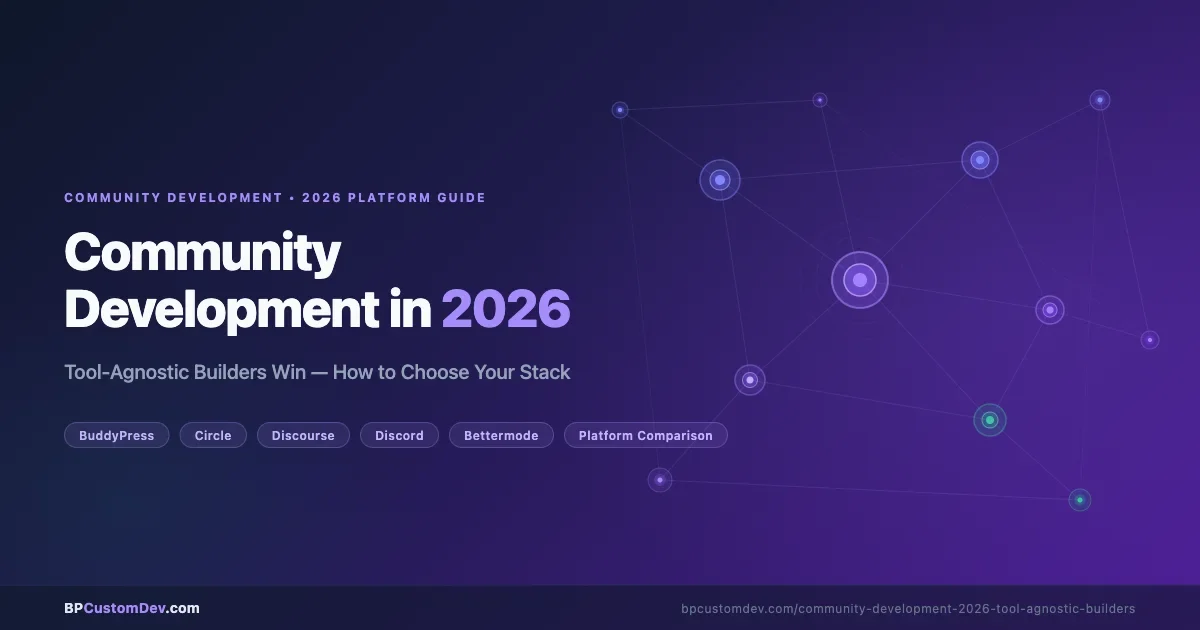
Community Development in 2026: Why Tool-Agnostic Builders Win (And How to Choose Your Stack)
Community development is the skill. The platform is a choice. Here is the full 2026 platform landscape, a framework for choosing your stack, and an honest take on where BuddyPress fits in a world full of Circle, Skool, Discord, and a dozen SaaS alternatives.

We have been building on BuddyPress since 2014. It is still our default choice for serious community projects. But I want to be honest with you: if you come to us with a community brief in 2026, the first thing we do is not open a BuddyPress repo. The first thing we do is ask five questions. The answers determine the platform. The platform does not determine the answers.
That is the shift this post is about. Community development is a discipline. It involves product thinking, moderation strategy, member journey design, monetization architecture, and long-term data ownership. The tool you build on is one variable in that system, not the whole system. The builders who understand this win. The builders who are loyal to a single platform because it is familiar often end up rebuilding from scratch eighteen months later.
This site exists to document that discipline, across every platform. We cover BuddyPress because it is where we do our deepest work. We also cover Circle, Skool, Mighty Networks, Discord, Slack, BuddyBoss, Discourse, Whop, Bettermode, Hivebrite, Mastodon/ActivityPub, and Jetonomy, because your members do not care what CMS you are running. They care whether the community works.

The 2026 Community Platform Landscape
The market has never been more crowded or more interesting. Here is where each major platform sits right now.
BuddyPress
Still the most customizable self-hosted community layer for WordPress. The 2025 block-based profile and activity rewrites made it significantly more usable out of the box. The plugin ecosystem around it (Jetonomy for credits and Q&A, WPMediaVerse for media, BuddyX for theming, BP Moderation Pro for trust and safety) now covers about 90% of what SaaS platforms offer, at a fraction of the recurring cost. The weakness is the same as it has always been: the default experience is not great without developer investment, and the mindshare loss to SaaS tools is real. Less people are googling BuddyPress in 2026 than in 2019. That is a fact, not a criticism.
Circle
Circle is the polished SaaS community tool. Good design, good events and courses integration, solid mobile experience. It works well for course creators and coaching communities who want to launch fast. The trade-off is obvious: you rent the platform. Your member data, your content, your community graph all live in Circle’s infrastructure. When you want to move, you discover how limited the export options are. Pricing scales quickly once you have real traction.
Skool
Skool went from niche to mainstream fast, mostly because of how well it fits the creator economy playbook: paid communities, courses, and leaderboard gamification in one flat-fee product. The gamification is genuinely clever. The limitations show at enterprise scale or when you need custom member roles, complex permissions, or any integration that is not on their pre-built list. If your monetization is simple and your audience is creator-adjacent, Skool works. If it is not, you will hit walls.
Mighty Networks
Mighty Networks positions itself as the premium end of SaaS community tools. Good content spaces, native courses, decent events. The mobile app is a real differentiator for community-first products. The pricing reflects the positioning: it is expensive. The customization ceiling is low. You get a Mighty Networks site that looks like every other Mighty Networks site until you are on the Mighty Pro tier, which costs serious money.
Discord and Slack
These two keep eating communities that should probably be somewhere else. Discord is extraordinary for real-time engagement, especially for gaming, crypto, and developer communities. The SEO story is zero: nothing inside Discord gets indexed. Slack is designed for teams, not communities, but many B2B SaaS products run their user communities in it because the integration story with Salesforce and Zendesk is strong. Both platforms are rented infrastructure with limited export.
BuddyBoss
BuddyBoss is BuddyPress with a commercial theme layer and tighter LearnDash integration. It is a reasonable choice for online course communities that need a polished out-of-the-box look. The cost is real: BuddyBoss Platform Pro plus the theme adds up, and updates have historically been slow to follow BuddyPress core. The right way to think about BuddyBoss is as a premium starting point, not a long-term architectural foundation. Many of the teams we work with started on BuddyBoss and eventually migrated to a leaner BuddyPress + BuddyX setup for more control.
Discourse
Discourse is the best forum software in the world. Full stop. The trust level system, the moderation tools, the SEO-friendly thread structure, the plugin API: it is a serious piece of software. Where it falls short is on the social layer. Profiles are shallow. There is no activity feed in the BuddyPress sense. It does not feel like a community, it feels like a very good forum. For discussion-first communities, that is fine. For anything requiring a social graph or user profiles as first-class objects, you will feel the gap.
Whop
Whop is the creator economy’s all-in-one shop: sell digital products, communities, software access, courses, and Discord invites under one roof. It is growing fast because it nails the monetization layer. The community features are secondary. If your primary goal is selling access to a community and you want payments and access management handled cleanly, Whop is worth a hard look. If the community itself is the product, it is not the right tool.
Bettermode
Bettermode (formerly Tribe) has matured into a solid developer-friendly SaaS community platform. The GraphQL API is genuinely good. White-labeling is available at paid tiers. It sits in a similar space to Circle but with a stronger technical foundation and a more B2B-friendly positioning. Worth evaluating if you need a SaaS community with real API access and do not want to run your own infrastructure.
Hivebrite
Hivebrite is enterprise community software, aimed at alumni networks, professional associations, and large membership organizations. The feature set is broad, the pricing is accordingly steep, and the deployment cycle is enterprise-pace. If you are building for a university alumni network or a national professional association with 50k+ members and a budget to match, Hivebrite is a legitimate option. For anything smaller, it is overkill.
Mastodon and ActivityPub
The federated social web got a lot of attention after 2022. ActivityPub communities via Mastodon, Pixelfed, or WordPress’s own ActivityPub plugin are genuinely interesting for communities where open federation and decentralization are part of the value proposition. The technical overhead is real, the UX is still rough for non-technical members, and monetization is minimal. The right niche for this stack is communities where the politics of the infrastructure matter as much as the features.
Jetonomy
Jetonomy deserves its own category. It is not a community platform by itself; it is a credits, reputation, and Q&A layer that sits on top of BuddyPress or WordPress. When you need a trust level system, a token-gated community, or a community-powered support forum, Jetonomy does things that no SaaS platform offers out of the box. It is a significant part of why the BuddyPress ecosystem can compete with tools like Tribe/Bettermode for technical communities in 2026.
If you’re choosing a community stack fresh, BuddyNext is a free, standalone community platform worth a look, an activity feed, member profiles, Spaces (groups), and deep moderation in one plugin, built as its own modern architecture rather than on top of BuddyPress (so it isn’t a BuddyPress add-on and existing BuddyPress plugins won’t run on it). Because it runs on your own site you keep full ownership of member data, and its Pro tier adds native Stripe memberships when you’re ready to monetize.
How to Choose Your Stack: The Five Questions
When a client brings us a community project, we work through five questions before we open a laptop. These questions surface the real constraints, and the real constraints determine the platform.
1. Where is your audience right now?
This is the most underrated question in community development. If your members are already in Discord, building a BuddyPress community and expecting them to migrate is a hard sell. If your audience is professionals on LinkedIn, a Slack community has a believable on-ramp. If your audience is WordPress site owners, a BuddyPress community on a familiar CMS interface makes sense. Meet people where they are, then decide how and when to move them.
2. What does monetization look like in year three?
Many platform decisions that look good at launch look terrible at scale. SaaS platforms take a revenue cut or charge per-seat pricing that becomes punishing at 10k members. Self-hosted platforms have infrastructure and developer costs. Think through the year-three model: subscription tiers, course upsells, marketplace fees, advertising, or just a paid membership gate? Different monetization shapes favor different platforms. A simple paid community on Skool is fine at 500 members. The same community at 5,000 members with multiple tiers and a course product needs a more flexible architecture.
3. What is your realistic technical capacity?
Be honest. A solo creator who is also doing marketing, content, and customer support does not have the bandwidth to manage a self-hosted BuddyPress deployment. A company with one developer on staff can. An agency with a dedicated DevOps person can build something serious. The right platform is the one your team can actually maintain. A BuddyPress site that goes six months without security updates is worse than a fully managed SaaS community that runs itself.
4. Who owns the data, and does it matter?
For some community operators, data ownership is existential. Healthcare communities, legal professional networks, enterprise knowledge bases: these cannot live in a third-party SaaS environment without serious compliance risk. For a course creator running a paid community of 300 members, data portability may be a nice-to-have rather than a blocker. Know which category you are in before you choose a platform.
5. What does scale look like, and when?
Scale questions cut both ways. Some platforms cannot handle the technical load of a large community. Others cannot handle the organizational complexity: 50 sub-communities with different permission sets, a moderation team of 30, localization across eight languages. Map out the scale scenario you are actually aiming for, and pressure-test the platform against it before you build.
Platform Comparison Table: 2026
Here is a side-by-side view of the major platforms across the dimensions that matter most for community development decisions.
Platform | Cost Model | Data Ownership | SEO | Customization | Monetization Options |
|---|---|---|---|---|---|
BuddyPress | Free core + paid plugins/hosting | Full (self-hosted) | Excellent | Unlimited (code) | Any WooCommerce-compatible model |
Circle | $89-$399/mo + transaction fees | Limited export | Poor (gated) | Low | Memberships, courses, events |
Skool | $99/mo flat | Limited export | Poor (gated) | Very low | Paid community only |
Mighty Networks | $41-$360/mo + revenue share | Limited export | Moderate | Low-moderate | Memberships, courses, live events |
Discord | Free + Nitro/Server Boost | None (platform-owned) | Zero | Bot/API only | Server memberships via Discord |
Discourse | Free (self-hosted) / $100+/mo SaaS | Full (self-hosted) | Excellent | High (plugins/themes) | Limited native; needs integration |
BuddyBoss | $228/yr platform + $149/yr theme | Full (self-hosted) | Excellent | High | Any WooCommerce-compatible model |
Bettermode | $599-$999/mo | API access, limited export | Moderate | Good (GraphQL API) | Gated content, paid spaces |
Hivebrite | Enterprise pricing | Good | Moderate | Moderate | Memberships, events, donations |
Whop | 3% transaction fee | Limited | Moderate | Low | Sell anything: access, courses, software |
An Honest Take on BuddyPress in 2026
I want to be straight with you here because I think a lot of BuddyPress content is either defensive cheerleading or dismissive trend-chasing, and neither is useful.
BuddyPress is losing mindshare. The Google Trends data is clear. Searches for BuddyPress peaked around 2015-2017 and have declined since. Meanwhile, searches for Circle, Skool, and Mighty Networks are up. This reflects a real shift: SaaS community tools are genuinely easier to start on, and the creator economy has normalized paying monthly rent for managed tools.
But mindshare and the right tool for a specific job are different things. Here is what BuddyPress still does better than anyone else in 2026:
- Data ownership and portability. Your members are in your database, on your server, under your control. No SaaS platform can match this.
- SEO architecture. Public-facing member profiles, group pages, and activity streams get indexed. A community on Circle or Discord is invisible to search engines.
- Customization depth. You can build literally anything on top of BuddyPress. Custom member types, complex permission systems, multi-currency credit economies via Jetonomy, full white-label mobile apps. The ceiling is your development budget, not the platform’s feature roadmap.
- Total cost at scale. At 10,000+ members, a self-hosted BuddyPress stack almost always beats SaaS pricing. The infrastructure cost is real, but the per-seat math favors ownership.
- WordPress ecosystem integration. WooCommerce, LearnDash, Elementor, ACF, Gravity Forms: the integration surface area of WordPress is unmatched.
What BuddyPress does not do well: out-of-the-box design (you need BuddyX or another theme doing heavy lifting), mobile UX without a dedicated PWA or app wrapper, and instant setup for non-technical operators. If you need to launch a community this week with no developer available, BuddyPress is not the right call. Circle or Skool probably is.
Our Agency Stance
We build on any platform the project requires. We have shipped Discourse setups for developer communities, Bettermode deployments for B2B SaaS products, and Discord bots for gaming communities. We meet the brief.
That said: when we are starting a project from scratch with full latitude, our default stack is BuddyPress + BuddyX Pro + BP Moderation Pro. BuddyPress for the social layer. BuddyX Pro from wbcomdesigns.com for the front-end, because it is the most capable BuddyPress theme we have used and it ships with the member profile layouts, group designs, and compatibility with our plugin stack that we need. BP Moderation Pro for trust and safety, which is non-negotiable on any community with more than a few hundred members.
We add Jetonomy when the community needs credits, reputation scores, or Q&A spaces. We add WPMediaVerse when media sharing is central to the experience. We layer in WP Gamification when engagement mechanics need to go beyond basic activity feeds. The result is a community stack that can genuinely compete with Bettermode and Circle on features while giving the operator full ownership and significantly better long-term economics.
We document all of this on this site, including the hard parts. You will find deep dives on building self-moderating forums with Jetonomy trust levels, guides to extending BuddyPress with custom code for Jetonomy and MediaVerse, and practical tutorials on adding points, badges, and leaderboards to your community. We also write honestly about alternatives: our post on the best bbPress alternatives in 2026 is a good example of that platform-agnostic approach in practice.
Common Mistakes in Community Platform Selection
After working on community projects across a wide range of platforms, the mistakes we see most often are not technical. They are decisions made before any code is written.
Choosing the platform you know, not the platform that fits. Every developer has a comfort zone. Comfort zone platform selection is the number one source of expensive rebuilds. The conversation should start with the community’s requirements, not the developer’s preferences.
Treating the launch platform as a permanent decision. It rarely is. Communities evolve. The platform that works at 100 members may not work at 10,000. The best community operators plan for the possibility of migration from day one, even if they never execute it. This means keeping member data clean and portable, avoiding deep platform lock-in on content formats, and documenting the community’s data model so a future migration team can understand it.
Underestimating moderation complexity. Every community hits a trust and safety inflection point. Platforms that handle moderation well (Discourse’s trust levels, BuddyPress with BP Moderation Pro, Hivebrite’s review queues) earn their keep the moment a bad actor shows up. Platforms that treat moderation as an afterthought create real operational problems at scale. Budget for moderation tooling from the start.
Ignoring the SEO story. If organic discovery is any part of your growth strategy, gated SaaS community tools are a structural problem. Nothing inside Circle, Skool, or Discord gets indexed. If you want Google to send you community members, you need public-facing content on an indexed domain. BuddyPress, Discourse, and self-hosted solutions have a structural advantage here that compounds over time.
What Tool-Agnostic Community Development Actually Looks Like
Being tool-agnostic does not mean having no opinions. It means having opinions that are grounded in the project requirements, not platform loyalty.
In practice it looks like this:
- We run the five-question framework on every new project before we recommend a platform.
- We document the reasoning, so the client understands the trade-offs they are accepting, not just the platform they are buying.
- We build for migration from day one. If a client starts on Circle and wants to move to BuddyPress in two years, we want the member data, content, and community graph to be moveable. This affects how we structure things, not just what platform we choose.
- We invest in platform expertise broadly. Understanding how Bettermode’s GraphQL API works makes us better BuddyPress developers, because we see what good API design looks like. Understanding Discourse’s trust level system informed how we integrate Jetonomy on BuddyPress projects.
The community development builders who will win over the next five years are not the ones who know BuddyPress best or know Circle best. They are the ones who can look at a community brief, identify the real constraints, and make a confident platform recommendation with clear reasoning. That is the skill we are building here.
Further Reading on This Site
This post is the positioning anchor for a broader content library. Here are some of the resources that go deeper on specific areas:
- How to build an employee intranet with BuddyPress, forums, media library, and recognition system
- Real-time collaboration in BuddyPress with WordPress 7.0 sync providers
- Build a course community with completion badges using BuddyPress, LearnDash, and WP Gamification
- How to build a community-driven marketplace with BuddyPress
- How to build a custom content moderation workflow for BuddyPress
- Why smart SaaS teams replace Zendesk with BuddyPress Q&A spaces
- Build a photo-sharing community like Flickr with BuddyPress and WPMediaVerse
Ready to Start Building?
If you are planning a community project and want to work with a team that will give you an honest platform recommendation rather than defaulting to whatever tool we know best, get in touch through wbcomdesigns.com.
If you are building on BuddyPress and want to start with the best possible theme foundation, take a look at BuddyX Pro. It is what we use on every BuddyPress project we build from scratch, and it is the reason we can move fast without compromising on front-end quality.
The community platform market in 2026 is bigger, more competitive, and more interesting than it has ever been. The builders who approach it with genuine expertise across the landscape, rather than tribal loyalty to a single tool, are the ones who will earn and keep the trust of the communities they build for. That is what this site is about. Stick around.