Real-Time Collaboration in BuddyPress: How WP 7.0 Sync Providers Change Community Sites
Real-time collaboration did not ship in WordPress 7.0 or 7.1. What the core team removed, what stayed in Gutenberg, and what it means for BuddyPress.

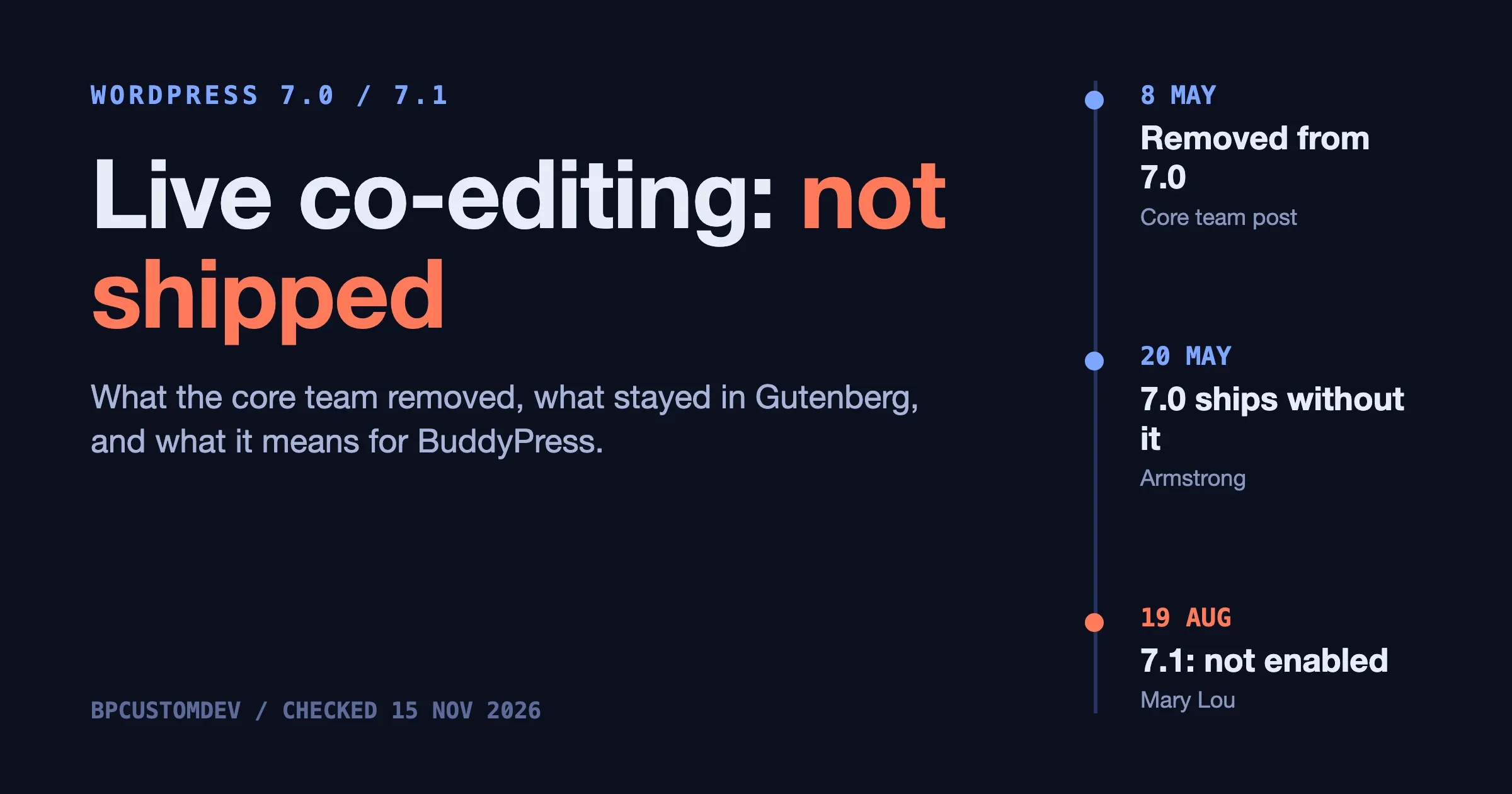
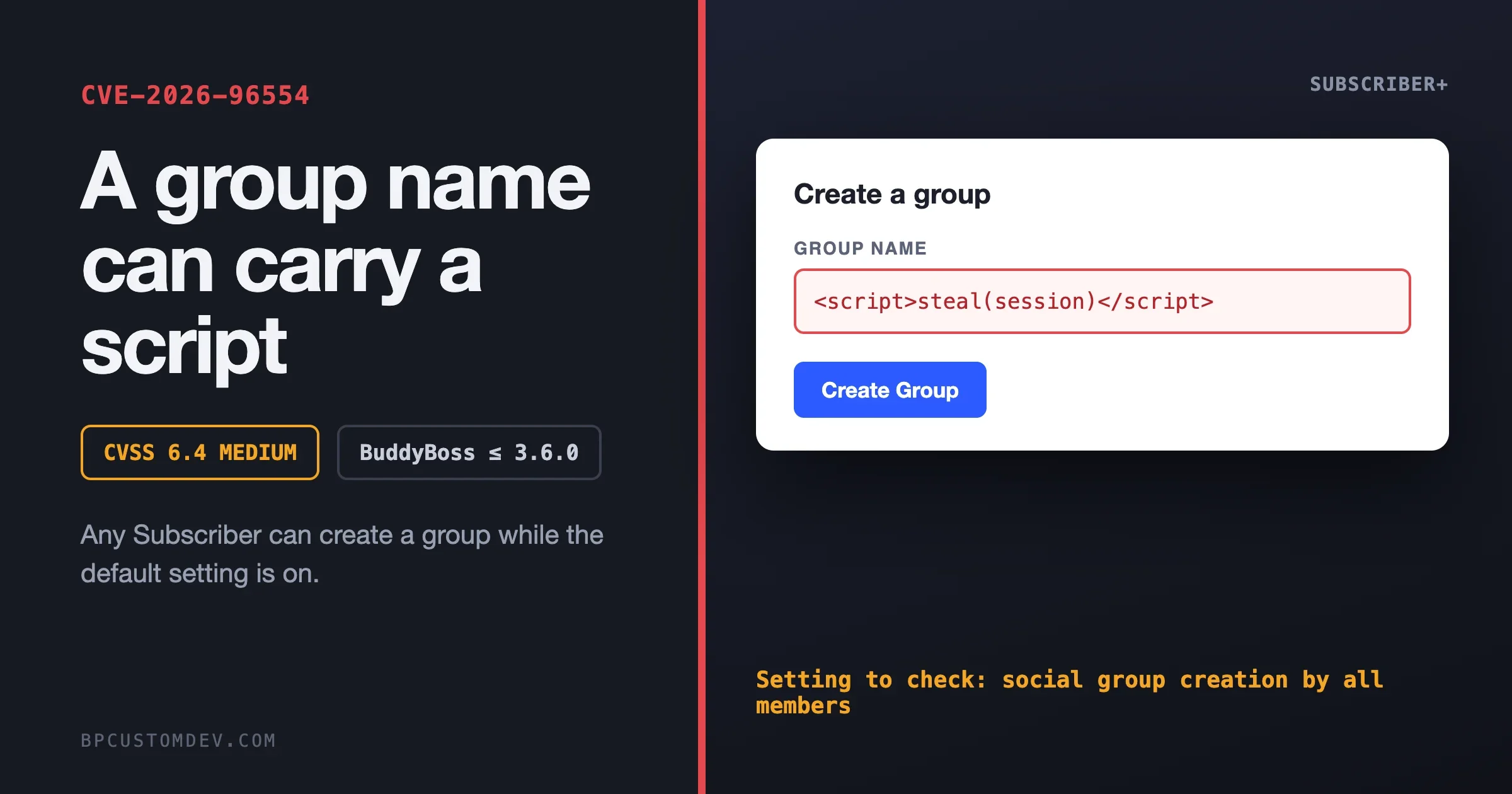
Real-time collaboration did not ship in WordPress 7.0, and as of 15 November 2026 it has not shipped in any WordPress release. It was pulled from 7.0 on 8 May 2026, twelve days before launch, and it was left switched off in 7.1 as well. The sync provider API we wrote about in April was real and documented, but it only ever ran in the Gutenberg plugin, and it belongs to the block editor, not to BuddyPress.
We need to say plainly that the first version of this post, published in April, got this wrong. It was written against the 7.0 release candidates and treated multi-user editing as a done deal. It was not. This refresh replaces it with what the official sources say, with dates, and with a clear line between what exists, what was removed and what is still undecided.
Everything below was checked on 15 November 2026. Where we are reading between the lines, we say so.
Did real-time collaboration ship in WordPress 7.0?
No. WordPress 7.0 “Armstrong” was released on 20 May 2026 without real-time collaboration. The decision was announced in the core team post Real-time collaboration will not ship in WordPress 7.0, published on 8 May 2026.
That post says Matt Mullenweg was not confident the current approach was solid enough for core at that point. It names surface area, race conditions, server load, memory efficiency and recurring bugs found through fuzz testing. Removal work was tracked in Trac ticket #65205. The release schedule did not move.
Plenty of articles written before 8 May still describe live co-editing as a 7.0 headline feature. They are out of date on that point, and so was our April version.
Did it ship in WordPress 7.1 instead?
No. WordPress 7.1 “Mary Lou” was released on 19 August 2026. The 7.1 Field Guide, published 5 August by Milana Cap, says real-time editing received extensive testing and feedback during the 7.1 cycle but is “not enabled in the final release”. It adds that work on the editing experience, conflict handling and compatibility continues.
A June outreach post had recruited hosts and site owners to test it during the 7.1 cycle. Its 21 July update records that collaborative editing was removed from 7.1 and that the outreach would carry on past 7.1.
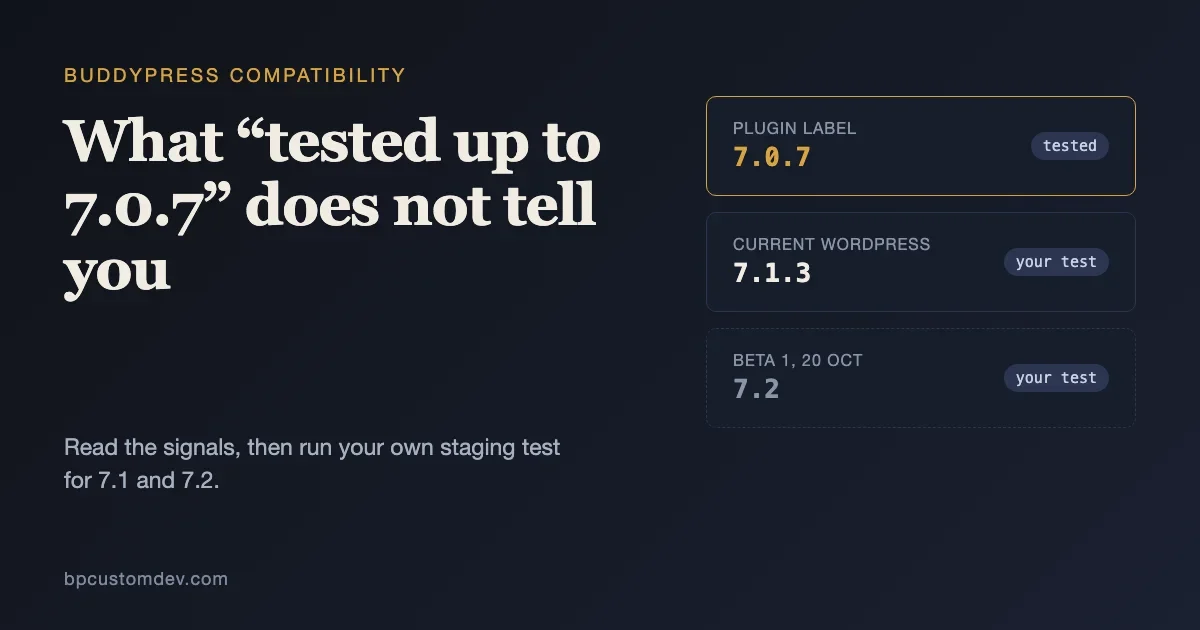
The current stable line is 7.1.4, released on 28 October 2026. A third-party roundup from SmartWP puts 7.2 release candidate 1 on 17 November and the final release on 8 December 2026, and says the 7.2 beta announcements so far focus on Notes, not live co-editing. We did not find that schedule on an official page, so treat the dates as reported, not confirmed.
What is the status of real-time collaboration right now?
The newest official word we found is a core team post from 18 September 2026, Moving to a server-aware approach for collaboration, by Chris Zarate. It argues that collaboration should be server-aware: instead of browsers passing edits to each other, updates go through WordPress, which records who changed what, checks authorization, merges, and stores the result.
It compares three engines for doing that. A Yjs engine keeps a CRDT document on the server. An intent-log engine keeps an ordered list of operations such as “move this block”. A third approach, called distributed editing, merges three-way on save or autosave. The authors say the work is “not ready for Core inclusion today”, name no target release, and describe their plugin, built in a gutenberg-sync-engines repository, as an exploratory tool.
Our reading: the idea of live co-editing is alive, the specific design that was in the Gutenberg plugin in spring is being reconsidered, and nobody has committed to a release. Anyone who tells you it lands in a specific WordPress version is guessing.
Timeline, with sources
Date | Event | Source |
|---|---|---|
1 Apr 2026 | Dev note on building a custom sync provider (updated 12 May) | |
8 May 2026 | Real-time collaboration removed from 7.0 | |
8 May 2026 | Hosting performance results published for future work | |
20 May 2026 | WordPress 7.0 released without it | |
3 Jun 2026 (updated 21 Jul) | Outreach effort for 7.1; update says it was removed from 7.1 | |
19 Aug 2026 | WordPress 7.1 released, feature not enabled | |
18 Sep 2026 | Server-aware approach proposed; no target release |
What is a sync provider, and does it exist in core?
A sync provider is the transport layer of the editor’s collaboration design. The editor keeps a shared Yjs document for the post being edited, plus “awareness” data such as who else is in the post. The provider moves that data between browsers.
The April dev note describes a client-side filter named sync.providers that lets a plugin replace the default transport. The default was HTTP polling that batches updates, sending a request every four seconds when you edit alone and every second when collaborators are present, with both intervals filterable. A provider creator receives the object type (for example a post), the object ID, the Yjs document and the awareness object, then returns an object with destroy() and on() methods. It reports connecting, connected and disconnected states.
The note names y-websocket as the most widely used option, says hosts including WordPress VIP have deployed it, and does not recommend y-webrtc unless you can run the servers it quietly depends on. It also puts authorization squarely on whoever runs the provider: short-lived tokens from a WordPress REST endpoint, checked on the server for every connection and every document.
The important caveat is where this lives. The removal pulled the real-time code out of WordPress core. You can still try collaboration through the Gutenberg plugin, where the outreach post says it can be switched on under Settings, then Writing, and where the core team says a separate feature plugin is not currently feasible. So today the sync provider filter is a Gutenberg plugin API tied to an experiment whose design is under review, not a stable WordPress API you can ship a product against.
Code, as documented (checked on 15 Nov 2026)
The shape below follows the April dev note: register on sync.providers, ignore the default creators, return your own. We have not run it against a live editor, because there is no stable core feature to run it against, and the Gutenberg plugin experiment may have changed since the note was written. The server URL is a placeholder.
import { addFilter } from '@wordpress/hooks';
import { WebsocketProvider } from 'y-websocket';

addFilter( 'sync.providers', 'my-plugin/websocket', () => [
	async ( { objectType, objectId, ydoc, awareness } ) => {
		const room = `${ objectType }/${ objectId }`;
		const provider = new WebsocketProvider(
			'wss://sync.example.com',
			room,
			ydoc,
			{ awareness }
		);
		return {
			destroy: () => provider.destroy(),
			on: ( event, callback ) => { /* map provider events to connecting, connected, disconnected */ },
		};
	},
] );
Do not put this in a production plugin yet. If you want to learn the model, read the dev note and the WordPress VIP reference plugin it mentions, and wait for a stable release.
Does real-time collaboration affect BuddyPress at all?
Directly, very little, and the reason is structural. The collaboration work targets the block editor editing a WordPress entity such as a post. The dev note’s examples use object types like postType/post. BuddyPress activity updates, private messages, group membership and notifications are not edited in the block editor. Activity items live in BuddyPress’s own tables and are posted from front-end forms. As far as we can tell from the published design, nothing in the editor sync layer touches them. That is our inference from the architecture, not a statement from the BuddyPress team.
So there are two separate things that people keep merging:
- Editing a document together. Two people in the same block editor screen, seeing each other’s cursors. That is the feature that was pulled. It would only help BuddyPress sites where members or staff edit WordPress posts in the block editor, for example staff writing help articles or a custom post type for group resources.
- Live community behaviour. A new activity item appearing without a refresh, a typing indicator, who is online, a live notification count. That never depended on this work. It is ordinary front-end engineering on polling, the Heartbeat API, server-sent events or WebSockets, and it is available on any current WordPress version.
BuddyPress itself is in a calm stretch. The wordpress.org API on 15 November reports BuddyPress 14.5.4, updated 23 October 2026, with more than 90,000 active installs and a “tested up to” value of 7.1.4. Nothing in that listing mentions collaboration. If you are weighing where the platform is heading, our honest look at BuddyPress in 2026 covers it.
What did our April post claim that no longer holds?
We are listing these so you can spot the same claims elsewhere.
April claim | Status on 15 Nov 2026 |
|---|---|
WordPress 7.0 ships real-time collaborative editing | Wrong. Removed on 8 May, 7.0 shipped 20 May without it |
Block editor sync is built into core | Not in any released version. Testable only in the Gutenberg plugin |
A documented “Real-Time Sync Providers” handbook extension point | We found a dev note on make.wordpress.org, not a stable handbook API |
Default provider handles roughly 100 concurrent users | No source. Removed. The official tests measured request cost on hosts, not user counts |
Group docs, moderation queues, presence and gamification become real-time | Not enabled by this work. Those need their own front-end code |
“I tested the 7.0 RC on three community sites” | Replaced. Release candidates before 8 May contained a feature that was later removed |
Which BuddyPress ideas still make sense, and how do you build them today?
The feature ideas in the April post were reasonable. What was wrong was the claim that WordPress 7.0 would supply them. Here is how each one stands without the editor sync layer.
Collaborative group documents
This is the one place editor collaboration would have mattered. Documents in a BuddyPress group usually come from the BuddyPress Docs add-on, a separate plugin. Its wordpress.org listing on 15 November shows version 2.2.7, last updated 19 March 2026, about 6,000 active installs, and a “tested up to” of 6.9.11. We have not verified how its editing screen would behave with a future collaboration feature, and we would not promise it. Until a stable core feature exists, the practical option is a group document tool that already does live editing, linked from the group.
Live moderation queues
Two moderators approving the same item is a real problem, and it does not need CRDTs. A short polling refresh on the moderation screen plus a server-side claim (“being handled by Priya”) removes most collisions. We cover the human side in community moderation with AI tools and human teams.
Presence and typing indicators
Presence is a front-end feature. Keep it opt-in, off by default, and expect your host to matter: long-lived connections are where cheap shared hosting struggles. The core team’s own hosting tests, published 8 May, found that storage strategy changed per-request cost noticeably across eight environments, which is a useful warning about any real-time layer on low-end hosting.
Live events and chat
Live agendas, Q and A and chat are better served by tools built for them. We compare the options in WordPress chat plugins and BuddyPress events plugins.
Instant badge feedback
Show a toast on the page where the member earned the badge. Pushing it to every other member’s screen adds load for little gain. If you want the hook-level wiring, the BuddyPress hooks cheat sheet lists where to attach.
What does real-time collaboration need from your hosting?
Nothing yet, because nothing is switched on in core. If you test the Gutenberg plugin experiment on a staging site, know what the core team measured. Their performance results post covers eight hosting environments across shared, shared with Redis, managed cloud and no object cache setups. The headline: a custom-table storage design with a transient-style cache beat the release-candidate approach of storing sync state in post meta, and it was recommended as the default for further testing. Stated figures were about 52 percent faster on average for the custom table with transients and about 37 percent faster for the plain custom table, compared with the post meta baseline. With a persistent object cache both transient-based options dropped to one database query per request.
What this means for a community site owner is simple. Persistent object caching helps, post meta is an expensive place to keep high-churn state, and you should not turn on an experiment on a busy production community to find out.
Would your community benefit from live co-editing at all?
Before you wait for the feature, check whether you have the problem it solves. Live co-editing helps when several people regularly work on the same long document at the same time. That describes an editorial team, a documentation group or a study cohort writing a shared guide. It does not describe a typical forum, a membership directory or a local interest group.
Ask three questions. How often do two members edit the same page in the same hour? What do they use today, and why have they not moved it into your site? And would they notice if edits merged only on save? Most communities answer “rarely”, “a shared document tool”, and “no”. In that case the real gap is usually discoverability or moderation, and fixing those will do more for activity than any editor feature.
One more point from the September post is worth keeping in mind. A server-aware design records who changed what and checks authorization on every change. For a community with private groups, that is the property you would want before letting members edit shared content. A design that cannot say who changed a paragraph is a poor fit for a space with rules.
What should a BuddyPress site owner do right now?
- Do not plan a launch or a marketing line around “real-time editing in WordPress”. It is not shipping in a version you can name.
- Update to a current release on the 7.1 line. The reason is the usual one, fixes and security patches, not collaboration.
- If you want to experiment, use a staging copy with the Gutenberg plugin and read the 3 June outreach post first. Report problems in the open issue tracker, not in a support thread.
- For features your members would notice, such as live notifications, presence or chat, build or buy them as front-end features that work today.
- Recheck the make.wordpress.org core blog around each major release. The 7.2 roadmap is the place a real decision would appear.
What should BuddyPress plugin developers do?
- Do not register a
sync.providersfilter in a released plugin. The API sits behind an experiment and the design is being reconsidered. - Keep your own live features independent of the editor. If a stable core feature arrives, you can adapt a single integration point.
- Treat authorization as yours. The dev note is explicit that WordPress cannot authorize requests to infrastructure outside it, so a custom transport needs its own short-lived tokens checked per connection.
- Watch the Gutenberg repository for meta box and custom block behaviour. Issues there show what breaks first, covered in the next section.
Common mistakes people report
These come from the core team posts and the Gutenberg issue tracker. All links were live on 15 November 2026, and we have paraphrased each one.
- Assuming it is in 7.0 or 7.1. Articles and plugin pages written before 8 May promised it. The 7.1 Field Guide says it is not enabled in the final release.
- Expecting legacy meta boxes to work. A January issue reports the TinyMCE editor in a post meta box failing to initialize in the block editor (#74627). Another asks for a filter to override the meta box safety check (#76940).
- Missing silent failures. Issue #78093, opened 8 May, describes incompatible meta boxes switching the collaboration interface off while sync kept running, so users saw no errors, including when a per-room peer limit was hit.
- Turning it on for every post type. People asked for a way to limit collaboration to specific post types (#75072), since a membership site rarely wants it on every custom type.
- Custom blocks breaking when a second editor joins. One commenter on the removal post reported an error in custom blocks at that moment. The post did not respond to it, so treat it as one unconfirmed report.
- Building a provider without authorization. The dev note warns that a plain WebSocket server with no token check lets anyone who finds the room name read the document.
Where does our own stack fit?
We build community products, so here is where we honestly sit. Our BuddyNext community platform and the Reign and BuddyX themes do not depend on the editor sync work, and we are not shipping co-editing on top of an unreleased feature. If you run BuddyPress, our add-ons for it are in maintenance mode, which means fixes for compatibility but no new features promised. If you need live behaviour in a community today, that is front-end work, and it is something our team does as custom development. The cons are the usual ones: custom real-time features cost more to run than static pages and need monitoring.
Frequently asked questions
Is real-time collaboration in WordPress 7.0?
No. It was removed on 8 May 2026 and 7.0 shipped on 20 May 2026 without it.
Is it in WordPress 7.1?
No. The 7.1 Field Guide says it was tested during the cycle but is not enabled in the final release.
Can I still try real-time editing?
Yes, in the Gutenberg plugin, where the core team says it can be enabled under Settings, then Writing. Use a staging site. It is an experiment, and its design is being reconsidered.
Does real-time collaboration make BuddyPress activity feeds live?
No. Activity feeds are not edited in the block editor. Live feeds need their own front-end code on any WordPress version.
Is the sync.providers filter safe to build on?
Not yet. It is documented in a dev note, it sits behind an experiment, and the September post proposes a different server-aware design.
Which WordPress version will get it?
No official source names one. The 18 September post gives no target release.
Do I need WebSockets for BuddyPress real-time features?
Not necessarily. Polling and the Heartbeat API work on ordinary hosting. WebSockets give lower latency but need a host that allows long-lived connections.
Sources checked on 15 November 2026
- Real-time collaboration will not ship in WordPress 7.0, make.wordpress.org, 8 May 2026
- Building a custom sync provider for real-time collaboration, 1 April 2026, updated 12 May
- Results: Real Time Collaboration performance testing analysis, 8 May 2026
- Collaborative editing outreach effort for 7.1, 3 June 2026, updated 21 July
- WordPress 7.1 Field Guide, 5 August 2026
- Moving to a server-aware approach for collaboration, 18 September 2026
- WordPress 7.0 Armstrong and WordPress 7.1 Mary Lou release posts
- SmartWP, WordPress 7.1 roundup (secondary source, used only for the 7.2 schedule)
- wordpress.org plugins API for BuddyPress and BuddyPress Docs, queried 15 November 2026