Community Moderation in 2026: AI Tools, Human Teams, and What Actually Scales
AI community moderation in 2026: the tools you can still use (OpenAI, Akismet, Hive, Perspective API ends 31 Dec 2026), a tiered human review ladder, moderator roles and what the DSA and UK Online Safety Act expect.

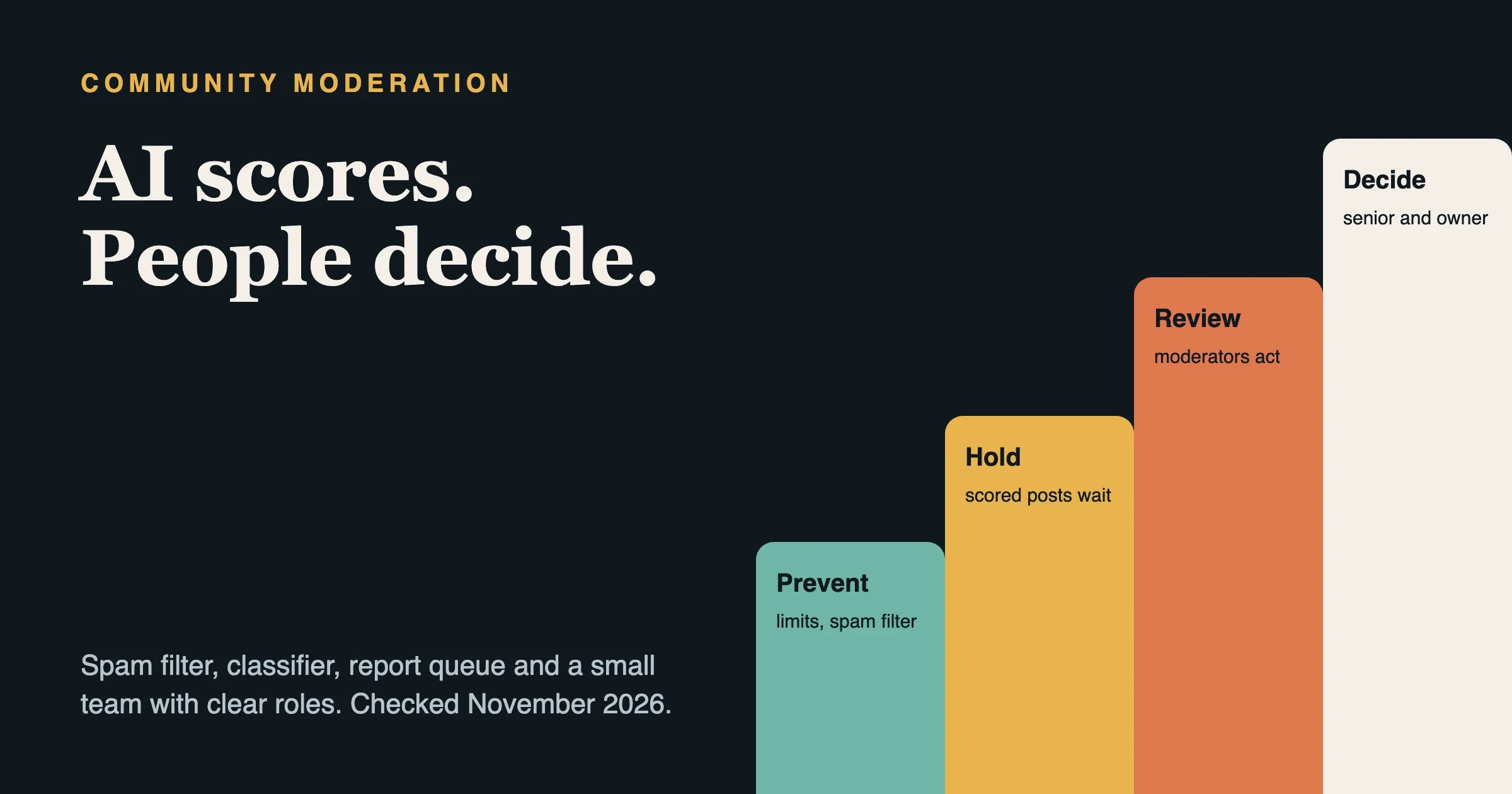
The best AI community moderation setup in 2026 is not one platform. It is three layers: a spam filter for the obvious junk, a classifier or language model that scores what is left and holds the risky posts, and a small human team that makes every final call on bans, disputes and anything borderline. Tools can cut the queue a moderator sees. They cannot replace the person who decides whether a heated reply is a joke between regulars or the start of a pile-on. We checked every tool and law named below on 15 November 2026 against the vendor’s own pages, WordPress.org and the regulators.
People reach this page searching for things like “ai community moderation platform”, “automated community moderation”, “ai online community forum moderation” and “community moderation software”. Those are the four questions this guide answers, in that order, and then it covers the human side, the legal side and the mistakes site owners keep reporting.
What is the best AI community moderation platform?
For a WordPress or BuddyPress community, the honest answer is a stack, not a product. Here is the shape we recommend to most site owners, and the reason each layer exists.
- Prevention. Registration limits, email verification, rate limits on new accounts and a spam filter such as Akismet. This stops the bulk of low-effort abuse before a person ever sees it.
- Scoring. A classifier (the OpenAI moderation endpoint, Hive) or a language model reads each new post and returns a score or a label. Nothing is deleted at this stage. Risky posts are held.
- A report button and a queue. Members spot things scoring misses. Every report lands in one queue that moderators can filter and sort.
- People with clear roles. Moderators act on the queue, a senior moderator handles disputes, and one named owner handles anything legal.
- A written policy and an appeal path. Without these, the other four layers just produce unexplained removals.
If a vendor sells you a single “AI moderation platform” that skips layers three to five, ask what happens to a member whose post was removed by mistake. That answer tells you more than the feature list.
Which AI moderation tools can you use in 2026?
Prices and status below were read from each vendor’s page on 15 November 2026. Where a page shows a price in a local currency or hides it behind sales, we say so instead of guessing.
Tool | What it does | Price as read on 15 Nov 2026 | Main catch |
|---|---|---|---|
OpenAI moderation endpoint | Scores text and images against 13 categories such as harassment, hate, illicit, self-harm, sexual and violence | The documentation states the endpoint is free to use | Nothing about your own rules. It does not know that a sharp joke is normal in your group |
Akismet | Spam filter for comments and forms, with a shared dataset across many sites | Personal plan is pay what you can for personal sites. Commercial plans are paid and the pricing page shows them in your local currency | Built for spam, not abuse or harassment. Legitimate posts do get flagged, which the support forum shows |
Hive Moderation | Classifiers for text, images and video | Hive’s pricing page now redirects to deploy.com/pricing, which lists text moderation at $0.50 per 1,000 requests and visual moderation at $3.00 per 1,000. The base tiers are capped at 100 requests a day and higher limits mean talking to sales | Cost grows with volume, and the daily cap on base tiers means a busy community needs a sales conversation |
Google Perspective API | Toxicity scoring | Free, but shutting down | Service ends on 31 December 2026 with no migration help, so do not build anything new on it |
A general language model (Claude, GPT) | Reads a thread in context and explains its reasoning | Billed per use by the provider. Check the provider’s current price page | Slower and costlier than a classifier, and not always consistent from one run to the next |
Is Google Perspective API still available?
Not for long. The Perspective API site says the service stays active until 31 December 2026 and will not be in service after 2026. New usage and quota requests stopped being accepted after February 2026, there are no extensions, and Jigsaw is not offering migration support. If a plugin or script you run calls Perspective, plan its replacement now. A language model with your own rules, or the OpenAI endpoint as a first pass, are the two options we see site owners move to.
Does Akismet work for community moderation?
It works for spam. On WordPress.org it shows more than 5,000,000 active installs, a 94 out of 100 rating from 1,186 ratings, version 5.7.2 last updated on 18 August 2026 and tested up to WordPress 7.1.4. Those numbers say it is well maintained and widely used. They do not say it will catch a member who is being quietly unpleasant to another member, because that is not what it was built to do. Use it as layer one and nothing more.
How do you call a moderation API from a WordPress site?
The request is small. This is the shape of a call to the OpenAI moderation endpoint, checked against the current documentation on 15 November 2026. Send the text of a new post, read the category scores in the response and compare them with a limit you set from your own sample of past posts.
curl https://api.openai.com/v1/moderations \
  -H "Content-Type: application/json" \
  -H "Authorization: Bearer $OPENAI_API_KEY" \
  -d '{"model": "omni-moderation-latest", "input": "text of the new post"}'
Two practical points. First, the documentation says some categories are text only, so an image on its own scores zero for them. Second, member posts leave your server when you do this, so your privacy notice must say which provider receives them. Our guide to what community platforms keep about member data covers the wording.
How does automated community moderation work in practice?
Automated moderation means software decides, without a person, what happens to a post first. The useful version of that sentence has one limit: software may hold or hide a post, and only a person removes it for good or sanctions a member. Here is the ladder we use when we set this up for a community.
Tier | What happens | Who or what acts | Typical outcome |
|---|---|---|---|
0 Prevention | New-account limits, spam filter, link limits, rate limits | Software | Junk never appears |
1 Auto-hold | A score crosses your limit, so the post waits for review | Software holds, person reviews | Post approved or removed within your target time |
2 Moderator action | Reported or held posts are reviewed against the written policy | Moderator | Approve, edit, remove, warn or mute |
3 Senior review | Repeat offenders, disputes, appeals, anything that involves a staff member or a long-standing member | Senior moderator | Suspension, ban or reversal of an earlier call |
4 Owner or legal | Threats, illegal content, requests from authorities, press | Named owner, with advice where needed | Report to the right body, preserve records |
Tier one is where most of the saved time comes from. A moderator who opens a queue of forty held posts, rather than reading every new post in the community, does the same job in a fraction of the time. The limit for what gets held should come from your own data: pull a few hundred past posts, mark the ones you would have removed and see where the scores fall. Vendor defaults are a starting point only.
Instrument before you automate. Count, for two weeks, how many posts are reported, how many reports are upheld and how long each takes. Those three numbers tell you whether you have a volume problem, a policy problem or a staffing problem. Automation helps only the first.
What can AI moderation not do?
It cannot settle the cases people actually argue about. A study of moderation logs from 24 subreddits over five years, accepted at ICWSM 2026, found that one in seven moderation cases was disputed among the human moderators themselves. Disputed cases often involved trolling, brigading and unclear intent. Nearly half of the disputed cases involved automated moderation decisions, and the authors report that current language models struggle with them. Their conclusion is that expert human moderators are essential for overseeing moderation. The study is on arXiv (2601.01620).
That fits what we see in smaller communities. A rule that works in a tech support forum fails in a hobby group, because the register is different. A model has no way to learn your register from a policy page. It learns it from your past decisions, which means someone has to make and record those decisions first.
- Context. Profanity between old friends is not harassment. A polite message sent forty times to the same person is.
- Intent. Sarcasm, quoting a rule-breaking post to criticise it and in-group jokes all read as violations to a classifier.
- Accountability. A member who is banned wants a person to answer. “The system decided” ends trust quickly.
- Changing norms. Your community’s standards move. A model trained on last year’s calls will not follow.
What should community moderation software include?
Before you buy or install anything, check it against this list. A tool that covers the first six rows is usable. One that skips the report queue or the audit log will cost you the time it saves.
Feature | Why it matters | How to test it |
|---|---|---|
Report button on every post, comment and profile | Members find what scoring misses | Report three different content types and see all three arrive |
One queue, filterable and sortable | A moderator can work the worst items first | Filter by type and sort by most reported |
Roles with limited scope | A volunteer should not see settings or private messages | Log in as a moderator and try to reach the settings screen |
Hold before publish for new members | Stops the first-post spam wave | Register a new test account and post |
Reason and record for every action | You can answer an appeal and spot a moderator who is too harsh | Remove a post and look for who, when and why |
Notice to the member | The law in some places requires a reason, and fairness does either way | Check what the member receives |
Moderator alerts that do not flood | Burnout starts with a noisy inbox | |
Export | You can leave the tool later | Export the queue history to a file |
Which WordPress tools fit a community site?
We build on WordPress, so this is the part where we are least neutral. Read it as one team’s view and check the product pages yourself.
BuddyNext. This is the community platform we are building for new sites, and it is where we point people starting fresh. Its product page lists moderation tools in the free plan, a reports queue that administrators and community moderators work from the front end (filterable by type and sortable by most reported) and a moderation tab for each space owner. AI moderation and auto-moderation are Pro features. The Pro plans are listed at $149 a year or $399 lifetime for one site, $249 a year or $599 lifetime for five sites and $399 a year or $999 lifetime for unlimited sites (read on 15 November 2026). The cons: it is a newer platform than BuddyPress, so the third-party add-on market around it is smaller, and the page does not list the moderation roles by name, so check what a space moderator can and cannot reach before you hand out the role. Product page: BuddyNext on Wbcom Designs.
BuddyX and Reign. These are our themes. They style the community. They do not moderate it, so the moderation layer always comes from the plugin underneath. Pick the theme for look and speed, and judge the moderation by the plugin. Reign is a community-focused theme, and BuddyX is at buddyxtheme.com.
BuddyPress Moderation Pro. We make it, and it fits an existing BuddyPress site that needs a report button, a review queue and suspension for members. The con you should weigh: we do not plan new features for it, so for a fresh build we send people to BuddyNext. Our full write-up is in the BuddyPress Moderation Pro review. BuddyPress core does not include a report queue of its own, which is why add-ons exist.
Trust levels for forums. If your community is forum first, a trust-level system that gives new members fewer powers and established members more is one of the cheapest ways to shrink the queue. We walk through one approach in building a self-moderating forum with trust levels. For a wider comparison of forum software, see the forum plugin guide.
Outside WordPress. Discourse has an AI triage feature, and its forum staff have said LLM auto-flagging can be paired with automation, according to a 2024 thread on Discourse Meta. We have not tested it for this guide, so treat that as a pointer, not a review.
How do you build a human moderation team?
Start with how much moderation there is, not with who is available. Count reports per week from your instrumented fortnight. If one person can clear the queue in under an hour a day, you need one lead and one backup. If not, you need a rota.
Which moderator roles do you need?
- Lead moderator. Owns the policy, trains others and handles appeals.
- Moderators. Work the queue. They can hide, edit and warn, but they cannot ban without a second opinion.
- Space or group moderators. Members trusted with one corner of the community. They need tools scoped to that space and nothing else.
- Named owner. The one person who talks to authorities and signs off on anything legal.
Volunteers or paid? Both work, with different promises. Volunteers from your own membership understand the register, and they leave the day the job stops being fun. Paid moderators are more reliable on hours and less familiar with in-jokes. Many communities pay a lead and keep volunteers for spaces. Whatever you choose, write down what a moderator may do alone and what needs a second person.
How do you stop moderators burning out?
Burnout comes from volume, from abuse aimed at moderators and from decisions with no backup. You can design against all three.
- Give every action a policy line to point to, so a ban is the rule’s decision, not the moderator’s.
- Let moderators hand a case up without losing face. A senior review tier is a relief valve.
- Hide graphic reports behind a click and rotate who reviews them.
- Keep moderator alerts to a digest unless something is urgent.
- Give moderators a place to talk about hard cases that members cannot see.
What does the law expect from a community owner?
This is not legal advice. It is a plain summary of what two major regimes ask of a site that hosts member posts, and it tells you what to ask a lawyer.
What does the EU Digital Services Act ask for?
The Digital Services Act applies to online services that reach people in the EU, wherever the owner is based, and its provisions have applied since 17 February 2024 under Article 93. Three duties matter to a community. A hosting service must give people a way to report illegal content and must respond to reports (Article 16). When it removes or restricts content, it must tell the member why (Article 17, a statement of reasons). An online platform must also offer an internal complaint route against its moderation decisions (Article 20). Article 19 excludes micro and small enterprises from the online platform section, which covers that complaint route, but the hosting duties for reporting and statements of reasons still apply to them. The European Commission summary of the Digital Services Act package describes the notice, reasons and appeal mechanics, and the regulation text is on EUR-Lex.
What does the UK Online Safety Act ask for?
The Online Safety Act covers services where users share content with each other. Ofcom’s guidance for small services lists what applies for illegal content: a suitable and sufficient risk assessment, terms and conditions that are easy to find and understand, a tool for users to report illegal or harmful material with a process to handle complaints, the ability to review and quickly remove content you have reason to believe is illegal, and a named person Ofcom can contact about compliance. There is no blanket exemption for small services. Ofcom says the heaviest duties fall on the largest and highest-risk services, that it will take a reasonable approach with small low-risk services, and that it is not setting out to penalise small, low-risk services trying to comply in good faith. Read the source: Ofcom guidance for small services under the Online Safety Act (last updated 17 December 2025 when we read it).
In practice both regimes ask for the same four things from a community: a way to report, a reason given when you remove something, a way to complain and a person who is responsible. The tier ladder above already gives you those, which is why we build it first.
Common mistakes people report
These come from public threads and reporting we read on 15 November 2026. We paraphrase them and link each one so you can read the original. They are individual reports, not statistics.
- Letting a score remove a post. A Discourse Meta member wrote in September 2025 that a new user whose post is wrongly flagged or who is wrongly suspended will likely leave, and that algorithms struggle with subjective cases. Fix: hold, do not delete, and tell the member how to appeal. Source: Discourse Meta thread.
- Scanning every post with a language model. In March 2024 a forum admin on the same thread called always-on AI monitoring expensive in both hardware and usage fees and said AI needs a human watching it. Fix: use a free or cheap classifier first and send only the unclear posts to a model.
- Trusting IP matching to spot duplicate accounts. The same thread warns that many legitimate users share an IP address. Fix: use IP as one signal for a human to check, never as grounds for an automatic ban.
- Treating Akismet as a harassment filter. The Akismet support forum has repeated threads from site owners whose real comments or form entries land in spam, from six to eight months before our read. Fix: check the spam folder on a schedule and keep a way for a member to say a post was wrongly held. Source: Akismet support forum.
- Building on a tool that is about to close. Perspective API ends on 31 December 2026, and plugins and scripts that call it will stop scoring. Fix: move to another classifier or a model with your own rules now. Source: Perspective API sunset notice.
- Leaving a mass removal unchecked. In August 2026 a gaming and tech outlet reported that moderators of r/AskHistorians traced the removal of a decade of posts to Reddit’s recently overhauled AI moderation tooling. The cause is the moderators’ account and Reddit had not responded to the outlet’s request for comment. Fix: keep removals reversible and review any sudden spike in removed content. Source: eGamers report.
How do you set a moderation policy that works?
Start with the policy and pick tools afterwards. A policy that fits on one page does more than a hundred-rule document nobody reads.
- Say what the community is for. Every rule should trace back to that sentence.
- List what always gets removed. Illegal content, threats, doxxing and spam. Keep this short and fixed.
- List what needs judgement. Heated arguments, self-promotion, off-topic posts. Give two real examples of each side.
- Describe the ladder. Warning, temporary mute, suspension, ban. Members should know where they stand.
- Publish the appeal route. A name or an address, and a time you aim to answer in.
Then close the loop. Every month, read the appeals you upheld and the reports you rejected. Each one is either a gap in the policy or a moderator who needs coaching. Feed the findings back into the policy page and tell members what changed. In our experience, explaining enforcement in plain words gives members less to argue about, and it is the step teams most often skip.
What scales and what does not?
Scales well | Does not scale |
|---|---|
Spam filters and new-account limits | One person reading every post |
Scoring that holds posts for review | Scores that delete without review |
Trust levels that grow with membership | Moderator powers handed to everyone who asks |
A written policy with examples | Rules held in the lead moderator’s head |
A senior review tier and a rota | A single volunteer who is always on call |
The pattern is the same in every row: software handles volume, people handle judgement, and the written policy connects them.
Frequently asked questions
Can AI fully replace human moderators?
No. The Reddit study above found that language models struggle with the disputed, unclear-intent cases, and those are the cases that cause the most trouble. AI can take the queue down. A person still decides.
Is the OpenAI moderation API really free?
The OpenAI documentation states the moderation endpoint is free to use, as read on 15 November 2026. Policies change, so check that page before you build a budget around it.
What is the cheapest way to start automated moderation?
Turn on a spam filter, add new-member post holds, add a report button and use the free OpenAI endpoint to score held posts. That costs setup time and not much else, and you can add paid tools after you have your own numbers.
Do small communities need to follow the DSA or the Online Safety Act?
If you serve people in the EU or the UK, the rules can apply to you however small you are. Micro and small enterprises are excluded from some DSA duties, and Ofcom says it will take a reasonable approach to small low-risk services, but both still expect a way to report illegal content. Ask a lawyer about your own case.
Which moderation tool should a new BuddyPress or BuddyNext site start with?
For a new site we would start with BuddyNext and its free reports queue, add a spam filter and write the policy page before launch. For an existing BuddyPress site, add a report queue plugin and the tier ladder above. If you want a hand setting either up, our team at BP Custom Dev does this work.
Facts and prices in this guide were checked on 15 November 2026. Vendors change pages without notice, so confirm the figure that matters to you before you rely on it.