How to Start a Paid Online Community for Your Coaching Business in 2026

You got into coaching because you wanted to help people transform their lives. What you probably did not expect is that one-on-one client work has a ceiling, and at some point you hit it. Your calendar fills up, your rates plateau, and you are still trading hours for dollars. A paid online community solves that. It gives your students a place to work together, hold each other accountable, and get your guidance at scale, while you earn recurring revenue that does not reset to zero every month. This guide walks you through the exact six steps to launch yours, from defining what you are selling to getting your first 30 members active and paying.
Updated September 2026.
In this guide
- Why Paid Communities Work Better Than Courses for Coaches
- Step 1: Define Your Community Offer Before You Touch a Platform
- Step 2: Set Pricing Tiers That Grow With Your Members
- Step 3: Connect Payment Processing Without Creating Friction
- Step 4: Choose Your Platform Based on Your Operating Model
- Adding a Structured Curriculum Without Losing the Community Feel
- Step 5: Build Your Onboarding Flow So Members Stay Past Month One
- Step 6: Your First 30-Day Playbook After Launch
- Pricing the Curriculum Separately or Bundling It In
- Common Mistakes That Stall Community Growth
- When to Hire Your First Community Manager
- How to Validate Demand Before You Build Anything
- Start Small, Stay Focused, Compound Over Time
Key takeaways
- Paid communities beat one-off courses for coaches: predictable MRR, lower churn, and peer accountability drive better member outcomes.
- Define your offer, the specific member, the transformation, the weekly rhythm, before you choose a platform.
- Use a three-tier pricing structure (Entry/Core/VIP), an annual discount, and a capped founding-member cohort at launch.
- Retention is won in the first 14 days: a welcome sequence, a first-win ritual, a buddy system, and visible progress milestones.
- Validate demand with a pre-sale before you build anything, 10+ genuine “yes” responses is the bar before you commit to a platform.
Why Paid Communities Work Better Than Courses for Coaches
Online courses have a dirty secret: completion rates average between 5 and 15 percent. Buyers download the files, watch the first module, and drift away. You get a one-time payment and a refund request ninety days later.
A paid community is structurally different. Members pay monthly or annually to stay inside. They show up because other members are there. The transformation happens through peer accountability, not just through consuming your content. You benefit in three ways:
- Predictable monthly recurring revenue (MRR) instead of launch spikes and valleys
- Lower churn because social connections make leaving feel like giving something up
- Better outcomes for members, which means better testimonials and word-of-mouth growth
The combination of financial stability and genuine client outcomes is why most established coaches who make the switch never go back to selling courses alone.
Selling Both the Community and the Curriculum
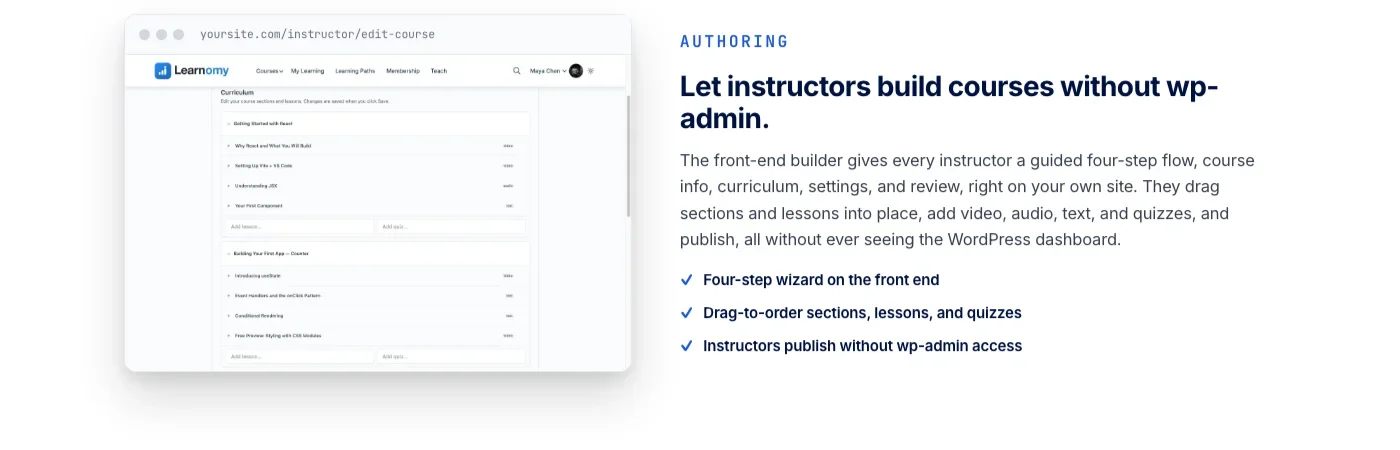
Most coaching communities eventually need a structured course alongside the discussion, whether that is a foundations module every new member works through or a certification track for your most advanced members. Learnomy is a complete learning platform with a drag-and-drop front-end builder, so you can build that curriculum without waiting on a developer, and without bolting a separate LMS onto the community platform you are about to choose. That front-end, drag-and-drop workflow matters beyond convenience, it is the difference between you (or a team member) actually building the curriculum versus everyone waiting on whoever knows wp-admin, see our piece on not having to learn new software just to build a course for why that gap matters.
Step 1: Define Your Community Offer Before You Touch a Platform
The biggest mistake coaches make is signing up for a platform on day one and then trying to figure out what they are building. Platform choice should be one of the last decisions you make, not the first.
Start with three questions:
Who is the specific member?
Not “coaches” or “women over 40.” Go tighter. “Health coaches who finished a certification in the last 18 months and have signed their first three clients but do not know how to get to ten.” The narrower your avatar, the easier it is to write a sales page, set a price, and create content that lands.
What is the transformation they pay for?
Write it as a before-and-after statement. “Before: I have 1-2 clients and work a side job. After: I have a full roster of 10 clients, consistent $5,000 months, and a waitlist.” That sentence becomes your headline, your sales copy, and your retention hook.
What do they do inside every week?
Your community needs a weekly rhythm that makes the transformation inevitable. A typical structure for a coaching community looks like this:
- One live group call per week (60-90 minutes)
- One async hot-seat thread where members submit wins, blocks, and questions
- One resource drop: a template, script, checklist, or short training video
- A daily or weekly accountability check-in thread
Write this rhythm down before you price anything. It tells you how much of your time the community will consume, which directly informs your pricing floor.
Step 2: Set Pricing Tiers That Grow With Your Members
Single-price communities leave money on the table and exclude people who would be great long-term members. A tiered structure captures both. Before you finalize numbers, it helps to understand exactly how to charge members a monthly fee through your chosen platform, so your pricing model and payment setup stay aligned from day one, and if part of your offer includes gated course access, see our guide on gating forum access behind course enrollment.
The Three-Tier Framework
Entry tier ($29-$79/month): Community access, the weekly resource drop, and the accountability threads. No live calls. This tier works for members who are in research or early-action mode. It funds the community while you grow and gives you a pool of people to upgrade.
Core tier ($99-$249/month): Everything in Entry plus access to the weekly group calls. This is where most of your members land. It is priced based on the outcome value, not your time cost. If joining a weekly call reliably adds one client per month, and clients are worth $500, charging $149 is not aggressive, it is logical.
VIP tier ($299-$499/month or $2,500-$5,000/year): Everything in Core plus a monthly one-on-one session, direct message access, or priority review of their work. This tier is for members who want to move faster and are willing to pay for proximity to you.
Annual Pricing
Offer an annual option at two months free (ten months of price for twelve months of access). Annual members churn at roughly half the rate of monthly members. Even a small percentage choosing annual dramatically improves your cash flow and reduces the administrative stress of monthly payment failures.
Founding Member Pricing
Before you launch publicly, sell a founding member cohort at 40-50% below your public price, with that rate locked in as long as they stay active. You get early cashflow and social proof. They get a deal they will tell others about. Cap it at 20-30 spots to create scarcity without underselling yourself.
Step 3: Connect Payment Processing Without Creating Friction
Payment friction kills conversions. A member who wants to join and hits a confusing checkout abandons and does not come back. The right payment setup is also the foundation for everything beyond subscriptions, if you plan to add sponsorships or affiliate layers later, review how to monetize a WordPress community before you commit to a payment stack that limits those options.
Stripe as Your Default
Stripe handles subscription billing, automatic retry logic for failed payments, pro-rated upgrades between tiers, and tax collection in most jurisdictions. It connects natively to every major community platform. Unless you are selling exclusively to enterprise clients with invoice requirements, start with Stripe.
Dunning Management
Failed payments are the silent killer of community MRR. Set up automatic retry sequences: retry on day 3, day 7, and day 14, with an email at each attempt. After day 14, send a personal “we want to keep you” message from your own address. Platforms like Circle and tools like Churn Buster automate this. Without dunning management, you lose 5-8% of MRR to passive churn monthly.
Upgrade Paths
Make it easy for Entry-tier members to upgrade to Core with a single click. If they have to cancel one subscription and create a new one, you lose half the upgrades. Pick a platform and payment stack that handles tier changes as a native feature, not a workaround.
Step 4: Choose Your Platform Based on Your Operating Model
Now that you know what you are building, who it is for, and how it is priced, you can choose a platform that fits rather than forcing your community into a shape it was not designed for.
Here is how the four most common choices compare:
Circle
Circle is purpose-built for paid communities. It handles spaces (discussion channels), live events, courses, and member profiles in one interface. The payment and membership management is built in, so you do not need a separate tool to manage access. It works well for coaches running content-plus-community models where you are combining training modules with discussion. The per-member pricing model makes it more expensive at scale, but for communities under 500 members it is straightforward to operate.
Best for: Coaches who want an all-in-one solution with minimal setup and are comfortable with a SaaS subscription.
Skool
Skool has a strong gamification layer, with points, levels, and leaderboards built into the feed, see our full breakdown of what Skool actually costs at scale if you are weighing it against a self-hosted stack. That structure works particularly well for communities where activity and streaks matter to member experience, like fitness coaching or habit-based programs. Its classroom feature is simpler than Circle’s, and it currently takes no revenue cut on memberships. The interface is opinionated, which means you get less customization but faster setup.
Best for: Coaches running engagement-heavy programs where daily participation is the core mechanism of transformation.
BuddyPress with BuddyX Theme and MemberPress
Running a paid community on WordPress with BuddyPress, BuddyX, and MemberPress gives you full ownership of your platform, your member data, and your revenue stream. There is no per-member fee. There is no platform that can change its pricing or terms and affect your business overnight.
BuddyPress provides the social layer: activity feeds, member profiles, groups, and messaging. BuddyX provides the visual structure designed for community sites. MemberPress manages membership tiers, payment processing, and access rules.
The tradeoff is setup complexity. You are managing hosting, plugin updates, and configuration. For a coach who is also comfortable with web administration, or who is working with a developer, the long-term economics favor this stack heavily. At 200 members paying $149/month, that is $29,800 MRR. On Circle, you might pay $199-$399/month in platform fees. On WordPress with BuddyPress, your hosting and plugin costs are a fraction of that, and the gap only widens as your member count grows, since a hosting bill scales far more slowly than a per-member SaaS fee does.
Best for: Coaches who want maximum control, data ownership, and long-term cost efficiency, and who are either technically comfortable or have access to WordPress development support.
For a paid or membership community you fully control, BuddyNext is a free, standalone community platform worth a look, an activity feed, member profiles, Spaces (groups), and deep moderation in one plugin, built as its own modern architecture rather than on top of BuddyPress (so it isn’t a BuddyPress add-on and existing BuddyPress plugins won’t run on it). Because it runs on your own site you keep full ownership of member data, and its Pro tier adds native Stripe memberships when you’re ready to monetize.
Kajabi
Kajabi is the broadest tool in this list. It covers courses, email marketing, landing pages, podcasts, and communities under one subscription. If you are building a business that genuinely needs all of those channels and you want to avoid stitching together separate tools, Kajabi’s community feature works. It is not as deep as Circle or Skool for community specifically, but as part of a larger content business it reduces integration complexity.
Best for: Coaches who are building multi-channel businesses (courses, email list, community, podcast) and want a single platform bill rather than four separate subscriptions.
The Deciding Question
Ask yourself: in three years, if this community has 500 paying members, do I want to own the platform or rent it? If the answer is own, start on WordPress. If the answer is rent and move fast, start on Circle or Skool. There is no wrong answer, but be honest about which operating model fits how you work.
Adding a Structured Curriculum Without Losing the Community Feel
Most coaching communities are not pure discussion spaces. Somewhere alongside the live calls and the accountability threads, there is usually a curriculum, a foundations module every new member works through, a resource library organized in a specific order, a certification track for members who complete a program. Trying to deliver that structured content through the community platform alone (a pinned Google Drive folder, a wiki page, a scattered set of resource posts) usually breaks down once you have more than a handful of modules.
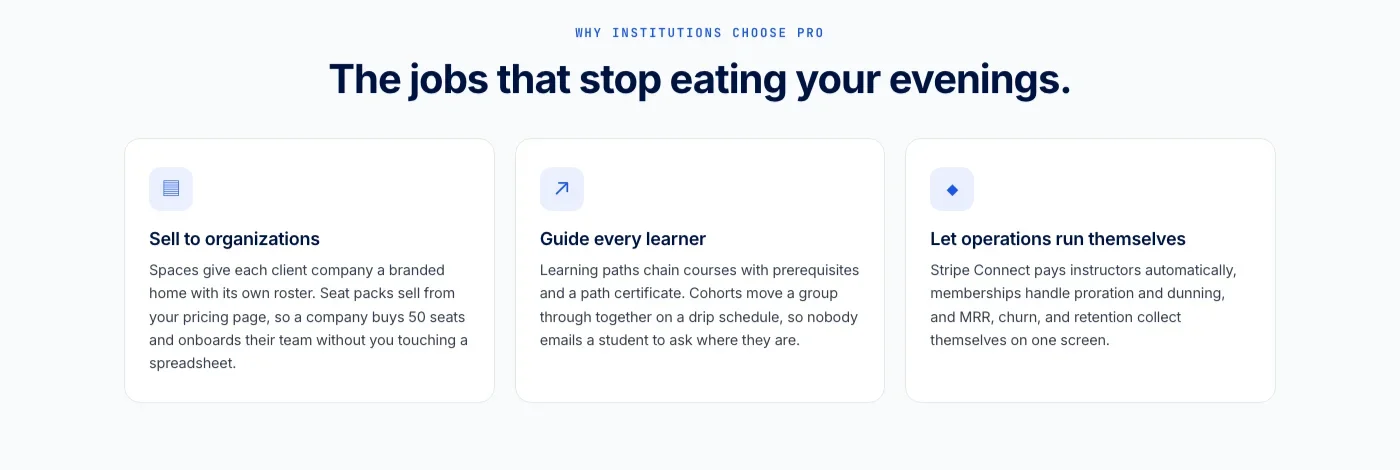
This is where the community platform and the learning platform are genuinely two different jobs, and it is worth keeping them conceptually separate even if you run both on the same WordPress site, our guides on private group chat for course students and why every course needs a discussion forum cover the community side in depth. BuddyPress, BuddyX, or BuddyNext handle the parts covered above: activity feeds, discussion, member profiles, moderation. Learnomy is a complete learning platform built for the other half of the job: unlimited courses with a drag-and-drop builder, quizzes with anti-cheat tracking, certificates your members can verify and share on LinkedIn, and direct Stripe and PayPal checkout with no platform fees if you want to sell the curriculum as a standalone product alongside your community tiers.
The two connect naturally in how members actually experience your program: they take the structured course inside Learnomy at their own pace, then bring their questions and wins into the community for live discussion and peer accountability.
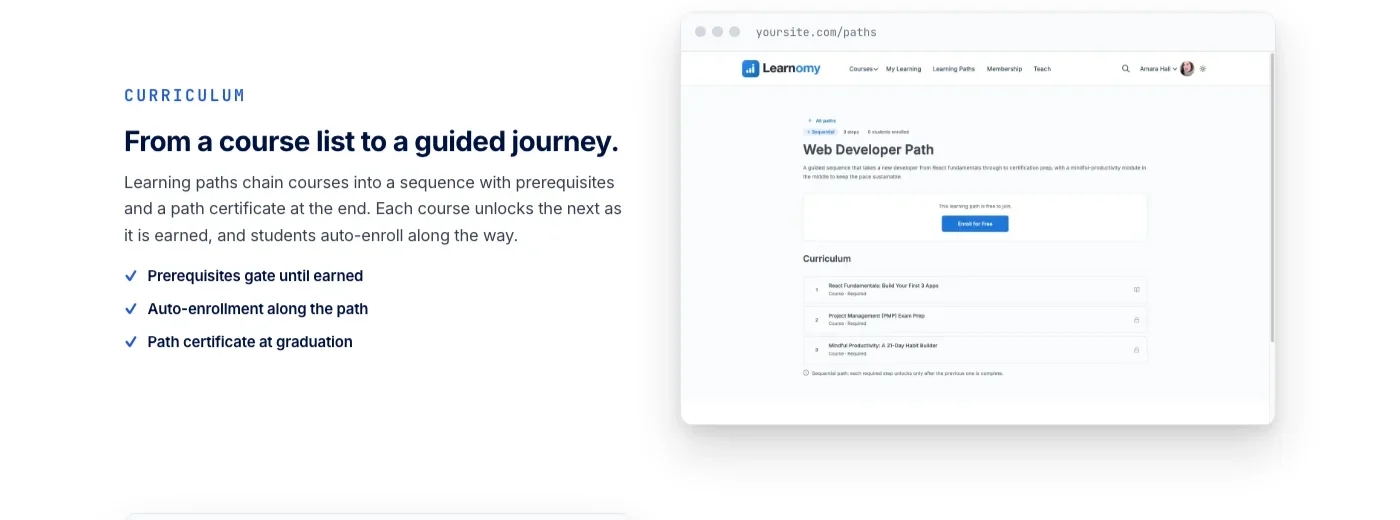
Course completion becomes a milestone worth celebrating in the feed, exactly the kind of progress marker described in the milestones section below. And because Learnomy is built by the same team, it does not stop at course delivery either, a learning community layer, discussion boards alongside your curriculum, and gamified progress with points and badges are all part of the same platform if your coaching business eventually wants the course itself to carry more of the community weight.
Step 5: Build Your Onboarding Flow So Members Stay Past Month One
Retention is won or lost in the first 14 days. A member who makes a friend, completes a first win, and understands where to find things stays for 12+ months on average. A member who joins and feels lost churns within 60 days.
Day 0: The Welcome Sequence
Send a welcome email within five minutes of payment. It should contain exactly three things: a direct link to the community, one instruction (“Your first step is to post an introduction in the Welcome space”), and a short personal video from you. Not a sales video. A genuine hello that says their name and tells them why you are glad they are there.
Set up an onboarding automation that sends five emails over fourteen days. Day 0 is the welcome. Day 2 is how to find this week’s live call time. Day 4 is where the resource library lives. Day 7 is a case study of a member who got a result. Day 14 is a direct ask to book a quick orientation call if they have not posted yet.
The First Win Ritual
Design your community so every new member can get a visible result within the first session. For a business coaching community, this might be: post your one-sentence offer in the Offers thread, get three feedback replies from existing members. That feedback is the win. It is fast, social, and reinforces that being here is valuable.
Buddy System
Pair every new member with an existing member in the same tier. The existing member earns a badge or points for the pairing. The new member gets a human connection. Both stay longer because they have a specific person watching their progress. This is one of the highest-impact retention mechanisms you can implement with zero cost.
Progress Milestones
Define four or five milestones in your community that map to the transformation. In a business coaching community: first post, first client signed inside the community, first $1,000 month, first $5,000 month, full roster. Celebrate each milestone publicly, tag the member, and pin their win to the feed for 24 hours. Every other member sees that progress is happening, which reinforces their own decision to stay.
Step 6: Your First 30-Day Playbook After Launch
The first 30 days set the culture of your community permanently. Whatever norms you establish in weeks one through four become the baseline expectation for every member who joins after. Go in with a plan.
Week 1: High-Touch Everything
Reply to every post personally. Not with a like, with a sentence or two. Ask follow-up questions. Call out members by name in your live call. This is not sustainable at scale, but in week one you are signaling that this is a place where you are genuinely present. That signal spreads through word of mouth faster than any ad.
Week 2: Surface the Best Work
Take the best question, the best win, and the most interesting struggle from week one and turn each into a short piece of content. A post in the community, a short video reply, or a pinned thread with your deep-dive analysis. This shows members that participation directly creates value for everyone, not just the person who posts.
Week 3: Install the Weekly Rhythm
By week three your live call, async thread, and resource drop should be running on a fixed schedule. Members should know that Thursday at noon is call time, Monday is the hot-seat thread, and Friday is the resource drop. Predictability is not boring inside a paid community. It is what makes it worth the recurring payment.
Week 4: Ask for Wins and Referrals
At the end of week four, send a personal message to the five most active members. Ask them: what has been the most valuable thing in the last four weeks? Their answer is your testimonial. Then ask: is there one person in your network who would benefit from being here? Offer them a referral link that gives both parties a discount on month two. Your founding members are your best marketing channel in the first 90 days.
The MRR Math for Year One
If you launch with 20 founding members at $75/month and add 10 new members per month at $149/month, with 5% monthly churn, you end month 12 with approximately 90 active members and $10,000 in MRR. That is not a get-rich-quick number. It is a stable, growing business that compounds over time and does not require you to launch a new product every quarter to pay your bills.
Pricing the Curriculum Separately or Bundling It In
Once you have both a community and a structured course, you face a real pricing decision: sell the course as a one-time purchase and the community as a separate recurring subscription, or fold curriculum access into your existing tier structure entirely. There is no universally correct answer, but the tradeoffs are worth thinking through before you launch either piece. The same tension shows up outside a coaching-plus-community setup too, plenty of course creators face the same call in isolation; see our take on a one-time sale versus a recurring subscription if you are weighing that decision on its own merits.
Bundling curriculum into your Core and VIP tiers, described earlier in the three-tier framework, keeps the offer simple: one price, everything included, no separate checkout to manage. This works well when the course is foundational, something every member should complete regardless of tier, rather than an optional add-on. Selling the course separately makes more sense when it targets a narrower audience than your full community, a specialization track that only some members want, or a lead-generation product that brings new people into your world before they are ready to commit to a recurring community membership. Many coaches run both: a free or low-cost intro course as an acquisition tool that funnels into the paid community, and a deeper certification course reserved for members already inside.
Common Mistakes That Stall Community Growth
After watching dozens of coaches launch paid communities, the same failure patterns appear repeatedly:
Launching too early to too few people. You need at least 20 founding members before you open the doors publicly. Below that, the community feels empty, new members churn immediately, and you spiral. Build a waitlist. Do a founding cohort. Open publicly only when the room feels alive.
Posting all the content yourself. If every piece of valuable content comes from you, members become passive consumers and leave when they feel they have extracted what they came for. Your job after the first 30 days is to ask questions, not answer them. Surface what members already know. Make peers the primary value source.
Skipping the onboarding sequence. “People will figure it out” is how you get a community that silently dies while your metrics show members paying. A new member who does not post in the first seven days has less than a 30% chance of still being a member at day 90.
Competing on price instead of outcome. Discount communities attract discount members who churn at the first sign of friction. Price for the transformation you deliver and spend your energy proving that transformation happens.
When to Hire Your First Community Manager
You cannot be the only person keeping the community alive indefinitely. When your community hits 100 members, you should be thinking about a part-time community manager. When it hits 200, you need one.
The community manager role in a coaching community is not moderator-level work. It is proactive: welcoming new members, surfacing quiet voices, flagging members at churn risk, and running the accountability threads when you are traveling or unavailable.
If you have added a structured curriculum, this role also tracks who has fallen behind on the course so the community side can nudge them before they quietly churn. Budget $1,000-$2,000/month for this hire and treat it as infrastructure, not a luxury.
The return is direct: every community manager who actively reduces churn by even 2 percentage points adds significant MRR at the 200-member mark. At $149/month average, 2% churn reduction keeps 4 members per month who would otherwise have left. That is $596/month in protected revenue for a $1,200/month salary investment.
How to Validate Demand Before You Build Anything
Before you spend a weekend configuring a platform, test that people will pay. This takes less time than you think.
Post a simple question in your existing audience, whether that is your email list, a Facebook group, or your Instagram followers: “I am thinking about launching a small paid group for [specific avatar]. If I open 20 founding spots at [price], would you be in?” You need at least 10 genuine yes responses before you proceed.
If you get fewer than 10 responses, the problem is usually one of three things: the avatar is too broad, the price is disconnected from perceived value, or your existing audience does not match the person you described. Tighten the definition and ask again before you build anything.
If you get 15 or more genuine yes responses, send a payment link immediately. Do not build first and collect payment later. Collect payment and then build. Founding members who pay before the platform exists are your strongest signal that you have a real offer.
The Pre-Sale Landing Page
You do not need a full website. A single page with five elements closes founding member sales:
- The before-and-after transformation statement
- What members do inside every week (the weekly rhythm)
- The three pricing tiers with what is included at each
- Two or three testimonials from clients you have already helped one-on-one
- A clear founding member deadline (14 days maximum)
Tools like Carrd, ConvertKit commerce, or a simple Stripe payment link attached to a Google Doc are sufficient for pre-sale validation. Do not let the absence of a polished website delay collecting money from people who already want to pay you.
Start Small, Stay Focused, Compound Over Time
A paid online community is not a product launch. It is a business you build over 18-24 months. The coaches who succeed are not the ones with the best platform or the most sophisticated pricing page. They are the ones who stayed consistent, kept member outcomes at the center of every decision, and let the community compound through retention and referrals.
Start with 20 founding members, a clear weekly rhythm, and a genuine commitment to showing up. The recurring revenue, the referrals, and the scale follow from that foundation, not the other way around, and whatever curriculum you eventually build on top of it works best when it grew out of real member questions rather than a syllabus you wrote before you had a single paying member.
The six steps in this guide are sequential for a reason. Skipping offer definition to jump to platform selection is the most common mistake. Skipping pricing tiers to run a single flat price leaves you unable to capture the full range of what your market will pay. And skipping the first-30-days playbook means your founding members experience a quiet community that does not feel worth the monthly payment.
Paid communities that survive year one and grow into year two are almost always built on a simple foundation: a clear outcome, members who help each other get there, and a coach who shows up consistently. Everything else is optimization.
If you are weighing which platform to build on long-term, particularly whether a self-hosted WordPress setup with BuddyPress or BuddyNext gives you the flexibility and data ownership your business needs as it grows, that decision is worth thinking through carefully before you commit to a SaaS platform that controls your data, your pricing, and your member relationships. The same logic applies to whichever platform ends up hosting your curriculum: a course library you own outright, on your own domain, compounds in value the same way a community you own does, while a course library built inside a hosted platform is subject to the same rent-versus-own tradeoff described throughout this guide.
Add the Learning Layer When You Are Ready
When your community is ready for a structured course, certificates your members can verify, or a checkout that does not depend on a separate billing plugin, Learnomy is a complete learning platform built for exactly that job, no platform fees on what students pay you, and no separate LMS subscription to reconcile against your community bill.