Circle vs Skool in 2026: Which Paid Community Platform Actually Converts Better?
Circle and Skool both promise conversion-focused paid communities, but they take very different paths to get there. Here is what the pricing, mechanics, and real conversion data actually show in 2026.

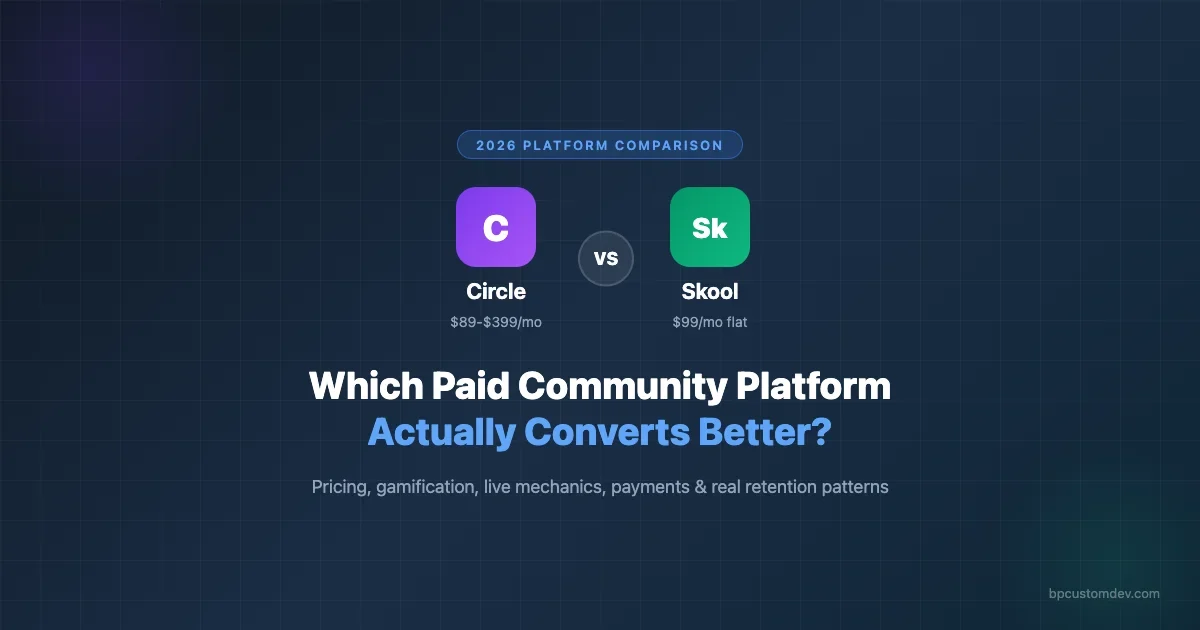
Choosing between Circle and Skool in 2026 is not a logo preference. It is a bet on how your community makes money, retains members, and grows without you grinding every single day. Both platforms charge a flat monthly fee. Both run courses alongside community. Both have mobile apps. The surface similarities end there. Underneath, they are built for completely different creator archetypes and picking the wrong one quietly kills your conversion rate over six to twelve months.
This comparison is based on running paid communities on both platforms, reviewing teardowns from operators doing $10k to $500k MRR, and stress-testing both products during their 2025-2026 feature cycles. No affiliate links. No sponsored sections. Honest numbers only.
Pricing in 2026: What You Actually Pay
Skool is $99 per month flat. One price. Every feature included. No per-seat charges. No transaction fees on top of your payment processor. That $99 covers unlimited members, unlimited courses, a live events calendar, leaderboards, gamification points, DMs, and group chat. If you bring in 50 members at $97 per month, you net $4,751 after platform costs. Skool takes $0 of that recurring revenue.
Circle tiers from $89 to $399 per month depending on the plan, plus 1% to 4% transaction fees on paid memberships on lower tiers. The Professional plan at $399 eliminates the transaction fee but introduces per-seat costs for private spaces and workflow automations. Circle’s pricing rewards scale but punishes you at launch when margins matter most. A Circle community doing $5,000 MRR on the Basic plan is handing back $200 per month in transaction fees before accounting for the platform subscription itself.
The honest three-year cost comparison for a creator launching a $97/month community targeting 100 members: Skool totals $3,564 in platform costs over 36 months. Circle Basic runs $3,204 in subscriptions plus approximately $4,800 in 1% transaction fees on $480k in revenue, totaling $8,004. Circle Professional runs $14,364 in subscription cost alone. Skool wins on economics unless you need specific Circle features that justify the premium.
Gamification: Skool’s Biggest Unfair Advantage
Skool’s leaderboard and points system is not decoration. It is the core retention engine. Members earn XP for posting, commenting, completing course modules, and showing up to events. The leaderboard resets monthly, which keeps even veteran members engaged instead of sitting at the top unchallenged. Community managers report 40% to 60% higher 90-day retention on Skool compared to non-gamified platforms when the leaderboard is actively referenced in posts and calls.
The unlock mechanic is even more powerful. Skool lets you lock course modules or private spaces behind XP thresholds. A member who hits 500 points unlocks the advanced training vault. This mechanic turns lurkers into contributors because contributing is the only path to the content they want. The best Skool operators design their XP unlock map before they write a single lesson. They think through exactly which behaviors they want to incentivize and map each XP reward to a specific community outcome.
Circle has no native gamification in 2026. No leaderboards. No points. No unlock mechanics. Circle’s retention relies entirely on content quality, community manager effort, and the strength of the member relationships. Some operators build gamification on top of Circle using Zapier plus Airtable integrations, but this adds $50 to $150 per month in tool costs and breaks regularly. If your retention model depends on behavioral incentives, Skool is the only real choice in this comparison.
Course Experience: Closer Than You Think
Both platforms deliver courses inside the community experience rather than as a separate product. This is the right design. Members move between community discussions and course content without context-switching to a different URL or dashboard.
Skool’s course builder is functional but not sophisticated. You get video modules, text blocks, quizzes, and completion tracking. There is no conditional logic, no drip scheduling on the standard plan, and no native certificate generation. For most creators selling a $97 to $297 per month community, this is adequate. Members are not buying a course. They are buying access to you and the peer group. The course is table stakes, not the core value.
Circle’s course experience is more robust on higher plans. You can schedule content drip by days since join, set prerequisite completion requirements, add progress checkpoints, and generate completion certificates. If your offer is a structured transformation program such as a 90-day coaching curriculum with strict pacing, Circle gives you more levers. The drip scheduling alone is worth the premium for offers that depend on members experiencing content in a specific sequence.
Circle also handles rich media inside courses better than Skool. Embedded PDFs, downloadable resources, and multi-column lesson layouts work smoothly in Circle’s course editor. Skool’s course editor is more restrictive in terms of layout flexibility, which matters when you are trying to create visually rich learning experiences.
Live Events and Calls: The Real Battleground
Both platforms embed live calls natively. Neither requires Zoom for the core live experience, though Zoom integration exists on both if you prefer it.
Skool’s events calendar shows upcoming calls to all members the moment they log in. RSVP counts are public, which creates social proof and urgency. The calendar also shows past events, so new members can see that the community is consistently active. This is underrated for conversion when free-trial members are evaluating whether to pay. Seeing 48 events in the past 90 days signals an active, well-run community before a member has spoken to anyone.
Circle introduced livestreaming in 2024 and improved recording handling significantly in 2025. Circle Live allows you to stream directly inside a Space, post replays automatically, and add community discussion underneath each recording. For communities built around live learning events rather than cohort courses, this is genuinely excellent. The threaded discussion under each replay turns passive watching into active engagement. Members who miss the live call can comment on the replay and still feel part of the conversation.
Skool’s live call infrastructure handles calls well but does not have the same replay-discussion threading. If your business model depends on a content library of live replays with ongoing community discussion attached, Circle handles that use case better. This is a meaningful distinction for communities where the replay library is a primary membership benefit.
Conversion: Free-to-Paid Mechanics
This is where the platforms diverge most sharply in 2026 and where your revenue model determines the right choice.
Skool has a native free community tier built into the platform. You can run a free Skool group as a lead magnet that feeds a paid Skool community. Members discover your free group, get value, see the locked paid spaces, and upgrade. This free-to-paid funnel is native, frictionless, and extremely effective when done well. The Skool Games leaderboard ranks community owners by free member growth and drives organic discovery. Top operators generate 500 to 2,000 free sign-ups per month purely through Skool’s internal ecosystem, with no external advertising required.
The locked space preview is a specific conversion mechanic worth understanding. When a free member sees a locked space labeled Advanced Strategies Vault and the description reads Members with 1,000+ XP unlock this, two things happen simultaneously. They understand exactly what they need to do to get access, and they start calculating whether the paid upgrade unlocks it faster. Many creators report that simply making the locked paid content visible to free members meaningfully increases upgrade rates within the first 30 days of membership.
Circle does not have a native free-to-paid upgrade path built into the platform UX. You can offer a free trial but the experience of upgrading is handled through your payment processor checkout, not through a slick in-platform gate. Circle connects to Stripe and most major processors cleanly, but the discovery and upgrade UX is not as native as Skool’s. Circle communities typically depend on external traffic sources including YouTube, email list, and podcast to fill the top of funnel, then convert through landing pages. This works well for established creators with existing audiences. It is harder for newer creators without existing reach.
Spaces and Content Organization
Circle’s Spaces system is its strongest organizational feature. You can create public spaces, paid member-only spaces, invite-only spaces for VIPs or mastermind tiers, and course spaces, all within one community. The sidebar navigation is clean and members can self-select into spaces relevant to their goals. This works exceptionally well for multi-tier memberships where different price points unlock different rooms. A $97 per month member sees the general community spaces while a $297 per month member sees the advanced spaces, all within the same Circle community.
Skool’s organization is flatter. You have one community feed, course modules, and a calendar. There are no hierarchical space structures. Some operators find this constraining when trying to serve multiple audience segments under one community. Others find the simplicity keeps engagement concentrated rather than scattered across twelve underused spaces. The right answer depends on whether your community benefits from segmentation or suffers from it. Most communities with under 500 members do better with Skool’s flat structure because there are not enough active members to sustain multiple concurrent conversations in separate spaces.
Mobile Experience in 2026
Both platforms have native iOS and Android apps that are genuinely good in 2026. This was not true two years ago when both apps felt like afterthoughts built to check a box rather than serve real mobile users. The improvement is meaningful. Members who primarily engage via mobile will have an acceptable experience on either platform.
Skool’s mobile app has a clean feed, push notifications that actually get opened, and seamless course consumption. The gamification notifications are particularly effective. A push notification telling a member they slipped from rank 3 to rank 5 on the leaderboard gets opened at dramatically higher rates than a generic content notification. This is not accidental design. It is built into Skool’s core assumption that behavioral triggers drive engagement better than content alone.
Circle’s mobile app improved substantially in 2025 with offline course downloads and better notification grouping. The offline download feature is specifically valuable for commuters and travelers who want to consume course content without a reliable internet connection. Circle’s app also handles rich media content better than Skool’s, which matters if your community posts a lot of images, documents, and embedded content alongside discussion.
Integrations and Automation
Circle has a more mature API and webhook system than Skool. It integrates natively with ConvertKit, ActiveCampaign, Mailchimp, and dozens of other tools. Zapier and Make both have robust Circle integration libraries. If you run complex email automation sequences triggered by community behavior, Circle gives you significantly more control. A member completing a specific course module can automatically trigger a personalized email sequence, a CRM tag update, and a notification to your team. Building this kind of automation on Circle requires some setup but is well-documented and reliable.
Skool’s automation capabilities are narrower. Zapier integration exists but the available triggers are fewer. If your community relies on tight CRM integration, you will hit Skool’s integration ceiling faster than Circle’s. For operators whose business depends on sophisticated behavioral email sequences or complex customer journey mapping, this is a real limitation to plan for before committing to Skool.
What Retention Data Actually Shows
Across operators who have migrated between platforms, the pattern is consistent. Skool communities running the leaderboard actively see better month-over-month retention for members in months 1 through 6. Circle communities see better retention for members in months 7 through 24 because the richer content organization and drip course mechanics give long-term members more to discover and consume.
This retention pattern maps directly to business model fit. If you charge $97 per month and most of your revenue comes from members staying 3 to 12 months, Skool’s gamification-driven early retention is the difference between a profitable community and a churn-heavy one. If you charge $200 to $500 per month and your ideal member stays 18 to 36 months in a deeply structured program, Circle’s rich content mechanics keep long-term members engaged more effectively than Skool’s simpler structure.
The number that matters most is your target member lifetime. Calculate the average number of months you need members to stay in order for your community to be profitable after accounting for acquisition costs. If that number is under 8 months, Skool’s early-retention advantages are decisive. If that number is 18 months or more, Circle’s long-term engagement infrastructure pays for itself.
The Decision Framework
Run through these questions in order. The first question where you have a strong answer usually determines your platform choice.
Do you have an existing audience of 1,000 or more people who already know you? If no, lean toward Skool because the ecosystem can help you build initial momentum. If yes, either platform works and the decision comes down to the questions below.
Is gamification central to your retention model? If yes, Skool is the only serious option. Circle’s lack of native gamification is a genuine gap that third-party integrations cannot fully close.
Do you need multiple membership tiers with different access levels at different price points? If yes, lean Circle. The Spaces system handles multi-tier access more elegantly than Skool’s flat structure.
Are you pricing under $150 per month and planning to have 50 or more members? Run the math on Circle’s transaction fees. Skool’s flat fee will likely win on economics at that price and scale combination.
Is your offer a structured program with drip content, prerequisites, and certifications? Circle’s course mechanics are genuinely superior for this structure. The drip scheduling and certificate generation alone can justify the price difference for the right offer.
Migrating Between Platforms: What It Actually Takes
If you already have a community running on one platform and are considering moving, the migration cost is a factor that most platform comparisons ignore. Member data, course content, and community history do not move cleanly between Circle and Skool. There is no official export-import tool between these two platforms.
Moving from Circle to Skool requires exporting your member list, manually recreating or uploading course content, and communicating the platform transition to your members in a way that minimizes churn during the move. The psychological friction of asking members to create a new account on a new platform causes some percentage to simply not migrate. Operators who have done this migration report 10% to 25% member loss during the transition window, depending on how engaged the community was and how well the migration was communicated.
Moving from Skool to Circle follows the same manual process with the same churn risk. The practical implication is that the right time to make this decision is before you launch, not after you have built momentum on one platform. If you are currently on a platform that is not serving your business model, budget for the migration cost when calculating whether switching makes financial sense. A platform that is structurally wrong for your offer is worth migrating off even with the transition cost. A platform that is mostly right but has some friction is probably not worth the disruption.
For operators considering a move away from SaaS platforms entirely, the self-hosted path deserves a serious look. We covered the full mechanics in our guide on how to migrate your community from Facebook Groups to a self-hosted platform, and many of the same principles apply to migrating from Circle or Skool. The data ownership and customization benefits compound over time in ways that are easy to underestimate when you are operating on a SaaS platform that works reasonably well today.
Frequently Asked Questions
Can I run both Circle and Skool simultaneously? Technically yes, but in practice it fragments your community and doubles your platform costs. The community engagement benefit of having everyone in one place is significant. Running split communities tends to result in both being less active than one consolidated community would be.
Which platform is better for a free community? Skool. Running a free Skool community costs $99 per month regardless of member count and gives you access to the internal Skool discovery ecosystem. Circle’s free community option exists but lacks the organic discovery mechanism that makes Skool free communities a viable acquisition channel.
Does Circle or Skool handle annual membership billing better? Both platforms integrate with Stripe and support annual billing cycles. The checkout experience is slightly smoother on Circle for complex pricing structures. For simple annual billing on a single membership tier, both work fine.
What happens to my community if I stop paying? On both platforms, your community goes dark if you stop paying. Members lose access and your content is inaccessible. Circle gives a grace period before deletion. Skool pauses the community rather than deleting it. Neither platform is immune to the core SaaS risk: the platform exists as long as you keep paying and as long as the company keeps operating. If data ownership is a concern, that is the conversation that leads to a self-hosted solution. Our breakdown of custom community platform versus SaaS walks through the full ownership and risk comparison for operators weighing these options seriously.
The Bottom Line
Skool wins for creators who are earlier in their journey, pricing under $200 per month, and want gamification to do the heavy lifting on retention. The flat pricing and native free-to-paid funnel are real advantages that compound over time. If you are launching your first paid community and you do not have an existing audience of tens of thousands, Skool’s internal ecosystem gives you a meaningful head start that Circle cannot match.
Circle wins for established operators running structured programs at higher price points who need multi-tier access control, richer automation, and superior course mechanics. The transaction fees are the main friction point. Budget them into your revenue model before committing, and seriously evaluate whether the Professional plan at $399 makes sense given your revenue trajectory.
If you are building on WordPress and want to own your platform entirely, neither Circle nor Skool gives you that. BuddyPress with a premium theme like BuddyX, or BuddyBoss as an all-in-one solution, puts the community and all member data on infrastructure you control. The trade-offs are real including more setup work and no internal discovery ecosystem. But for operators who need data portability or agency clients who cannot afford platform dependency risk, the WordPress path is worth understanding before committing to any SaaS community platform.
If you’d rather own your platform than rent a SaaS, BuddyNext is a free, standalone community platform worth a look, an activity feed, member profiles, Spaces (groups), and deep moderation in one plugin, built as its own modern architecture rather than on top of BuddyPress (so it isn’t a BuddyPress add-on and existing BuddyPress plugins won’t run on it). Because it runs on your own site you keep full ownership of member data, and its Pro tier adds native Stripe memberships when you’re ready to monetize.