Community vs Audience vs Network: The 2026 Framework for Building All Three

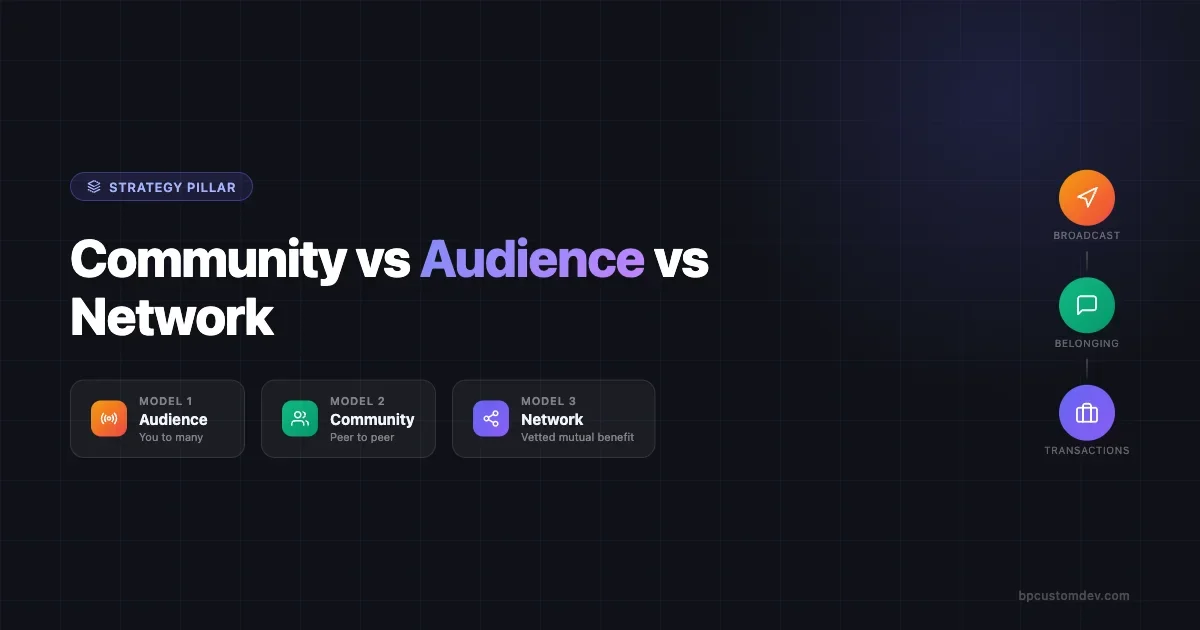
You have a newsletter with 12,000 subscribers. You have a Slack group with 400 members. You have a LinkedIn network of 8,000 connections. Are these the same thing? Not even close. Conflating audience, community, and network is the single most expensive strategic mistake people make when building digital presence in 2026. Each operates on different mechanics, requires different infrastructure, and produces different outcomes. This guide gives you a clean framework for all three, then shows you how to layer them without burning out or spreading yourself thin.
Why the Definitions Actually Matter
Most people use “community” as a catch-all word for any group of people gathered around a shared interest. That imprecision causes real problems. You build the wrong platform. You use the wrong retention tactics. You measure the wrong metrics. You invest in tools that do not match your actual goal.
The three models are not interchangeable. Each has a distinct direction of value flow, a distinct set of platform types that support it well, and a distinct north star metric that tells you whether it is working. Get the definitions crisp first; everything downstream gets easier.
Model 1: Audience (Value Flows One Way)
An audience is a group of people who have opted in to receive your output. The value flows from you to them. You publish, they consume. The relationship is fundamentally asymmetric: you carry the creative weight, they carry the attention. This is not a criticism. Audiences are powerful. They convert. They share. They trust you more over time. But they do not talk to each other, and they are not invested in the group itself. If you disappear for three months, they find someone else. There is no community holding them together.
Audiences scale well because the marginal cost of reaching the next person is essentially zero once your distribution is built. A Substack with 1,000 subscribers and one with 100,000 subscribers requires roughly the same production effort from the creator.
Infrastructure for Audience
The platforms that serve audiences best are broadcast-first by design. Substack handles email newsletters with built-in discovery and payment rails. YouTube serves video audiences with recommendation algorithms that can compound reach over years. Podcasting platforms like Spotify and Apple Podcasts are audience infrastructure in audio form. X (formerly Twitter) and LinkedIn serve audiences when you think of them as publishing platforms, not networking tools. Beehiiv is gaining ground as a newsletter platform with better monetization options and referral mechanics built in.
The key capability you need from audience infrastructure is reliable delivery and good analytics. Open rates, play-through rates, subscriber growth, and churn are your core metrics. The infrastructure should stay out of your way and let you focus on content quality.
What Audience Does Well
Audiences are your widest funnel. They generate brand awareness, establish authority in a niche, and create a pool of warm leads you can convert to higher-commitment relationships over time. They are excellent for top-of-funnel SEO when your content gets indexed, and they produce the social proof that makes your community or network easier to sell into. Think of audience as the surface area of your digital presence.
Model 2: Community (Value Flows Peer to Peer)
A community is a group where members derive value from each other, not just from you. You facilitate; they generate. The value flow is horizontal. When your community is healthy, you can take a two-week break and come back to find conversations, answered questions, and new connections that happened without your involvement. That is the single clearest signal of a genuine community: it functions without the founder in the room.
Communities are defined by belonging, not consumption. Members show up because they feel part of something, because their peers are there, and because the group identity means something to them. This is why communities are harder to build than audiences. You cannot manufacture belonging through volume. A community with 200 engaged members is worth more than a Discord server with 5,000 lurkers.
Infrastructure for Community
Community infrastructure needs to support asynchronous discussion, member profiles, organized spaces (channels, sub-groups, categories), and moderation tools. The platform choice depends heavily on your audience’s technical comfort, your monetization model, and how much you want to own the data.
BuddyPress and BuddyBoss give you a self-hosted community on WordPress. You own the data, control the design, and can integrate with your membership plugin, WooCommerce, or LMS. The trade-off is that you are responsible for hosting, performance, and spam management. For technical teams and organizations that need deep integration with existing WordPress infrastructure, this is often the right call. The BuddyPress plugin ecosystem is extensive, with official documentation and community resources at BuddyPress.org if you want to explore what is available before committing to the platform.
If you’re choosing a community stack fresh, BuddyNext is a free, standalone community platform worth a look, an activity feed, member profiles, Spaces (groups), and deep moderation in one plugin, built as its own modern architecture rather than on top of BuddyPress (so it isn’t a BuddyPress add-on and existing BuddyPress plugins won’t run on it). Because it runs on your own site you keep full ownership of member data, and its Pro tier adds native Stripe memberships when you’re ready to monetize.
Circle is the leading hosted community platform in 2026. It handles spaces, courses, events, live rooms, and member directories with a clean UI that non-technical community managers can operate without engineering support. The pricing is higher than self-hosted, but the managed infrastructure removes a significant operational burden. If you are a coach or creator evaluating Circle against Skool, Kajabi, and BuddyPress, this comparison of community platforms for coaches in 2026 covers the tradeoffs in detail.
Mighty Networks positions itself at the intersection of community and courses, making it a good fit for creator-educators who want cohort-based programs inside the same platform as ongoing discussion. Discord dominates gaming and developer communities where fast, informal, channel-heavy communication is the norm. Discourse is the right choice for long-form asynchronous discussion that needs to be searchable and permanent, particularly for developer forums and support communities.
What Community Does Well
Communities drive retention. Members who feel belonging stay longer, spend more, and refer more frequently than audience members who never interacted with anyone else. Communities generate user-generated content, reduce support load through peer-to-peer help, and create the kind of social proof that comes from people defending and recommending you publicly without being asked.
The unit economics of community are fundamentally different from audience. An audience relationship is attention-based. A community relationship is identity-based. Identity-based relationships are far stickier and far more defensible against competitive pressure.
Model 3: Network (Gated Mutual Benefit)
A network is a group of people who can help each other in concrete, transactional ways, and where access to the group itself is a filtering mechanism. Value flows in multiple directions, but it is more deliberate than a community. Members join because of what they can get and give, not primarily because of belonging or content consumption. The network has a gate, either explicit (application, vetting, invitation) or implicit (cost, prestige, qualification). That gate is what makes the connections inside valuable.
LinkedIn is the largest professional network in the world, but the real value is not your connection count. It is the quality of your first-degree connections and whether they can actually do something useful for your career, business, or client base. The network’s value is correlated with the strictness of the implicit gate and the density of relationships within the group.
Slack Connect is one of the most underrated network infrastructure tools available today. It lets organizations create shared channels across company boundaries, which means you can build a network that feels like a community (Slack interface, familiar UX) but operates on network logic (pre-qualified members, cross-organizational access, deal flow and referral mechanics). If your team is currently using a Slack workspace as a makeshift community and thinking about the move to a real platform, this guide on moving from Slack to a community platform for SaaS teams covers exactly that transition.
Infrastructure for Network
Network infrastructure needs to support member discovery, direct introductions, and some form of reputation or credibility signaling. LinkedIn handles this for professional networks at scale. Geneva is gaining ground for smaller, curated networks. Luma serves event-based networks where in-person or virtual gatherings are the primary trust-building mechanism.
For high-value professional networks, the best infrastructure is often a combination of a private Slack or Discord (for daily communication) plus Luma or Partiful for events plus a simple member directory page. Fancy platforms can get in the way of what actually makes networks work: real relationships between people who can help each other.
What Network Does Well
Networks generate deal flow, job opportunities, partnership introductions, and high-trust referrals. They tend to have lower volume and higher quality interactions than communities. The ROI of a network is harder to measure because it operates through relationships that take time to compound. A well-run network of 150 vetted operators is worth more commercially than a community of 5,000 loosely affiliated followers.
Networks are also uniquely good at producing opportunities that could not have been predicted. Serendipitous introductions, unexpected partnerships, and referrals from people who saw your work through a mutual connection are network effects in the truest sense of the phrase.
The Three-Way Comparison: Value Flow at a Glance
To make this concrete, here is how the same scenario plays out across all three models. Suppose you run a SaaS tool for community managers.
In an audience model, you publish a weekly newsletter about community management tactics. 15,000 people subscribe. Some percentage clicks your tool’s link each week. The value flows from you (content) to them (education). You measure open rates and click-throughs. New subscribers arrive through SEO and word-of-mouth. You never meet most of your audience.
In a community model, you host a forum or Circle space where community managers ask questions, share frameworks, and critique each other’s strategies. The value flows between members. You facilitate but do not produce all the content. Your tool becomes the platform recommendation inside discussions, organically. You measure member activity, discussion volume, and retention. Engaged members stay for years.
In a network model, you run a curated Slack group for senior community leads at companies above 500 employees. Entry is by application. Members can post job openings, request introductions, and share budget benchmarks that they would never publish publicly. Your tool gets mentioned in context because you are a trusted member of the group. You measure relationship density and deal flow.
Same general audience. Three completely different mechanics. Three completely different platform choices. Three completely different growth strategies.
How to Layer All Three (Without Burning Out)
The layering model works when you respect the sequence. Most people try to build community before they have an audience. They wonder why nobody shows up. The answer is that community needs critical mass to self-sustain, and critical mass is easier to seed from an existing audience than from zero.
Stage 1: Build Audience First
Spend the first six to twelve months building an audience around a specific, narrow topic. A newsletter, a YouTube channel, a podcast, or a LinkedIn presence. The goal is not fame. The goal is to accumulate a pool of people who trust your judgment on a specific set of problems. When you eventually open a community, these people will be the founding members who set the culture and prove the concept to later joiners.
The strategic thinking behind this sequencing draws on real community builds across different platforms. Discourse publishes extensive documentation and community guides at discourse.org that are worth reviewing once you are ready to move from audience to community.
Stage 2: Launch Community with a Founding Cohort
When you have 500 to 1,000 engaged audience members, pick 50 to 100 of them and invite them into a community before you announce it publicly. This founding cohort shapes the culture, populates early discussions, and creates the social proof that makes the community feel alive when the broader wave arrives. Founding members typically get a pricing advantage, a special designation, or elevated access in exchange for being early.
The platform you choose at this stage matters significantly. If you are building a community that needs to integrate with your existing WordPress site, LMS, or membership plugin, BuddyPress or BuddyBoss gives you control that hosted platforms cannot match. If you want to move fast without engineering overhead, Circle is the default recommendation in 2026 for most community types outside the developer and gaming niches.
Stage 3: Build Network Inside Community
The network layer emerges naturally inside a healthy community when you start identifying your most active, highest-value members and creating spaces or rituals specifically for them. A monthly call for “pro members.” An inner Slack channel for operators above a certain revenue threshold. A mastermind thread inside your community platform that requires an application. You are not leaving the community; you are adding a gated layer inside it for the people who want more depth and are willing to commit more.
This is how the three models stack: audience provides reach, community provides retention and belonging, network provides high-value relationships and deal flow.
Common Mistakes at Each Layer
Audience Mistakes
The most common audience mistake is optimizing for size instead of quality. A newsletter with 50,000 disengaged subscribers has worse unit economics than one with 5,000 people who read every issue. Vanity metrics compound into bad product decisions. Focus on open rate, reply rate, and conversion to higher-commitment touchpoints (community membership, paid products) over raw subscriber count.
The second audience mistake is treating every platform the same. LinkedIn audiences expect different content than Substack subscribers. YouTube audiences have different attention patterns than podcast listeners. Distributing identical content everywhere rarely works. Each platform has its own content grammar.
Community Mistakes
The most damaging community mistake is building too early, before you have enough context about what your members actually need from each other. Many communities fail not because of poor moderation but because there is no real reason for these particular people to talk to each other about this particular topic. Audience research before community launch is not optional.
The second community mistake is under-investing in moderation and culture-setting in the first 90 days. The culture established in the first three months is extremely hard to change later. Every early decision about what posts get praised, what behavior gets removed, and what the founding members model for later joiners has outsized influence on what the community becomes at scale.
Network Mistakes
The primary network mistake is optimizing for size. Networks are valuable because of quality filtering. Every time you lower the gate to grow membership numbers, you dilute the thing that makes the network worth joining. Resist this instinct. A network of 200 rigorously vetted operators will generate more real-world value than a network of 2,000 loosely connected people who paid a small fee to join.
The second network mistake is building a network before you have enough reputation to attract the caliber of member you want. The founding 20 to 30 members of a network determine who the next 200 members will be. Spend disproportionate time on these early relationships.
Metrics for Each Model
Measuring the wrong model against the wrong metrics produces false confidence. Here is what to actually track:
For audience: subscriber growth rate, open rate (email) or view-through rate (video/podcast), unsubscribe/churn rate, conversion to paid products or community membership, and inbound leads attributed to content.
For community: monthly active member rate (not total members), discussion-to-member ratio, member retention at 30/60/90 days, user-generated content volume, and Net Promoter Score specific to the community experience.
For network: introduction success rate, deal flow volume (job postings filled, partnerships formed, referrals completed), member retention year-over-year, and engagement density (how often do members interact with specific other members, not just broadcast to the group).
Platform Recommendations by Model in 2026
Audience Platforms
- Email newsletter: Beehiiv (best monetization + referral), Substack (best distribution), ConvertKit (best automation)
- Video: YouTube (evergreen), TikTok (short-form reach), LinkedIn Video (B2B)
- Podcast: Spotify for Podcasters, Apple Podcasts, Transistor (best hosting)
- Social publishing: LinkedIn (B2B), X (thought leadership), Threads (growing)
Community Platforms
- Self-hosted: BuddyPress/BuddyBoss on WordPress (full data ownership, deep integrations)
- Hosted: Circle (best all-around in 2026), Mighty Networks (community + courses), Discourse (developer/long-form)
- Chat-first: Discord (gaming, developers, informal), Slack (professional, team-like)
- Niche: Kajabi Communities (course creators), Heartbeat (smaller niches)
Network Platforms
- Professional: LinkedIn, Geneva, Luma (events-first)
- Operational: Slack Connect (cross-org channels), private Discord
- High-commitment: custom membership site (WordPress + paid membership plugin + curated application flow)
The Decision Framework: Which Should You Build First?
Answer these three questions. They will tell you where to start.
First: do you have consistent things to say on a specific topic, and can you commit to saying them regularly for at least a year? If yes, audience is your starting point. If no, community first is possible but riskier.
Second: do you know 50 to 100 people who would benefit from talking to each other about the problems you understand? If yes, you are close to community-ready. If no, build more audience before opening the community.
Third: do you have enough reputation and relationships that a curated group of 20 to 30 high-quality people would join something you started? If yes, you can start building a network layer. If no, go back to audience and community first.
The sequence is not a rule. Some founders start with a network (a mastermind among peers) and build community and audience outward from that core. Some creators build massive audiences and never need a formal community. But for most people building in 2026, the optimal path is audience first (newsletter, content), community second (Circle, BuddyPress, or Discord), network third (inner tier of your most valuable members).
How to Move People Between Layers
The final strategic piece is the migration path. Audience members should have clear on-ramps to your community. Community members who become highly active should have on-ramps to your network. These transitions should feel like upgrades, not separations.
In practice, this means having a visible community CTA in every piece of audience content. It means identifying your top 5-10% of community members each quarter and personally inviting them to a more exclusive tier. It means the network tier should be aspirational for community members, not invisible.
Each layer feeds the next. Audience generates community awareness. Community generates the relationships and social proof that make network invitations credible. Network relationships generate content, case studies, and personal recommendations that grow the audience. When all three are running, the system compounds. When only one is running, growth hits a ceiling.
Building all three is a multi-year project, not a launch. Respect the sequence, invest in the right infrastructure at each stage, and measure each layer against the right metrics. The framework is simple. The execution is patient, consistent, and platform-specific work.
One More Thing: Ownership
Before you pick platforms, think seriously about data ownership. Audience on Substack means Substack holds the subscriber list. If Substack changes its pricing model, algorithmic discovery, or goes away, your audience goes with it to some degree. The same applies to YouTube, LinkedIn, and Discord. This is not a reason to avoid these platforms. It is a reason to have an owned layer underneath everything.
Email is still the most owned form of audience distribution. Your subscriber list, exported as a CSV, is yours regardless of what any platform does. For community, a self-hosted solution like BuddyPress or a headless community setup gives you the same portability that email gives audiences. For network, the relationships themselves are portable even if the Slack group dissolves.
Build on rented land strategically. Use platforms for discovery and growth. But make sure every model you are running has a path to data portability. Audience, community, and network that you genuinely own and can migrate are worth far more than equivalent size on a platform where you are a tenant. This consideration does not change the framework. It just adds a layer to every infrastructure decision you make.