How to Build a Reputation System That Rewards Your Best Members
A reputation system transforms a forum from a place people visit into a place people invest in. Here is how to design one with trust levels, points, and leaderboards that actually motivate the right behavior.

Every community has a core group of power users who contribute far more than the average member. They answer questions, share knowledge, welcome newcomers, and keep discussions on track. Without them, your forum is a ghost town.
The problem is that most forums treat these power users the same as someone who registered yesterday and never posted. There is no visible recognition, no earned privileges, no public status that says: this person’s contributions matter.
A reputation system fixes this. It tracks contributions, assigns scores, unlocks abilities, and makes the community’s most valuable members visible to everyone. Done right, it creates a self-reinforcing loop: people contribute more because contributions are rewarded, which makes the community better, which attracts more contributors.
The Three Components of a Good Reputation System
Effective reputation systems have three interconnected parts:
1. Points (The Score)
Reputation points are the currency of community contribution. Members earn points through actions that benefit the community:
Action | Points Earned | Why This Value |
|---|---|---|
Post a topic | +5 | Creating content takes effort |
Post a reply | +3 | Replies help but require less effort than topics |
Receive an upvote | +10 | Community validation of quality |
Answer accepted | +15 | Confirmed solution to someone’s problem |
Give an upvote | +1 | Curation helps everyone |
Receive a downvote | -2 | Mild penalty for poor content |
Notice the weighting: receiving upvotes earns more than posting. This incentivizes quality over quantity. A member who posts one brilliant answer that gets 10 upvotes earns more reputation than a member who posts 10 mediocre replies.
2. Trust Levels (The Ladder)
Points accumulate, but they need to unlock something tangible. Trust levels convert reputation into earned abilities:
Trust Level | Reputation Required | Abilities Unlocked |
|---|---|---|
Level 0 (New) | 0 | Read, post (rate limited) |
Level 1 (Basic) | ~20 points | Upload images, send messages, no rate limits |
Level 2 (Member) | ~100 points | Edit own posts, flag content, create tags |
Level 3 (Regular) | ~500 points | Close duplicates, recategorize, edit others’ posts |
Level 4 (Leader) | Manual grant | Full moderation in assigned spaces |
Level 5 (Elder) | Manual grant | Site-wide moderation |
The auto-promotion from Level 0 through Level 3 happens naturally as members participate. They do not need to apply or be approved. The system evaluates their contribution history and promotes them when they meet the thresholds.
This creates a clear progression path. New members can see what they need to do to unlock more abilities. The system is transparent and meritocratic.
For the technical details of trust level configuration, read our guide on building a self-moderating forum with trust levels.
3. Visibility (The Recognition)
Points and trust levels need to be visible. Hidden reputation is wasted reputation. Here is how to make it visible:
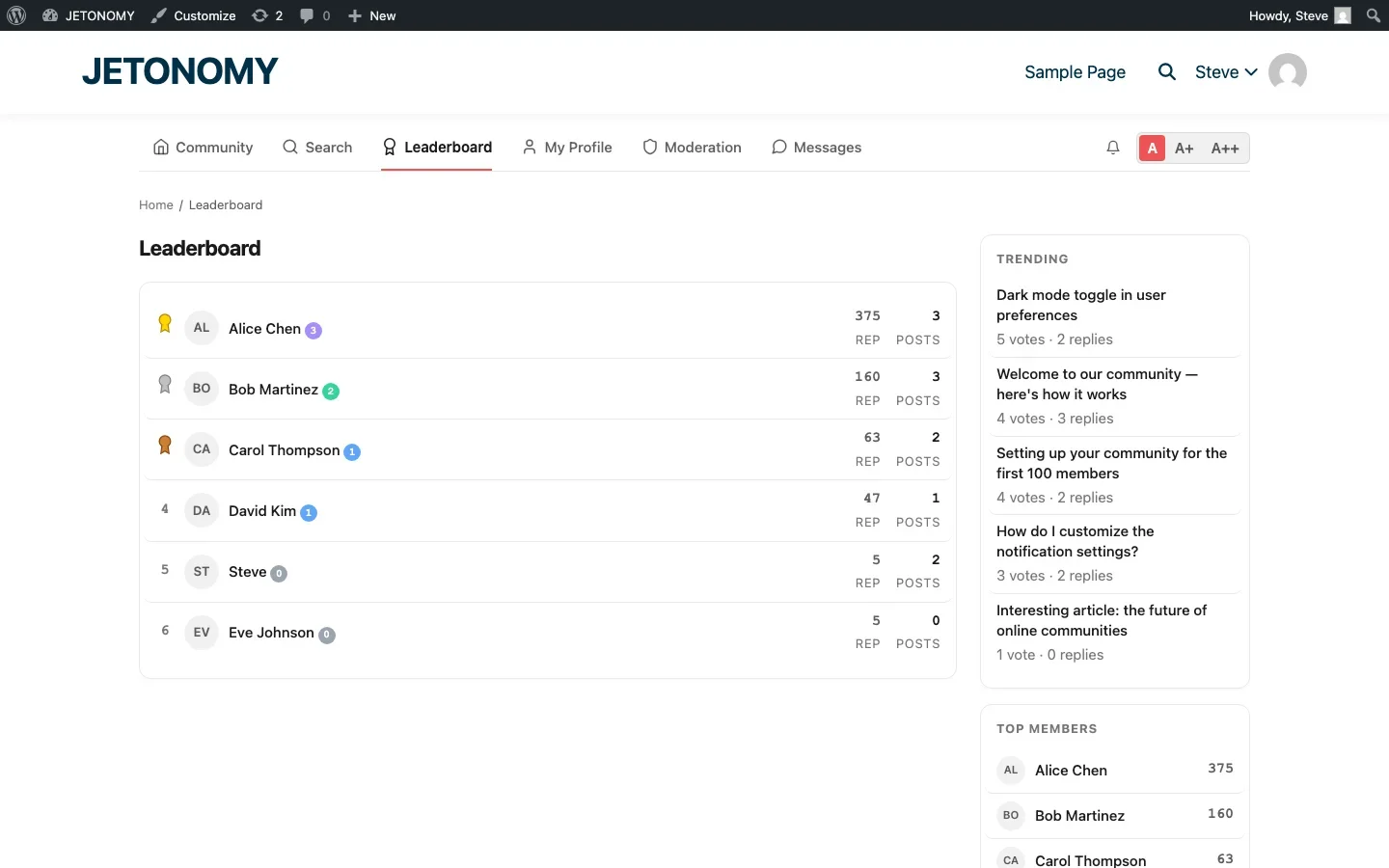
- Trust level badges appear next to every user’s name on every post. A colored dot (or icon) shows their level at a glance. When you see a Level 3 user’s answer, you know it comes from someone the community trusts.
- Reputation score is visible on user profiles and hover cards. When you hover over a user’s avatar, you see their reputation, trust level, and recent activity.
- Leaderboard ranks all members by reputation. The top contributors get public recognition. Being ranked #1 on the leaderboard is genuinely motivating.
Designing Incentives That Work
A reputation system can either encourage healthy participation or create toxic competition. The difference is in the incentive design.
Reward Quality, Not Quantity
If posting earns points but quality does not matter, you get spam. If upvotes earn more points than posting, you get quality. The point values in the table above are designed to reward content that others find valuable, not just content that exists.
Make the Ladder Meaningful
If trust levels do not unlock real abilities, they are just vanity metrics. Members stop caring once they realize the badge next to their name does not actually do anything.
Real abilities to unlock at each level:
- Level 1: Image uploads and private messaging (useful, not just cosmetic)
- Level 2: Editing and flagging (trusted members help maintain quality)
- Level 3: Topic management (experienced members can organize content)
Each promotion should feel like an achievement that grants tangible new capabilities.
Avoid Punitive Systems
Downvotes should carry a small penalty (-2 points), but never enough to make members afraid of participating. A member who posts a wrong answer and gets three downvotes loses 6 points. They still have a net positive from their correct answers. The penalty is enough to signal “this was not helpful” without being crushing.
Never revoke trust levels for low activity. If someone earns Level 3 and then takes a three-month break, they should still be Level 3 when they return. Trust is earned, not rented.
Custom Badges: Beyond Trust Levels
Trust levels handle the progression ladder. Custom badges handle achievements and milestones.
Jetonomy Pro’s Custom Badges extension lets you create badges that are awarded manually or via automated rules:
Badge | Criteria | Type |
|---|---|---|
First Post | Created first topic | Automatic |
Helpful | 10 answers accepted | Automatic |
Community Expert | 50 answers accepted | Automatic |
Top Contributor | Monthly leaderboard #1 | Manual award |
Beta Tester | Participated in beta testing | Manual award |
Founding Member | Joined in the first month | Manual award |
Badges serve a different purpose than trust levels. Trust levels unlock abilities. Badges celebrate achievements. Both are visible on user profiles and posts, creating a rich identity that members take pride in.
For the technical setup of badges and leaderboards, see our guide on adding points, badges, and leaderboards.
The Psychology of Reputation
Understanding why reputation systems work helps you design better ones:
- Status signaling. Humans naturally seek social status. A visible reputation score and trust level badge satisfy this need in a constructive way.
- Progress motivation. Seeing yourself at 80 points when Level 2 requires 100 creates a pull to keep contributing. This is the same psychology that makes progress bars effective in apps.
- Social proof. When new members see a leaderboard of active contributors, it signals: this community is alive and worth participating in.
- Reciprocity. When someone answers your question and you see their reputation earned from helping others, you are more likely to help someone else in return.
Common Mistakes
- Making reputation too easy to earn. If everyone reaches Level 3 in a week, the levels are meaningless. Set thresholds that require weeks or months of genuine participation.
- Making reputation too hard to earn. If Level 1 requires 100 posts, new members feel the system is unattainable. The first level should be achievable within a few active days.
- Ignoring your top contributors. A leaderboard is good. A personal thank-you message is better. Check in with your top 5 contributors monthly. Ask what they would like to see improved. Make them feel valued beyond the points.
- Not celebrating milestones. When someone hits Level 3 or earns their 100th accepted answer, acknowledge it. An automated notification is fine. A public shoutout in the Announcements space is better.
Measuring Reputation System Effectiveness
Track these metrics to know if your reputation system is working:
Metric | What It Tells You | Healthy Sign |
|---|---|---|
Level distribution | How many members at each trust level | Pyramid shape (many L0, fewer L1, fewer L2, few L3) |
Promotion rate | How many members move up each month | Steady flow of promotions |
Activity by level | Which trust levels contribute most | L2–L3 members contributing disproportionately |
Leaderboard turnover | Whether top 10 changes over time | Some stability with new names appearing |
Getting Started
Jetonomy includes the reputation system and trust levels in the free version. Custom badges require Jetonomy Pro.
- Install Jetonomy, follow the setup guide
- Configure trust level thresholds in Settings → Trust Levels (the defaults work for most communities)
- Adjust reputation point values in Settings → Reputation (or keep defaults)
- Enable the leaderboard (it is on by default)
- Optionally enable Custom Badges (Pro) for achievement-based recognition
Your community already has unrecognized heroes. A reputation system makes their contributions visible, rewards their effort, and inspires others to follow. That is how great communities sustain themselves.
What Happens When a High-Trust Member Starts Behaving Badly
This post is explicit that trust levels should never be revoked for low activity, and that guidance is correct. But it leaves an open question: what about a Level 3 member who has real reputation and real unlocked abilities, but starts using them badly, editing others’ posts to push their own agenda, closing duplicates that are not actually duplicates, or generally abusing moderation-adjacent privileges? Inactivity and misbehavior need different responses.
- Define a manual demotion path separate from the automatic promotion system, trust levels earned through good behavior should be revocable through a documented moderator decision when behavior changes, not just accumulated forever.
- Log the specific action that triggered a demotion and communicate it privately to the member first, a silent trust-level drop reads as arbitrary and erodes goodwill even when it was warranted.
- Distinguish a one-off bad judgment call from a pattern, a single contested edit does not need the same response as repeated misuse of unlocked abilities.
Where Trust Levels End and Jetonomy Pro Begins
The full points, trust level, and leaderboard system in this post ships free with Jetonomy, no Pro purchase needed to run the reputation system itself. Jetonomy Pro’s Custom Badges extension is what adds the manual and milestone-based achievement layer on top, useful once trust levels alone stop telling the whole story of who is contributing what. Details are on the Jetonomy Pro page.