Updated September 2026.
Building a branded online community is one of the best ways to grow memberships, engage customers, and create a loyal audience. However, not every community platform gives you full control over your branding, customization, and data. Some let you swap a logo and pick an accent color; fewer let you actually own the layout, the design system, and the infrastructure underneath it.
A true white label community platform removes third-party branding entirely and lets you create a community experience that looks and feels like it was built in-house, because in the ways that matter, it was. Whether you’re building a membership site, creator community, online course platform, customer forum, or private network, choosing the right platform is essential, and the difference between “white label” as a marketing checkbox and “white label” as structural reality is bigger than most buyers expect going in.
In this guide, we compare the 7 best white label community platforms in 2026, their features, advantages, disadvantages, and ideal use cases, along with what “white label” actually costs you in flexibility on each one.
Watch the Video
Prefer watching instead of reading? Check out our quick video covering the 7 best white label community platforms in 2026, where we compare their key features and help you choose the right solution for your business or online community.
1. BuddyNext
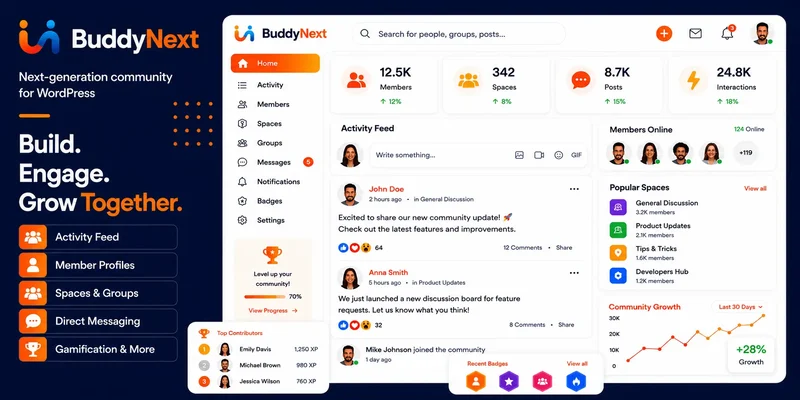
BuddyNext is a complete, self-hosted white label community platform for WordPress that gives businesses complete ownership of their community. Unlike hosted SaaS platforms, where “white label” usually means your logo on their layout, BuddyNext runs on infrastructure you control, which means the branding, layout, colors, navigation, and user experience are genuinely yours to shape, down to the pixel, not a template with your name pasted over it.
It ships as a complete platform: activity feed, Spaces, member profiles, messaging, moderation, and native paid membership tiers, and it extends into forums and Q&A, courses with certificates, photo and video sharing, gamification, job boards, and directories, all part of the same connected ecosystem rather than separate purchases from separate vendors. It integrates with popular WordPress tools including WooCommerce, LearnDash, Tutor LMS, and common membership plugins, so an existing WordPress-based business doesn’t need to rebuild what already works.
Features
- Fully white-label WordPress community with a token-based design system for real brand control
- Complete branding customization: colors, typography, dark mode, and layout style variations
- Member profiles, activity feeds, groups and Spaces, private messaging, notifications
- Responsive member directories and advanced search
- Native paid membership tiers with no per-member fees
- Forums and Q&A, courses with certificates, gamification, job boards, and directories
- WooCommerce integration and LearnDash/Tutor LMS support
- SEO-friendly architecture built on WordPress
- Self-hosted with full data ownership
Pros
- Complete control over branding, not a logo swap on a shared SaaS template
- Full ownership of your community and member data
- Highly customizable, and extendable through the broader WordPress plugin ecosystem
- No vendor lock-in and no per-member pricing as you grow
- Covers community, memberships, courses, forums, and gamification as one connected platform
Cons
- Requires your own WordPress hosting
- Initial setup takes more time than signing up for a hosted SaaS platform
- Some of the deepest capabilities (courses, media, forums) come through companion apps rather than a single monolithic install
Best For: Businesses, membership websites, creators, online learning platforms, agencies, and organizations that want complete branding freedom, ownership, and long-term scalability without renting their community’s identity from someone else.
2. Mighty Networks
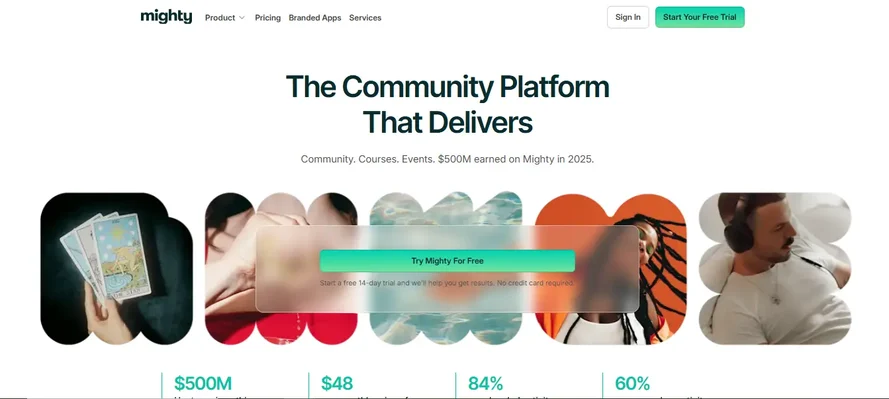
Mighty Networks is one of the most popular hosted community platforms designed for creators, coaches, and educators. It combines memberships, courses, events, and community discussions into one branded platform, hosted on Mighty Networks’ own infrastructure.
Features
- White label branding on top of a hosted platform
- Courses and community feeds
- Paid memberships and events
- Mobile apps and live streaming
- Member discovery and analytics
Pros
- Easy to launch with minimal setup
- Strong mobile experience
- Built-in monetization tools
- Well suited to individual creators
Cons
- Monthly subscription cost that typically scales with plan tier and member count
- Limited customization compared to self-hosted platforms; “white label” here means brand skinning within their layout constraints
- Less control over your own data, since it lives on Mighty Networks’ servers
Best For: Coaches, creators, educators, influencers, and subscription communities that want to launch fast and don’t need deep design control.
3. Circle
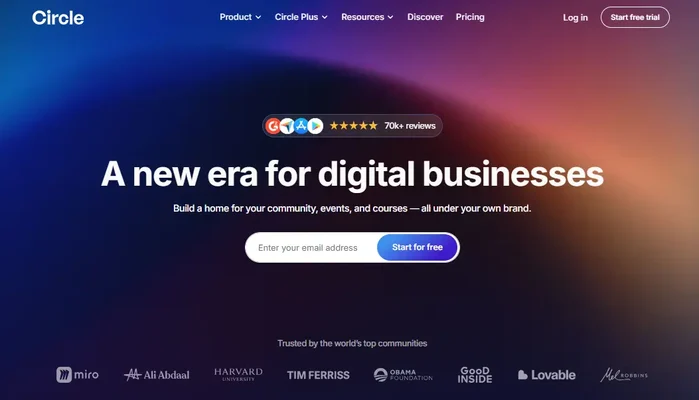
Circle is a modern community platform focused on discussions, memberships, online courses, and live events. Its clean interface makes community management simple for creators and businesses, though like Mighty Networks, it’s a hosted product with its own constraints.
Features
- Community discussions and Spaces
- Live events and online courses
- Member profiles and automation
- Integrations and email broadcasts
- Analytics
Pros
- User-friendly interface
- Fast setup
- Good third-party integrations
- Strong community engagement tools
Cons
- Premium pricing tiers
- Limited design customization relative to a self-hosted platform
- Hosted platform, so your data and uptime depend on Circle’s infrastructure
Best For: Content creators, membership businesses, and online course creators who want an out-of-the-box hosted experience.
4. Bettermode
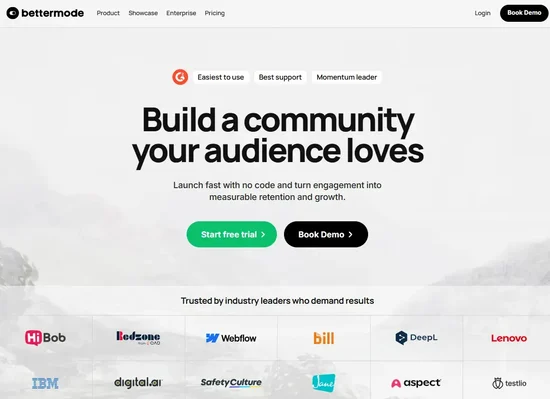
Bettermode focuses on building customer communities, support portals, and knowledge bases rather than general social networking. It offers modular customization and multiple community templates, aimed more at product and support teams than creators.
Features
- Community forums and knowledge base
- Q&A functionality and user profiles
- Modular widgets and white label branding
- Analytics and API access
Pros
- Flexible modular customization
- Strong customer support features
- Good integrations with support and product tools
- Professional, polished interface
Cons
- Advanced customization has a real learning curve
- Enterprise-tier features can get expensive quickly
Best For: SaaS companies, customer support communities, and product documentation portals.
5. Disciple
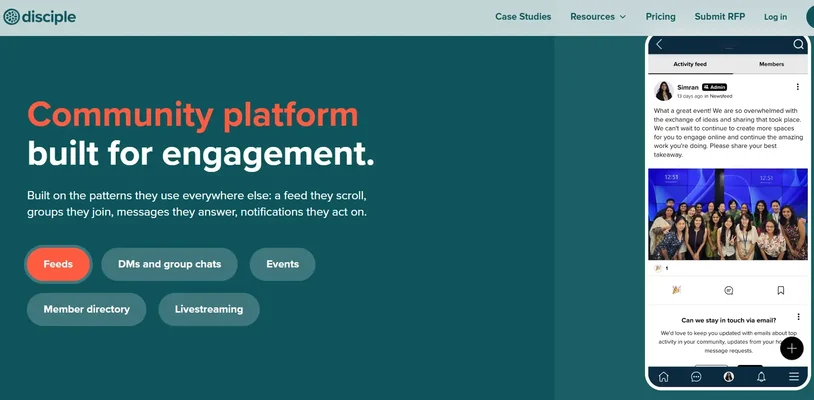
Disciple helps businesses build branded communities with dedicated websites and mobile apps. It focuses on community engagement through live streaming, memberships, and social interaction, with a strong emphasis on the branded mobile app experience specifically.
Features
- White-label mobile apps
- Community feed and groups
- Events and live streaming
- Courses and memberships
- Analytics
Pros
- Native mobile apps under your own brand
- Strong branding presentation
- Solid engagement features
- Professional appearance out of the box
Cons
- Premium pricing
- Less flexibility than a self-hosted, WordPress-based platform
- Hosted infrastructure, so data lives with the vendor
Best For: Brands, influencers, coaches, and organizations that specifically want a branded mobile community app as the primary experience.
6. Hivebrite
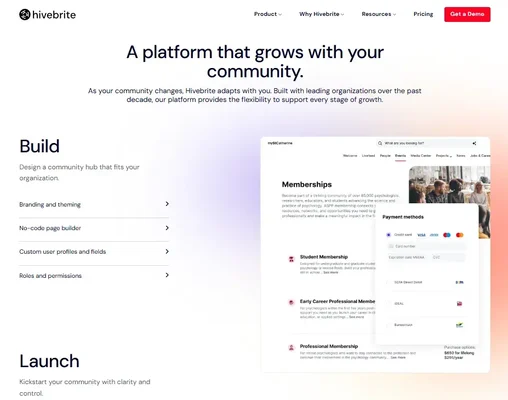
Hivebrite is designed for professional organizations, alumni associations, nonprofits, and private business communities. It offers advanced networking and member management capabilities aimed at institutional use cases rather than individual creators.
Features
- Member directory and groups
- Events and fundraising tools
- Email marketing and CRM integrations
- Job boards
- Analytics
Pros
- Powerful member management for large rosters
- Strong networking features built for professional communities
- Enterprise-ready
- Solid event management tools
Cons
- Higher pricing tier, aimed at institutional budgets
- More suited to larger organizations than solo creators
- Setup can be complex for a first-time community manager
Best For: Alumni associations, nonprofits, universities, professional organizations, and enterprise communities.
7. Higher Logic Vanilla
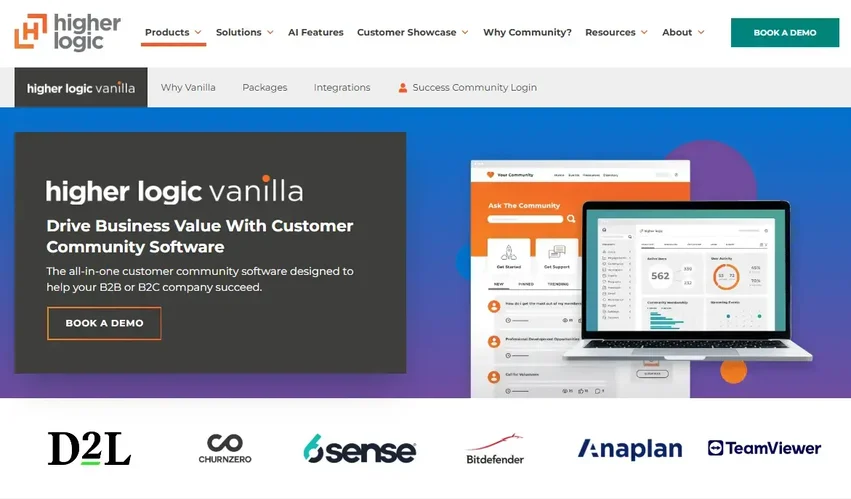
Higher Logic Vanilla is a community platform built for customer engagement, knowledge sharing, and enterprise support communities, with a track record among larger software companies running high-volume support forums.
Features
- Discussion forums and knowledge base
- Gamification and user reputation
- Analytics and moderation tools
- White label branding
- API integrations
Pros
- Enterprise-grade features and support
- Strong moderation tooling
- Solid customer support integrations
- Scalable architecture for high forum volume
Cons
- Expensive for small businesses
- Advanced setup process
- Less suitable for creator communities that need a social feed rather than a support forum
Best For: Large businesses, enterprise customer communities, software companies, and support forums.
Comparison Table
Platform | White Label | Self-Hosted | Mobile Apps | Membership Support | Best For |
|---|---|---|---|---|---|
BuddyNext | Yes, full design layer | Yes | Available through WordPress integrations | Yes, native | Businesses, membership sites, online communities, and learning platforms |
Mighty Networks | Yes, brand-skinned | No | Yes | Yes | Creators, coaches, and online educators |
Circle | Yes, brand-skinned | No | Yes | Yes | Membership communities, online courses, and creator businesses |
Bettermode | Yes | No | Limited | Limited | Customer communities, support portals, and knowledge bases |
Disciple | Yes, mobile-first | No | Yes | Yes | Branded mobile communities, creators, and membership businesses |
Hivebrite | Yes | No | Yes | Yes | Alumni associations, nonprofits, professional networks, and organizations |
Higher Logic Vanilla | Yes | No | Limited | Limited | Enterprise customer communities, support forums, and knowledge-sharing platforms |
What “White Label” Actually Means, and Where It Gets Misused
“White label” gets used loosely across this category, and the differences matter more than the marketing copy suggests. On most hosted SaaS platforms in this list, white label means you can replace the vendor’s logo with yours and pick from a set of predefined themes or color options. The underlying layout, navigation patterns, and interaction design stay fixed, because you’re customizing a shared product used by thousands of other communities.
On a self-hosted platform like BuddyNext, white label means something closer to its literal definition: the design system itself is yours to reshape, token by token, not just recolor. That distinction shows up the moment you want something the vendor’s theme options don’t support, a non-standard layout, a specific interaction pattern, an integration with an internal tool. On a hosted platform, that request goes into a feature request queue. On a self-hosted platform, it’s a design and development decision you get to make yourself.
Neither approach is wrong, but know which one you’re buying. If “looks like my brand” is enough, any platform on this list qualifies. If “behaves and feels like something we built” matters, the self-hosted option is doing meaningfully more work.
Buying Framework: Matching White Label Depth to Your Actual Need
1. How much does deep design control actually matter to your brand? An enterprise software company with an established design system will notice every pixel that doesn’t match; a solo coach launching their first paid community may not need that level of control on day one.
2. Do you need a branded mobile app specifically? Disciple and Mighty Networks lead here. BuddyNext works through WordPress mobile integrations rather than shipping a dedicated white-label app by default, so if a branded app store listing is the priority, weigh that specifically.
3. What’s your tolerance for vendor lock-in? Hosted platforms make switching later harder, since your community’s structure, member data, and design live inside their system. Self-hosted platforms keep switching costs lower because your data already lives in a database you control.
4. Do you need enterprise-scale member management, or creator-scale simplicity? Hivebrite and Higher Logic Vanilla are built for large institutions with dedicated community managers; Circle and Mighty Networks are tuned for individual creators moving fast.
5. Is monetization structure a factor? Some hosted platforms take a cut of transactions or price by active member count. Self-hosted platforms with native billing, including BuddyNext, keep that cost structure flat regardless of how large your paid membership base grows.
Common Mistakes When Choosing a White Label Community Platform
- Assuming “white label” means “fully custom.” Read the specific customization options each vendor actually offers before assuming you can build the exact experience you’re picturing.
- Ignoring how pricing scales with your member count or revenue. A platform that looks affordable at 200 members can become expensive at 5,000, especially on hosted plans that charge more as your community or transaction volume grows.
- Skipping the data export question. Before committing years of community history to any platform, confirm you can export member data, posts, and group structures in a usable format.
- Underweighting setup time. Self-hosted platforms take longer to configure initially; hosted platforms launch faster but leave less room to change your mind about design later. Budget accordingly for either path.
- Choosing a platform built for the wrong audience type. An enterprise-grade tool like Higher Logic Vanilla is overkill and overpriced for a small creator community, just as a lightweight creator tool will struggle to serve a 50,000-member alumni association.
What a Token-Based Design System Actually Buys You
The phrase “token-based design system” shows up a lot in platform marketing, so it’s worth explaining concretely what it changes for a white label community. Design tokens are the underlying variables, color values, spacing units, font sizes, that define how every element on the page looks. When a platform is built on tokens, changing your brand’s primary color updates every button, badge, and accent across the entire community in one place, rather than requiring you to hunt down and override dozens of individual CSS rules.
This matters for white labeling specifically because it’s the difference between “customizable” and “consistently customizable.” A community with fifty admin-configured colors scattered inconsistently across different pages looks unfinished even if every individual piece is technically brand-colored. A token-based system keeps that consistency automatic, which is part of why platforms built this way (rather than retrofitted with a theming layer after launch) tend to look more polished once branded.
Practically, when evaluating any platform on this list, ask to see two differently-branded communities running on the same underlying software. If they look meaningfully different beyond the logo and primary color, that’s a good signal the design system goes deeper than surface-level theming.
Setup Timeline: What to Expect From Each Category
Hosted platforms in this list (Mighty Networks, Circle, Bettermode, Disciple, Hivebrite, Higher Logic Vanilla) typically get you to a branded, functional community within a few days to a couple of weeks, most of that time spent on content setup and branding decisions rather than technical configuration. The platform itself handles hosting, security, and updates from day one.
A self-hosted platform like BuddyNext usually takes two to six weeks to fully configure and brand, depending on how much custom design work you want and whether you’re migrating existing members from another system. That timeline covers WordPress hosting setup (often already in place if you run an existing WordPress site), plugin configuration, membership tier setup, branding and theme work, and testing with a pilot group before a full launch.
Neither timeline is objectively better; it depends on whether you’re optimizing for speed to launch or depth of long-term control. A team with WordPress experience already on staff will find the self-hosted timeline much shorter than a team starting from zero.
Migration Considerations Between White Label Platforms
Switching white label community platforms later, whether you’re moving from a hosted SaaS tool to a self-hosted one or between two hosted platforms, involves more than a data export. Plan for three separate migration tasks: moving member accounts and their associated data (profiles, group memberships, activity history), rebuilding your branding and design decisions on the new platform’s system, and communicating the transition to your community so the change doesn’t feel like an unannounced disruption.
The member data migration is usually the most technical part and the one most likely to require developer help, particularly when moving between fundamentally different data models (a hosted platform’s proprietary format versus a self-hosted platform’s open database). Budget real time for this rather than assuming an export button solves the whole problem.
Ownership and Long-Term Risk: The Structural Question Behind “White Label”
A branded community only stays branded for as long as the underlying platform exists and keeps operating on terms you can live with. Hosted platforms can change their pricing, alter their feature set, or in rare cases shut down entirely, and a fully white-labeled hosted community still depends entirely on that vendor’s continued operation. Your members may never see the vendor’s name, but your business relationship with that vendor still determines whether the community keeps running.
Self-hosted platforms shift that risk. As long as you maintain your own hosting and keep the software updated, a self-hosted community keeps running regardless of what happens to the company that built the software, since you already have the code and the data. This isn’t purely theoretical: enterprise buyers evaluating platforms like Hivebrite or Higher Logic Vanilla for multi-year institutional deployments increasingly ask about this exact risk during procurement, because a community platform tied to alumni relationships or professional certification needs to outlast any single vendor’s business decisions.
Which White Label Community Platform Should You Choose?
The best platform depends on your goals.
If you want complete ownership, unlimited customization, full branding control, SEO flexibility, and the power of WordPress, BuddyNext is the strongest option.
If you prefer an all-in-one hosted platform for creators and want to launch quickly without managing infrastructure, Mighty Networks or Circle are strong choices.
Organizations managing alumni, nonprofits, or enterprise support communities may find Hivebrite or Higher Logic Vanilla better suited to their scale and institutional needs.
Brands that specifically need a branded mobile app as the centerpiece of the community experience should look closely at Disciple.
Frequently Asked Questions
1. What does “white label” mean for a community platform?
White label means the platform can be branded as your own, without the vendor’s name, logo, or default styling showing through. The depth of that customization varies significantly, from swapping a logo on a hosted platform’s fixed layout to reshaping the entire design system on a self-hosted one.
2. Is BuddyNext really white label, or just customizable?
BuddyNext ships with a token-based design system built specifically for brand control, colors, typography, dark mode, and layout style variations, on top of being fully self-hosted. There is no BuddyNext branding baked into the member-facing experience by default.
3. Which white label platform is cheapest to run long-term?
Cost comparisons depend on your specific usage, but self-hosted platforms like BuddyNext avoid per-member pricing entirely, which matters more as your community scales. Hosted platforms often price by plan tier or member count, so review each vendor’s current pricing page against your expected growth before comparing sticker prices.
4. Can I get a branded mobile app with a self-hosted platform?
Mobile access on WordPress-based platforms like BuddyNext typically comes through PWA support and WordPress mobile integrations rather than a dedicated white-label app store listing. If a fully custom branded app in the App Store and Play Store is the priority, Disciple or Mighty Networks are built specifically for that.
5. Do white label platforms let me use my own domain?
Most platforms on this list support a custom domain as part of their white label offering, including the hosted ones. Confirm this specifically for enterprise plans, since custom domain support sometimes sits behind a higher pricing tier.
6. What happens to my white label branding if I switch platforms later?
None of your branding investment (logo, colors, design decisions) is portable at the code level between platforms, but the strategic branding work, your visual identity, tone, and content, carries over regardless of the underlying software. Self-hosted platforms make the technical migration slightly easier since your data already lives in a database you control.
7. Is a self-hosted white label platform harder to maintain than a hosted one?
Yes, generally. Self-hosted platforms require you to handle updates, backups, and hosting, in exchange for deeper control and no per-member fees. Hosted platforms handle that maintenance for you as part of the subscription, in exchange for less design flexibility and ongoing platform lock-in.
8. Can a small creator use an enterprise-grade platform like Hivebrite or Higher Logic Vanilla?
Technically yes, but the pricing and setup complexity are built around institutional budgets and dedicated community management staff, so most solo creators will find better value in a creator-focused tool like Circle, Mighty Networks, or BuddyNext.
9. Do these platforms support custom CSS or code-level design changes?
This varies significantly. Self-hosted platforms like BuddyNext, being WordPress plugins, allow full custom CSS and even PHP-level customization by a developer, since you have complete access to the codebase. Hosted platforms typically offer a more limited custom CSS injection point, if any, and reserve deeper design changes for enterprise-tier plans or don’t offer them at all.
10. Which platform is best for a community that will eventually add paid courses?
Mighty Networks and Circle both bundle courses into their hosted offering. BuddyNext extends into courses through its companion app rather than a single built-in module, giving similar end-result functionality with the added benefit of native paid membership tiers managing the billing relationship. Bettermode, Hivebrite, and Higher Logic Vanilla are not built around course delivery and would need a separate LMS integration for that use case.
11. How do I evaluate whether a platform’s “enterprise” tier is worth the added cost?
Look specifically at what unlocks: dedicated support with defined response times, single sign-on for large member bases, advanced security and compliance certifications, and custom contract terms. If your community doesn’t need those specific things, a mid-tier plan on the same platform, or a different platform entirely, likely serves you better without the enterprise markup.
Content and Community Type: A Quick Cross-Reference
Different community types lean naturally toward different platforms on this list, beyond the general branding and ownership questions already covered.
- Paid coaching or cohort communities tend to do well on Mighty Networks, Circle, or BuddyNext, since all three combine discussion with native monetization.
- Customer support and product feedback communities fit Bettermode or Higher Logic Vanilla best, given their focus on knowledge bases and structured Q&A over social feeds.
- Alumni and professional networking communities are the core use case for Hivebrite, with its directory, fundraising, and CRM-focused feature set.
- Brand communities built around a mobile-first audience fit Disciple’s branded app approach particularly well.
- Communities that expect to add memberships, courses, forums, and gamification over time, without knowing exactly which combination they’ll need first, benefit most from a platform built to add those pieces natively, which is the specific gap BuddyNext is designed to fill.
Pricing Structures to Watch For
Even without quoting specific numbers, it’s worth understanding the shape of pricing across this category, since the structure matters more than any single figure. Hosted platforms generally fall into one of two pricing patterns: a flat monthly plan tier that caps certain features (member count, admin seats, custom branding depth), or a plan that scales directly with active members or transaction volume. The second pattern is the one to watch closely, since a community that succeeds and grows can trigger an unplanned cost increase at exactly the moment it’s working.
Self-hosted platforms flip that structure. A one-time or annual license fee covers the software regardless of how many members join, and the ongoing cost is hosting, which scales with server resources rather than member count directly. For a community that expects meaningful growth, this difference compounds significantly over a three-to-five-year horizon, even if the entry-level hosted plan looks cheaper in year one.
Before comparing any two platforms on this list, ask each vendor directly how their pricing changes as your member count, admin seats, or transaction volume grows, not just what the starting price is today.
Final Thoughts
Choosing the right white label community platform is an important decision because it affects your branding, member experience, and long-term scalability. It’s also a decision where the marketing term “white label” hides real differences in how much control you actually get.
If your priority is full customization, complete data ownership, WordPress flexibility, and white-label branding that goes deeper than a logo swap, BuddyNext stands out as one of the best community platforms available in 2026. Hosted solutions like Mighty Networks, Circle, Bettermode, Disciple, Hivebrite, and Higher Logic Vanilla remain strong alternatives for teams who prefer an all-in-one managed platform and are comfortable trading some design depth for faster setup.
Evaluate your budget, customization needs, and growth plans before making your final decision, and choose the platform that best supports your community’s long-term success, not just its launch-week appearance.
Whatever you choose, treat the branding work as an ongoing investment rather than a one-time launch task. Communities evolve, visual trends shift, and the platform that felt perfectly on-brand at launch may need a refresh two or three years in. Pick a platform that makes that future refresh straightforward rather than one where every design change requires a support ticket and a wait.
The strongest signal that you’ve chosen well isn’t how the community looks on launch day, it’s whether members forget they’re on a “platform” at all and simply experience it as your brand’s own space. That’s the real test white labeling was always meant to pass.
Revisit this comparison again once your community has real usage data behind it. The right platform at 300 members answering an open question is not always the right platform at 3,000 members with an established brand identity and revenue riding on the outcome.