How to Test-Drive a Community Platform Before You Commit: A One-Hour Evaluation Script
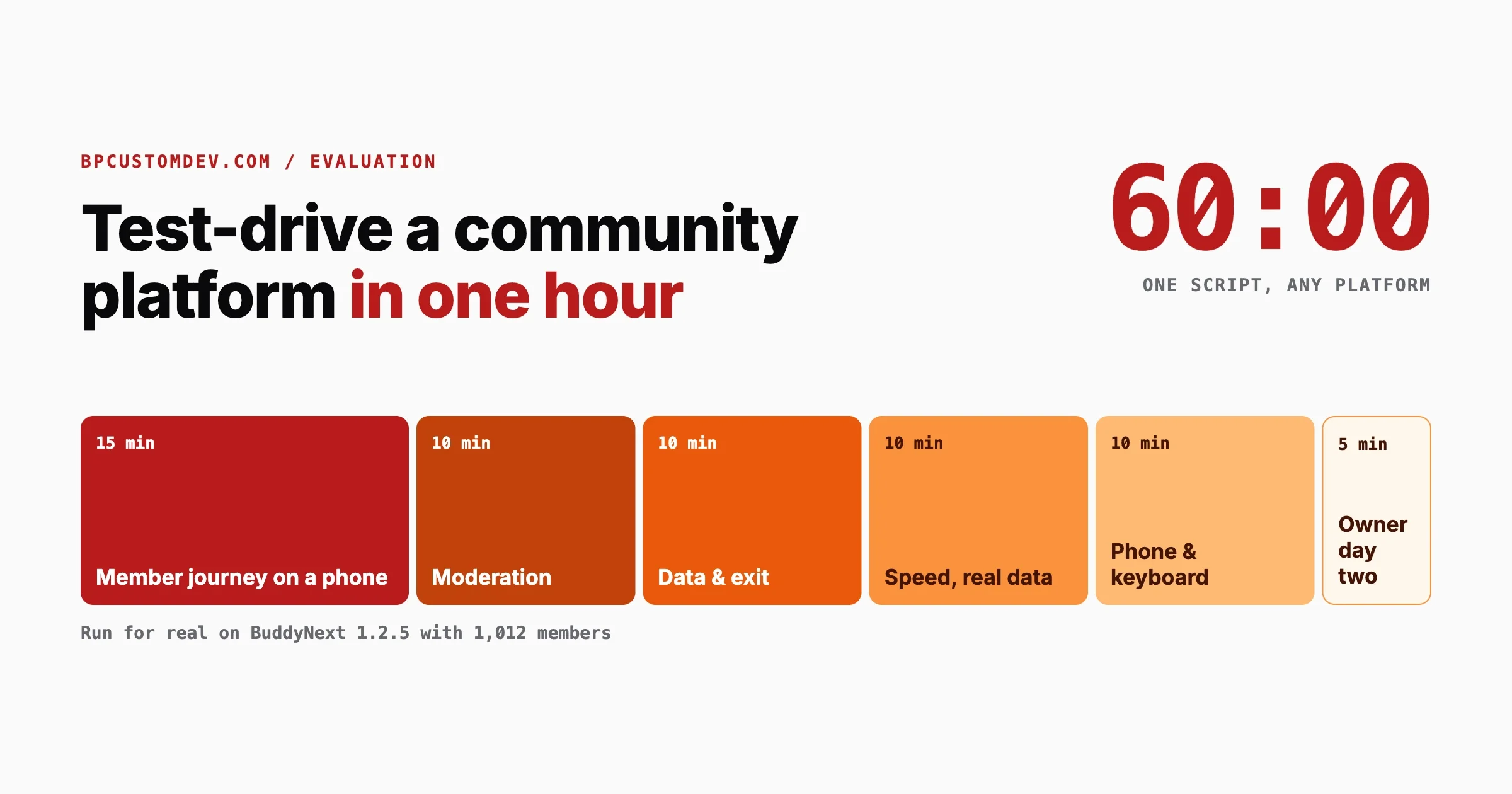
A one-hour script to evaluate any community platform during a trial: member journey, moderation, data export, speed, phone and keyboard, and the owner's day two. Run for real on BuddyNext with 1,012 members.

Most community platform evaluations are a sales demo followed by a gut feeling. Someone clicks around a polished sample community, it looks fine, and the real questions come up three months later: members cannot find the join button on a phone, nobody knows where reports go, and the export turns out to be a CSV of email addresses.
This is a one-hour script you can run against any community platform during a trial, a sandbox or a test install, and it works whether you are comparing hosted tools or a WordPress community. Each step says what to do, what good looks like, and what should worry you. To show what a real run looks like, we ran the whole script on a fresh install of BuddyNext 1.2.5 (our own community plugin) with 1,012 members, and the results are included at each step, including the ones that were not flattering.
Before you start: 5 minutes of setup
An evaluation only works if you can see what the owner sees and what a member sees. Before the clock starts, get these ready:
- Owner access. A tour or a read-only demo is not enough. You need the admin side to test moderation and settings.
- Two browsers, or one normal and one private window. One logged in as the owner, one as an ordinary member. Many problems only show up when you switch between them.
- A phone, or your browser’s device mode at 390 pixels wide. Most members will arrive on a phone.
- Realistic data. An empty community hides every performance and navigation problem. Use the platform’s seeded sample data, or import a few hundred test members if you can.
- A notes file with the scorecard from the end of this guide.
How long you get to test, as of today
Trial terms change, so check the vendor’s own page on the day. This is what each pricing or demo page said on 17 October 2026:
Platform | How you can test it |
|---|---|
Circle | 14-day free trial, no credit card required |
Mighty Networks | 14-day free trial, no credit card required, on its Growth plan |
Skool | The pricing page shows a “Try for free” button but does not state the trial length or whether a card is needed |
BuddyBoss | No free trial; a 14-day money-back guarantee, and a demo import tool once you own it |
BuddyNext | A sandbox with owner access that lasts four hours and needs an email address, or the free plugin installed on your own site with no time limit; the source code is public |
For a full hour of testing, any of these is enough. The difference matters later: a trial ends, while a free install on a staging site can stay up while you decide.
Who should be in the room
An evaluation run by one person tests one point of view. If you can, split the hour between three people, or at least wear three hats deliberately:
- The owner, who will configure the platform and answer for it. They run Blocks 3 and 6.
- A moderator, even a volunteer, who will deal with reports on a busy evening. They run Block 2 and should be the one who decides whether the queue makes sense.
- Someone like your members, ideally not technical and not involved in choosing. They run Block 1 on their own phone, while you watch and say nothing. Where they hesitate is where your real members will give up.
Write down where each person got stuck, in their words. “I could not find where my groups were” is more useful than a score.
Block 1: The member journey (15 minutes)
Do this as a member, on the phone, not as the owner on a laptop.
- Sign up as a new member. Count the steps and the fields. Note whether you can tell what to do next once you are in.
- Fill in your profile and check who can see each field.
- Write a post in the main feed, then one inside a group or space.
- Join a group or space, and then try to leave one.
- Get a notification: have your owner account reply to your post, then check what the member sees, both on the site and by email.
Good looks like: each action takes one obvious tap, gives clear feedback, and shows up where you expect it. Worry if: buttons are hidden in menus on a phone, posts appear only after a reload, or a notification never arrives.
What we found on BuddyNext
- The feed opened with the composer at the top (“What’s on your mind, Alex Rivera?”), feed tabs (For you, Following, Spaces, Network) and a bottom navigation bar for Activity, Spaces, Notifications and Profile at phone width. No sideways scrolling.
- Posting took 0.8 seconds from tapping Post to the post appearing in the feed, with no reload.
- Joining a space was one tap. When our test script accidentally hit “Joined: click to leave” on a different space, a “Leave this space?” confirmation stopped it. We cancelled and the membership was untouched, which we confirmed in the database. Small, but it is the kind of thing that saves members from accidents.
- Email notifications could not be tested, and the platform told us why (see Block 6).
Block 2: Moderation (10 minutes)
Every community eventually needs to remove something. Test the whole path, not just whether a “report” button exists.
- As a member, report another member’s post. Note what the reporter is told, and whether you can give a reason.
- As the owner, find the report. Time how long it takes to locate the queue without help.
- Act on it. Remove the content, then check as the member that it is really gone.
- Look for a record. Is there a log of who removed what, and when? Can removed content be recovered?
Good looks like: one queue, reasons attached to reports, a confirmation before removal, and a log. Worry if: reports go to an email inbox, removal is a permanent delete with no record, or members can see who reported them.
What we found on BuddyNext
- The report dialog asked for a reason (spam, harassment or hate speech, misinformation, inappropriate content, fake account, impersonation, something else) with optional details, and told the reporter: “Reports are reviewed by moderators. The person you report is not notified.”
- The report appeared in the owner’s Moderation, Reports queue straight away, with filters by content type and reason and a sort by newest or most reported.
- “Remove content” asked for confirmation and explained that the content “is hidden, not hard-deleted”. After confirming, the queue showed 0, the post had disappeared from the feed, its status in the database was
deletedrather than gone, and the action was recorded in the moderation log with who did it and when. - The moderation area also has tabs for pending posts, suspensions, appeals and the moderation log, so it is clear where each kind of decision lives.
Block 3: Data, export and leaving (10 minutes)
This is the block most evaluations skip and most owners regret skipping. You are not only choosing software, you are choosing where your members’ data lives and how it gets out again.
- Export one member’s data, as you would for a privacy request. Look at what is actually included: posts, comments, follows, memberships, or only the profile?
- Find the full export. Can you get every member, post and relationship out, in a format another system could import?
- Find out where the data lives. Your database, or the vendor’s? Which country?
- Read the exit terms. What happens to your data when you stop paying?
Good looks like: a complete personal export, a documented full export, and a clear answer to “where is it stored”. Worry if: the export is email addresses only, posts and conversations cannot be exported, or the answer to “where” is vague. Our guide to what a community platform keeps about your members lists the questions to put to a vendor, and leaving Circle, Skool, Mighty Networks or Discord shows what each one’s export actually gives you.
What we found on BuddyNext
- BuddyNext plugs into WordPress’s built-in personal data export and erase tools. For our test member, its exporter returned 13 groups: profile and settings, profile fields, following, followers, connections, space memberships, notifications, posts, comments, reactions, bookmarks, presence and the email log. A matching eraser is registered for deletion requests.
- Everything lives in your own WordPress database: we counted 41 BuddyNext tables (posts, comments, spaces, memberships, follows, connections, reports, the moderation log and so on). A normal database backup is a complete export, and it never leaves your server.
- The plugin source is public on GitHub, so you can see exactly what is stored before you commit.
Block 4: Speed with real data (10 minutes)
A community with five members is always fast. Test with hundreds or thousands.
- Load the main feed, the member directory and the list of groups while logged in, and time each one.
- Page through the member directory and search for a member by name.
- Check that pages are paginated, not one endless list loading everything at once.
- Write down the numbers, then repeat them on the hosting you would actually use before you decide.
Good looks like: pages that stay quick as data grows, and lists that paginate. Worry if: the directory slows down as members are added, or the vendor will not say how large their biggest communities are.
What we found on BuddyNext
- BuddyNext ships a WP-CLI command to build a realistic test community.
wp buddynext demo scale --members=1000created 1,000 members, about 5,000 follows, 2,000 connections, 1,000 space joins and 250 posts in 68 seconds, on top of the curated demo of 12 members, 14 spaces and 19 posts. - With 1,012 members, the logged-in feed, member directory, spaces list and notifications page each came back from the server in about 35 milliseconds. That was on a local Docker machine with no network in between, so treat it as “the software is not the bottleneck”, not as what your hosting will do.
- The feed is rendered on the server, so content is in the page without waiting for JavaScript. The full feed page HTML was about 450 KB, which is worth watching on slower mobile connections and is the kind of figure to compare between platforms.
For what changes on real hosting, our community hosting guide covers the server side.
Block 5: Phone and keyboard (10 minutes)
- At phone width, check every screen you used in Block 1: nothing should scroll sideways, and the main actions should be reachable with a thumb.
- Put the mouse away and use Tab. Can you reach the post box, the post button and the menu? Can you see which element has focus?
- Turn on your phone’s larger text setting and check that nothing breaks.
Good looks like: a layout designed for phones, not a shrunken desktop page, and every control reachable by keyboard with a visible focus ring. Worry if: buttons are icon-only with no labels, or focus disappears.
What we found on BuddyNext
- At 390 pixels wide the feed had no horizontal scroll, with a fixed bottom bar for the main sections and a floating button for new posts.
- Tabbing from the top of the feed reached the site name, account menu, main menu, post box, poll, emoji, schedule, audience (“Posting to Public”), Post button and the four feed tabs, in that order. All 14 had an accessible name and a visible focus indicator.
Block 6: Day two for the owner (5 minutes)
Start with first-run setup. Note what the platform created for you and what you would have to build yourself. On BuddyNext, activating the plugin created six pages on its own (Activity, Members, Spaces, Messages, Notifications and Login), so the community had working addresses before we touched a setting. On a hosted platform, check the equivalent: which sections exist on day one, and which you have to design.
Running a community is mostly the days after launch. Spend the last block as the owner, looking for the things that will need you.
- Read every warning in the admin area. Good software tells you what is wrong before members do.
- Check email delivery. Are sign-up and notification emails actually being sent? Is there a log?
- Find the settings you would change first: registration, privacy defaults, notification defaults.
- Check updates and support: how often is the software updated, and where do you get help?
What we found on BuddyNext
This block produced the most useful finding of the hour. Our test site had no mail server, which is common on staging and on some new hosting. Instead of failing silently, BuddyNext showed a warning across its admin screens: “BuddyNext email is failing to send. 1,012 email(s) failed in the last 24 hours. This usually means the site has no working mailer (SMTP plugin or server MTA). Members are not receiving verification, invite, 2FA or notification email,” with a link to the email log.
That is exactly the problem that otherwise surfaces as “nobody can verify their account” a week after launch. It also showed a notice that setup was not complete, with a link to the setup wizard. On any platform, look for this kind of honesty: a quiet admin area with broken email is worse than a noisy one.
The scorecard
Copy this into your notes and score each platform 0 to 2 per row (0 = failed or missing, 1 = works with friction, 2 = works well). The point is not the total, it is having the same questions answered for every option.
Check | What a 2 looks like |
|---|---|
Sign-up on a phone | Few steps, clear next action |
Posting | Appears instantly, no reload |
Joining and leaving groups | One tap, with a confirmation before leaving |
Notifications | On-site and email both arrive |
Reporting | Reasons, reporter kept anonymous |
Moderation queue | One place, filters, confirmation, log |
Personal data export | Posts, comments and relationships, not just the profile |
Full export and exit | Documented, complete, importable |
Where data lives | Clear answer, ideally your own server |
Speed with real data | Stays quick at hundreds or thousands of members |
Phone layout | No sideways scroll, thumb-reachable actions |
Keyboard and labels | Every control reachable, visible focus |
Admin warnings | Problems like failing email are flagged |
Red flags that end an evaluation early
- You cannot get owner access during the trial.
- The only export is a list of email addresses.
- Removing content is a permanent delete with no record of who did it.
- The phone layout is the desktop page shrunk down.
- The vendor cannot say where member data is stored.
- Pricing grows with every member, with no published ceiling. Our breakdown of what Skool costs against self-hosted WordPress at 500, 1,000 and 5,000 members shows how quickly that adds up.
What one hour cannot tell you
Be honest with yourself about the limits of a test drive. In one hour you will not learn:
- How it behaves on your hosting under real traffic. Test speed again on the server you will use.
- Whether email reaches inboxes at volume. That depends on your mail setup as much as the platform.
- How payments behave over months: renewals, failed cards, refunds and upgrades.
- How a migration goes with your real data. If you are moving an existing community, run a test import of real data before deciding.
- How the vendor responds when something breaks. Ask a support question during the trial and time the answer.
Frequently asked questions
How long should a community platform evaluation take?
One focused hour per platform covers the member journey, moderation, data export, speed, phone use and the owner’s day-to-day. Run the same script on every option so the results are comparable.
Is there a BuddyPress or BuddyNext demo I can try?
BuddyNext has a sandbox with owner access that lasts four hours and needs an email address, and the free plugin can be installed on your own site with no time limit. For BuddyPress, the simplest test is a free install on a staging site, so you can test with your own theme and plugins.
What should I test first in a community platform trial?
The member journey on a phone. If members cannot sign up, post and find their groups easily on a phone, nothing else in the evaluation matters.
How do I test performance during a trial?
Load the platform with realistic data, hundreds or thousands of members, then time the feed, member directory and group list. Repeat the test on your real hosting before deciding.
What should a community platform’s data export include?
For a member: their profile, posts, comments, group memberships and relationships, not just their email address. For the whole community: every member, post and relationship in a format another system can import.
BuddyPress or BuddyBoss: which should I evaluate?
Run the same script on both, plus any hosted option you are considering. BuddyBoss has no free trial but offers a 14-day money-back guarantee, so plan your hour inside that window; BuddyPress is free to install on a staging site.
Why test with two browsers?
Because many problems only appear when you switch roles: a report the owner never sees, a notification that never reaches the member, or a private group a member can still read.
How we ran this
We ran the script on 17 October 2026 on a fresh install of WordPress 7.1.3 and BuddyNext 1.2.5 (free) from its public GitHub release, on PHP 8.3 in Docker, with 1,012 members created by BuddyNext’s own seeding command. Member steps were done in a real browser at 390 pixels wide; the owner steps at desktop width. Results were checked in the database where possible, for example the space membership and the removed post’s status. Trial terms for other platforms come from their own pricing pages on the same day and may change. BuddyNext is built by our team, which is why we used it as the worked example; the script itself works on any platform.
Choosing a platform for a real community? Our community platform alternatives guide compares the options, our community development team can run this evaluation with you on your own data, and you can book a discovery call to talk through what you are building.