Membership Website Development: Scope, Build Order and the Decisions You Can't Undo
Membership website development for owners commissioning a members-only community: the one-page scope, the build order that avoids rework, and the eight decisions that cost most to change later.

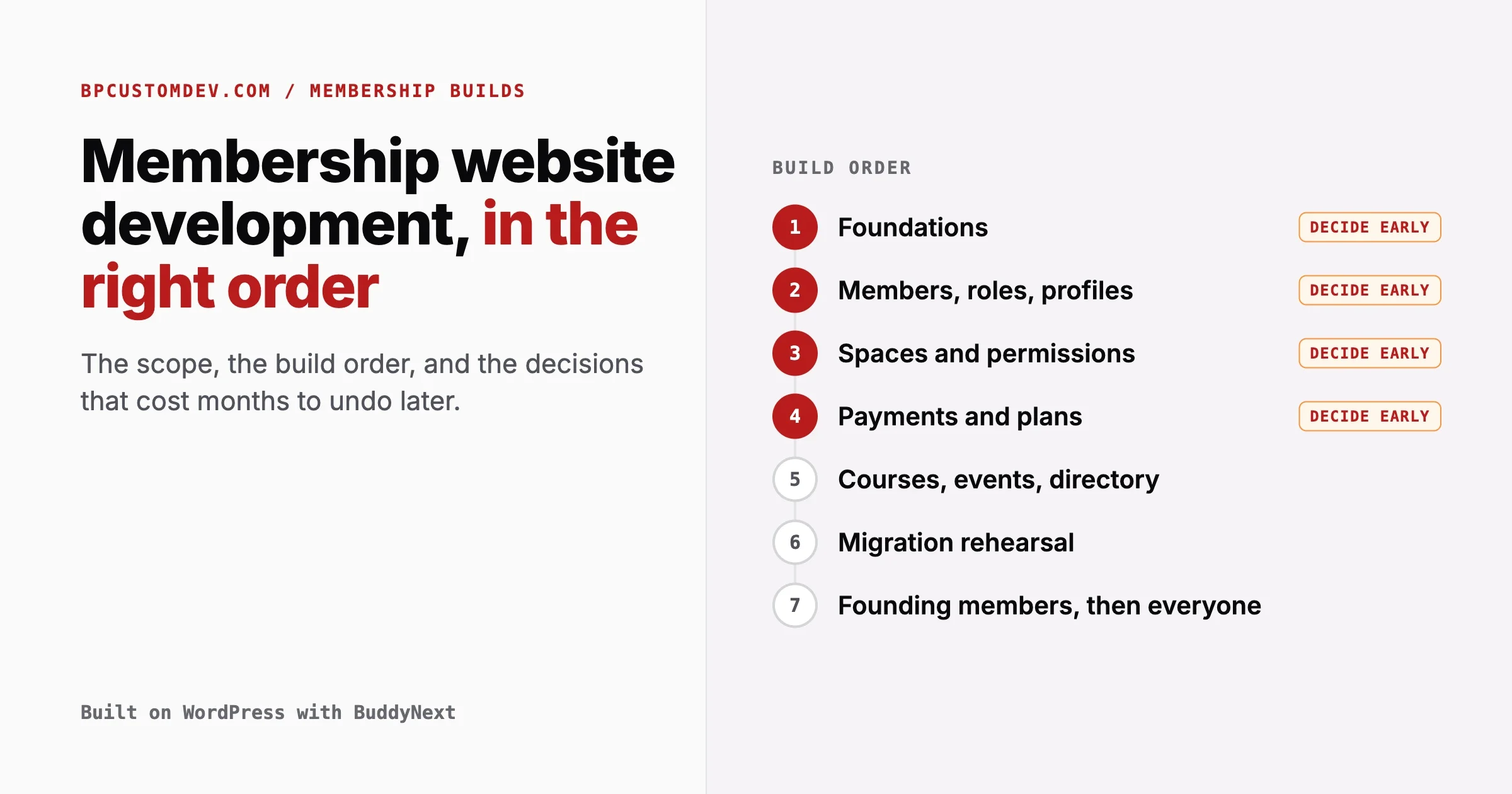
Membership website development goes wrong in a predictable place. Not in the code, which any competent team can write, but in a handful of early decisions that look small in week one and cost months to reverse in year two: who holds the billing record, how member data is shaped, what the URLs look like, and which spaces are private. This guide is for the person commissioning the build. It covers what to scope, the order to build in, and the decisions to settle before anyone writes a line of code.
We build community platforms on WordPress with BuddyNext, our community software, so the examples use it. The build order and the irreversible decisions apply whatever you build on.
In this guide
- First decide which kind of membership site you are building
- The scope, on one page
- The membership website development order that avoids rework
- The decisions you cannot undo cheaply
- What BuddyNext covers, and what it leaves to other tools
- Moving an existing membership across
- Launching without a quiet empty room
- What to hand your developer
- Frequently asked questions
First decide which kind of membership site you are building
“Membership site” names two different products, and buying for the wrong one is the most expensive mistake on this list. One sells access to content: articles, videos, downloads behind a paywall. The other sells access to people: a community where members talk, meet, share and help each other. They need different software.
Question | Content membership | Community membership |
|---|---|---|
What does a member pay for? | Reading or downloading something | Belonging somewhere, and what they can do inside |
What does the platform protect? | Posts, pages, files | Spaces, conversations, member-only areas |
What brings members back? | New content you publish | Other members |
Typical tools on WordPress | MemberPress, Paid Memberships Pro | A community platform such as BuddyNext |
Plenty of real sites are both, and that is fine. The clean way to run both is to let a content membership plugin keep charging for the content while the community platform runs the community, with the membership grant bridged between them so one payment opens both doors. What you want to avoid is forcing one tool to do the other’s job: a content paywall bolted onto a forum, or a community tool asked to protect a library of downloads.
If you are still choosing between hosted platforms and your own site, our guide to community platform alternatives compares the options before any build starts.
The scope, on one page
Write the scope before you ask for a quote. A one-page scope is not a specification. It is the set of answers a developer needs to give you an honest estimate, and the document you will come back to every time someone asks “can we also add...”.
Scope item | Write down | Example |
|---|---|---|
Who it is for | One sentence, plus who it is not for | “Independent physiotherapists in the UK. Not patients.” |
Membership model | Free, paid, or both; one level or several | “Free tier to join, paid tier for the clinical spaces” |
What each level opens | Spaces, features, limits | “Paid opens the case-review space and direct messages” |
Profile data | Every field, and who can see it | “Specialism (public), registration number (admins only)” |
Where the money goes | Which system holds the subscription | “Existing WooCommerce store keeps billing” |
Content beyond the community | Courses, events, directory, jobs | “Monthly live sessions; courses in year two” |
Existing members | How many, and where they live now | “2,400 members in an old BuddyPress site” |
Moderation | Who moderates, and how fast | “Two volunteer moderators, reports answered within a day” |
Launch size | Founding members, then everyone | “150 founding members in month one” |
Our list of 33 questions to send vendors before you sign turns this page into a request every bidder answers in the same format, which makes quotes comparable. For the feature side, the membership site features checklist covers what members expect to find once they are inside.
The membership website development order that avoids rework
Build from the data outwards: identity and profiles first, then spaces and permissions, then payments, then everything that hangs off them. Teams that start with the homepage design or the payment page end up rebuilding both once the member model settles. This order is the one we follow, and the reason for each step is the rework it prevents.
Phase 1: Foundations
Hosting sized for logged-in traffic (community pages are rarely cached the way a brochure site is), the final domain, transactional email sending from your own domain with SPF, DKIM and DMARC set up, backups with a tested restore, and a staging copy. Nothing here is visible to members, and all of it is painful to change after launch.
Phase 2: Members, roles and profiles
Registration, the profile fields, who can see each field, member types if you need them, and the roles your team will hold: administrators, moderators, perhaps space leaders. Settle this before any content exists, because every later feature reads from it.
Phase 3: Spaces and permissions
The places members gather, whether each is public or private, who can post, and who moderates. Map every space to the membership level that opens it. A simple table, spaces down the side and levels across the top, catches most permission mistakes before a member finds them.
Phase 4: Payments and plans
Only now connect the money. Decide which system holds the subscription (see the decisions below), map each plan to what it opens, and run real test purchases: join, upgrade, downgrade, cancel, fail a renewal. In BuddyNext, a payment bridge grants nothing until monetization is switched on and a product or level is explicitly mapped to a plan. That is deliberate, so nobody gets inside by accident, and it means the mapping is a step to plan and test, not a box that ticks itself.
Phase 5: Everything that hangs off the community
Courses, events, a directory, jobs, gamification, a member blog. Each is a separate product with its own data, so add them one at a time and confirm each one shows up in the community the way you expect before starting the next.
Phase 6: Migration rehearsal
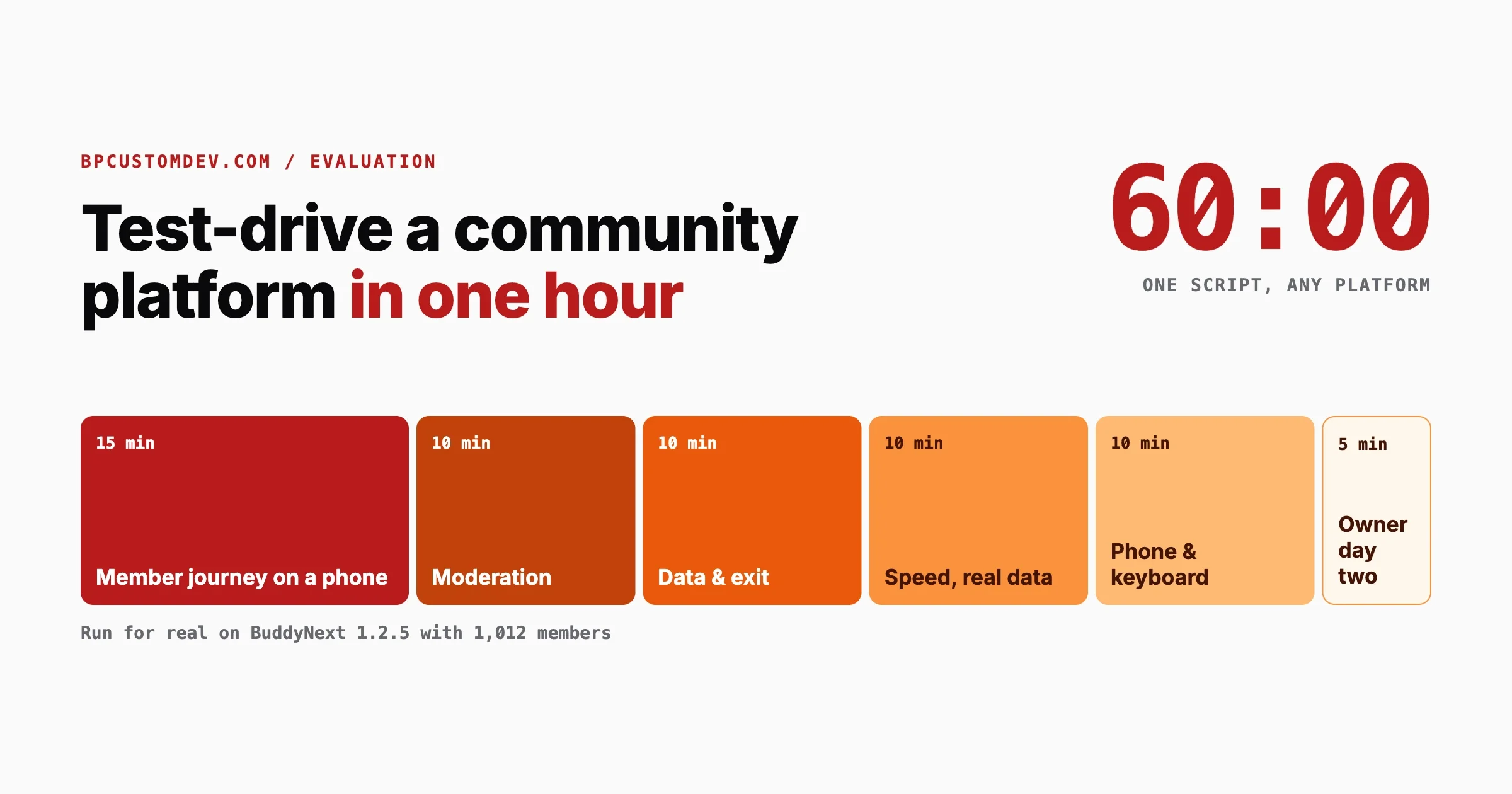
If members are coming from another platform, run the import on staging at least once before launch, with real data, and have two or three real members log in and check their profile, their messages and their history. The first import always finds something.
Phase 7: Founding members, then everyone
Open to a small group first, fix what they find, then open the doors. More on this below.
The decisions you cannot undo cheaply
These are the decisions that cost the most to change after launch, because each one gets written into thousands of records or links. Settle every one of them in writing during discovery.
1. Which system holds the billing record
The subscription lives in exactly one place: the community platform’s own billing, a membership plugin, or your store. Moving it later means moving every active subscription and payment method, which most gateways will not let you do silently; members may have to re-enter card details. BuddyNext Pro can run its own plans, or take the membership grant from Paid Memberships Pro, WooCommerce or Learnomy, so a system you already trust can stay in charge of the money. Pick one as the system of record and write it down.
2. One source of truth for “is this person a member?”
Two plugins that both decide membership will eventually disagree, and a member who paid will be locked out of something. If you bridge a grant from a store or membership plugin into the community, that bridge is the only thing that opens community access. No manual role changes “just this once”.
3. The shape of member data
Profile fields become the basis of your directory, your search filters, your onboarding and your reports. Renaming a label is cheap. Splitting one free-text field into three structured ones after 3,000 members have filled it in is a data clean-up project. Decide which fields are free text and which are choices, which are required, and which are private, before registration opens.
4. URLs and slugs
Member profile URLs, space URLs and content URLs get shared in emails, bookmarked and indexed by search engines. Changing them later means redirects for every one of them. Decide the URL pattern once, and never reuse a slug that has been public.
5. What is private
Making a public space private is easy. Making a private space public exposes every conversation members had when they believed it was closed. Default new spaces to private when in doubt, and treat any change from private to public as a decision for the people in that space, not a setting.
6. Where member data lives
On your own WordPress, members sit in a database you control, can be exported, and do not leave when you change suppliers. On a hosted platform, the export is whatever the vendor provides. If owning the member list matters to your organisation, decide that before the build, not when you want to leave. Our guide to what a community platform keeps about your members covers the questions to ask.
7. Email sending
Notifications, digests and password resets all leave from one sending domain. Set it up properly on day one. Moving sending domains later resets your reputation with inbox providers, and a community whose notifications land in spam goes quiet without anyone noticing why.
8. Who moderates, and how
Write down who can remove content, who handles reports, and how quickly. Moderation tools can be added at any time; a culture where reports go unanswered for a week is much harder to reverse.
What BuddyNext covers, and what it leaves to other tools
Being clear about the boundary saves a wrong purchase. Here is how BuddyNext divides the work:
Need | Where it lives |
|---|---|
Feed, spaces, member profiles, messaging, moderation | BuddyNext free core |
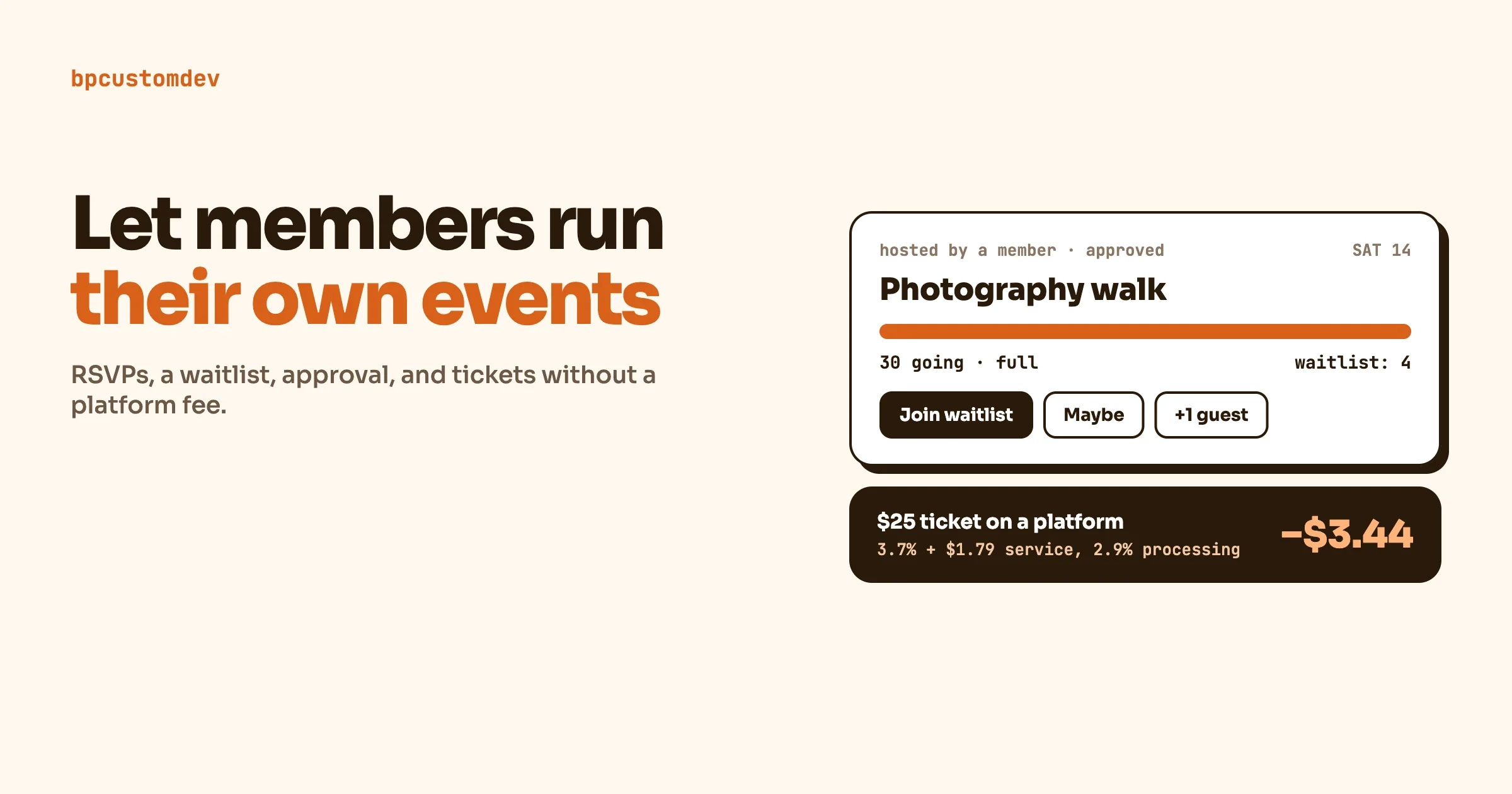
Membership plans, gated spaces, payment gateways | BuddyNext Pro: plans open spaces and lift member limits |
Taking the membership grant from an existing system | BuddyNext Pro bridges to Paid Memberships Pro, WooCommerce and Learnomy |
Protecting blog posts, custom post types or downloads | A content membership plugin such as MemberPress or Paid Memberships Pro |
Courses | Learnomy, with course completions and certificates appearing in the community feed |
Member analytics | BuddyNext Pro: daily, weekly and monthly active members, top members, space health and cohort retention |
Two limits worth knowing before you scope: BuddyNext Pro membership tiers gate spaces and posts, not courses, directory listings or events, and the payment bridges need monetization enabled and a product or level mapped to a plan before they grant anything. The full comparison is on the BuddyNext free vs Pro page.
The sensible way to start is the one we recommend to every client: run the free core first, get people talking, and add paid plans once there is something worth paying to be part of. A paywall on a room nobody visits is a slow way to learn that the room needed work first.
Moving an existing membership across
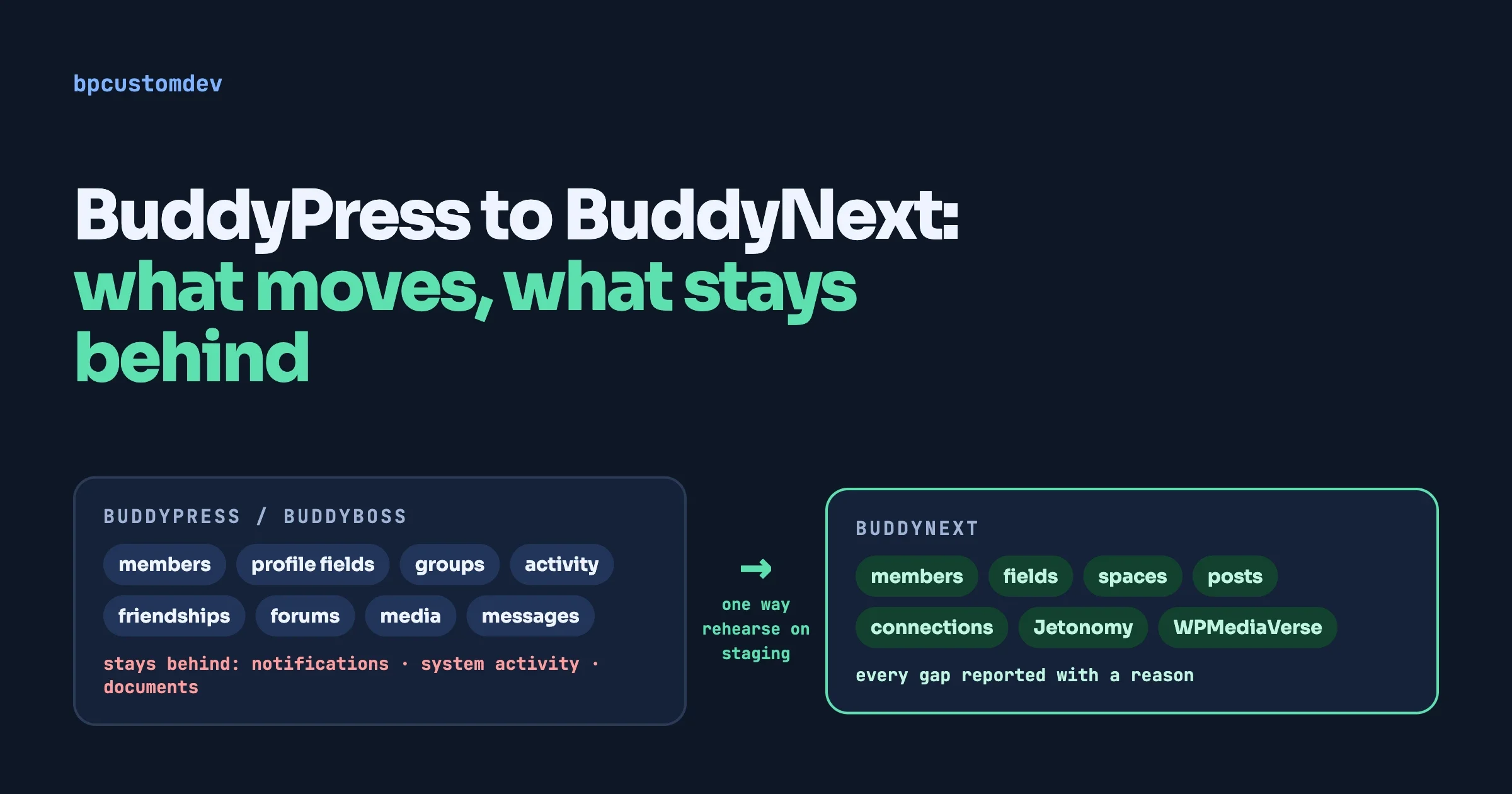
If your members already live in BuddyPress or BuddyBoss, the importer brings them across rather than asking them to start again. BuddyNext’s importer reads the existing tables and brings over profile fields and member types, groups (which become spaces, keeping their privacy settings and member roles), activity history with comment threads, friendships, follows and reactions, bbPress forums with topics and replies, avatars and cover images, albums and media, and private messages.
A migration still needs a plan:
- Rehearse on staging with a full copy of real data, and time it, so you know how long the live move will take.
- Freeze changes during the live move, with a short notice to members.
- Keep the old URLs working with redirects, so links in old emails and search results still land somewhere sensible.
- Tell members what changed: where things moved, what looks different, and who to ask.
Our BuddyPress to BuddyNext migration guide covers what maps to what in detail, and if you are leaving a hosted platform instead, see moving from a SaaS community to WordPress.
Launching without a quiet empty room
Launch to a founding group before you launch to everyone. A new community fails most often not because of a bug, but because the first visitors find nobody there and never come back. A founding group fixes both problems at once: they find the real bugs, and they leave conversations behind for the people who arrive next.
- Invite 50 to 150 people who already know you and each other.
- Seed each space with two or three real questions or posts before anyone arrives.
- Run it for two to four weeks. Watch where people get stuck: registration, profile, finding a space, notifications.
- Fix, then open. When you open to everyone, the community already has a history.
If paid plans are part of the model, consider letting founding members in free or at a founding price, and turning plans on when the wider launch happens. People pay to join something that is visibly alive.
Test these before anyone pays
Most launch-week problems in membership builds are not bugs in the code; they are paths nobody walked. Before the founding group arrives, have someone who did not build the site walk every one of these with a real test account, not an administrator account. Administrators can see everything, so they hide permission mistakes.
Path | What to confirm |
|---|---|
Join on the free level | Registration email arrives, profile fields save, only free spaces are visible |
Buy a paid plan | Access opens within seconds of payment, the receipt arrives, the member lands somewhere useful |
Upgrade and downgrade | Spaces open and close to match the new plan, nothing the member posted disappears |
Cancel | Access ends when the paid period ends, not the moment they click, and the member is told when |
Failed renewal | The member is told, gets a chance to update the card, and access is handled the way your policy says |
Refund | Access is removed, and the subscription does not keep sending reminders |
Each role | A moderator can moderate, a space leader can lead their space only, a member cannot see admin tools |
Private space | Content from it never appears in the public feed, search results or notification emails to non-members |
Phone | Registration, checkout and posting all work at phone width, with the keyboard open |
Notifications reach Gmail and Outlook inboxes, not spam folders |
Write the results down. The same list becomes your regression check every time a plugin, theme or payment setting changes after launch, which is when the quiet breakages happen. A membership site that worked on launch day and stopped granting access after an update three months later is a common story, and a ten-minute walk through this table after every update catches it.
One more check that is easy to skip: log in as a member on a second browser while you change their plan as an administrator. The member’s view should update on the next page load. If it only updates after they log out and in again, members will report it as “I paid and nothing happened”, and your support inbox will hear about it before you do.
What to hand your developer
A developer who has these on day one can give you a real estimate and a real plan:
- The one-page scope above, with the decisions section filled in.
- The spaces-by-levels permission table.
- Every profile field, its type, whether it is required, and who can see it.
- Which system holds billing, and the plans with what each one opens.
- Access to any existing site and a sample of real data for the migration.
- Who on your side decides, and how fast they can answer questions.
Ask for the build order in writing too, with what you will be able to click on at the end of each phase. Phases you can see beat a single delivery date you cannot.
Budget for the years after launch as well as the build. Our breakdown of what a custom community build costs to own over five years lists the running costs that rarely make it into the first quote.
Frequently asked questions
What is the difference between a membership site and a community site?
A membership site usually sells access to content, such as articles, videos or downloads. A community site sells access to other people and what members can do together. Many sites are both, and run a content membership plugin alongside a community platform.
Can BuddyNext charge for membership on its own?
Yes, with BuddyNext Pro. Plans open spaces and lift member limits, with their own payment gateways. The community features themselves are in the free core.
Can I keep my existing membership plugin or store?
Yes. BuddyNext Pro can take the membership grant from Paid Memberships Pro, WooCommerce or Learnomy, so your existing system keeps the billing. The bridge needs monetization enabled and each product or level mapped to a plan before it grants access.
Can BuddyNext protect blog posts or downloads?
That is a content membership job, and a dedicated plugin such as MemberPress or Paid Memberships Pro does it better. BuddyNext gates community spaces and posts, and can take the membership grant from those plugins.
Can existing BuddyPress or BuddyBoss members be moved over?
Yes. The importer brings across profile fields, member types, groups as spaces with their privacy and roles, activity, friendships, forums, media and private messages. Rehearse it on staging before the live move.
What should we decide before development starts?
Which system holds billing, the single source of truth for membership, the shape of profile data, the URL pattern, which spaces are private, where member data lives, the email sending domain, and who moderates. These are the most expensive to change later.
How long should a founding-member phase last?
Two to four weeks is usually enough to find the real problems and leave conversations behind for the next members.
How we wrote this
The build order and decisions come from how we scope community builds. Statements about what BuddyNext does and does not do were checked against BuddyNext’s own product and documentation pages on 17 October 2026, including the list of claims the product team keeps for things it does not do. We have not quoted prices, because every build is scoped on a call first.
Planning a membership community? Our social network with paid membership page shows what we build, and our community development team can turn your one-page scope into a build plan. Book a discovery call and bring the decisions list.