Member-Run Events: RSVPs, Waitlists and Paid Tickets
How to let members run their own events inside your community: RSVPs, waitlists, approval, paid tickets, what ticketing platform fees cost and when to move events to your own site.

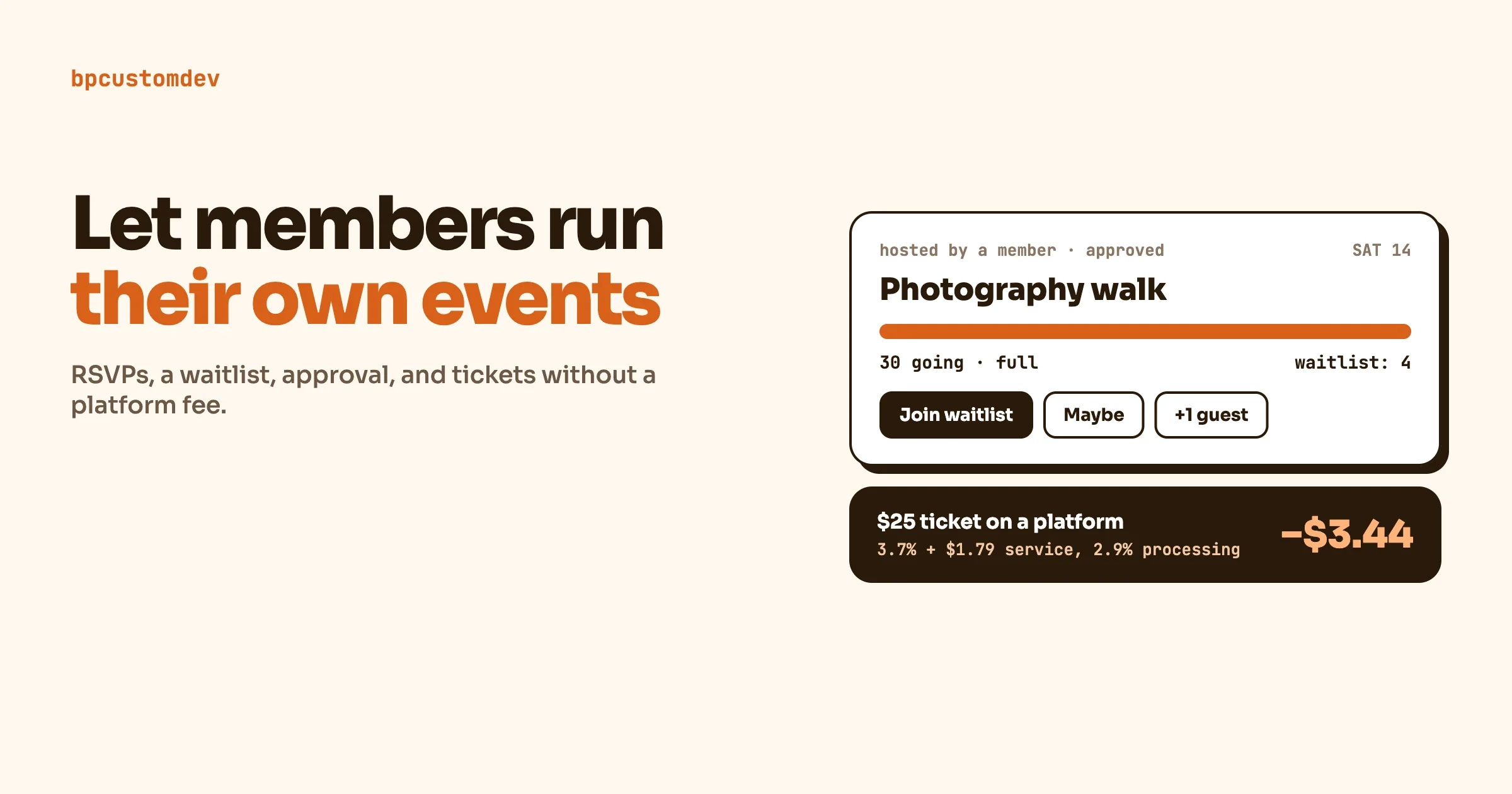
A community comes alive when members run events for each other, not when every meetup has to pass through one busy admin. To make that work you need five things: a way for members to create events without the admin area, an approval step you control, RSVPs with a capacity limit and a waitlist, paid tickets when money is involved, and the event showing up where members already spend time. This guide explains each one, what a ticketing platform’s fees cost you, and when it makes sense to bring events onto your own site.
It is written for the person who owns the community and its budget. You do not need to be technical. Where we mention a product, we say which facts come from its own published pages and on what date we read them.
In this guide:
- Why member-run events stall, and how to tell if yours have
- The five things member-run events need
- What ticketing platform fees cost on a typical event
- How to cut fees without leaving your current platform
- When to move events onto your own site
- What this looks like on WordPress with a community engine
- Rules to set before you open event creation to members
- A rollout plan for the first 60 days
- Questions people ask
Why do member-run events stall?
Because the path from “I would like to host something” to a live event page has too many steps, and most of them go through you. A member emails the details. You retype them. They spot a mistake. You fix it. The room changes. You fix it again. After two or three rounds, members stop offering.
How to check whether this is happening to you
Answer four questions from the last three months.
- How many events were created by someone who is not staff or a moderator?
- For the last member-suggested event, how many messages did it take to get it published?
- Where do RSVPs live? In one list you can export, or spread across a form, a chat thread and somebody’s inbox?
- Do you know the email addresses of the people who attended your last event, and are you allowed to contact them?
If the answer to the first question is “none” or “one”, your members are not short of ideas. The process is in their way. If the answer to the fourth is “no”, your events are building someone else’s contact list.
What do member-run events need?
1. Members can create an event without the admin area
A member should be able to fill in a title, a date, a place and a description from a page on your site that looks like the rest of your site. They should not need a login to the WordPress admin, and they should not see settings that are none of their business. They also need one place to see the events they have created, edit them, and see who is coming.
2. You control who can create, and what goes live
Opening event creation to everyone on day one is how a calendar fills with spam and half-planned ideas. You want three controls:
- Who can create. A minimum role or membership level. Start with trusted members and widen later.
- Approval. New events wait in a queue until a moderator approves them. Trusted organisers can skip the queue.
- Limits. A cap on how many events one member can have open, so one enthusiast does not take over the calendar.
3. RSVPs with capacity and a waitlist
An RSVP is a simple “going”, “maybe” or “not going”. For anything with a room, a table or a coach, you also need a capacity limit. When the event is full, a waitlist collects the overflow in order, and the next person moves up when someone cancels. Without a waitlist, organisers over-invite to cover dropouts, and then too many people turn up.
Two smaller things matter more than they sound. Guests should be able to bring a plus-one and say so. And people without an account should be able to RSVP with a name and an email address, then change or cancel later through a link in their confirmation email. Every extra step before “going” loses attendees.
4. Paid tickets when money is involved
Many community events are free, and the first three points are all they need. When you charge, you need ticket types, a checkout, tax handling where it applies, discount codes, refunds, and a list at the door. This is the point where most communities reach for a ticketing platform, and where the fees start. The next section puts numbers on that.
5. The event appears where members already are
An event on a separate calendar page that nobody visits will not fill. It needs to appear in the community feed, in the group or chapter it belongs to, and in members’ notifications. A member should be able to say “going” from the place they first see it. If members have to leave your community to RSVP on another website, a share of them will not come back.
What do ticketing platform fees cost on a typical event?
We will use Eventbrite as the example because it is the platform most communities start on, and because it publishes its fees clearly. On 12 October 2026 its organiser pricing page for the United States listed:
- No fees for free events.
- A service fee of 3.7 percent plus $1.79 per paid ticket.
- A payment processing fee of 2.9 percent per order.
Fees differ by country and can change, so read the page for your own country before you rely on these numbers.
The sum for one event
Take a workshop with 80 tickets at $25, each bought as a single order, and assume you absorb the fees instead of adding them to the price.
Line | Sum | Per ticket | For 80 tickets |
|---|---|---|---|
Service fee, percentage part | 3.7% of $25 | $0.93 | $74.00 |
Service fee, fixed part | $1.79 | $1.79 | $143.20 |
Payment processing | 2.9% of $25 | $0.73 | $58.00 |
Total fees | about $3.44 | about $275 | |
Ticket income | $25.00 | $2,000 |
That is close to 14 percent of the ticket price. Two things stand out. The fixed $1.79 is the largest part, so cheaper tickets lose a bigger share. On a $10 ticket the same sum comes to about $2.45, or roughly a quarter of the price. And the cost repeats with every event, so a community running one paid event a month meets it twelve times a year.
Run this sum with your own ticket price and your last twelve months of ticket counts. It takes five minutes, and it is the number every other decision in this guide depends on.
Eventbrite fees are eating into our ticket sales
You have three ways to reduce what you pay, and only the last one involves moving. Pass the fee to the buyer, raise the ticket price so the fixed fee is a smaller share, or sell tickets on your own site where the only fee is your payment provider’s. Which is right depends on how many paid events you run in a year and whether the platform brings you buyers you would not find yourself.
Option 1: pass the fees to the buyer
Eventbrite lets an organiser choose whether fees are absorbed or added on top of the ticket price at checkout. Passing them on costs you nothing in fees. The trade-off is that buyers see a higher total on the last screen, and some will leave. Test it on one event and compare the number who start checkout with the number who finish.
Option 2: change the ticket mix
- Fewer, larger tickets. A season pass or a bundle of four sessions pays the fixed fee once, not four times.
- Keep free events free. Free events carry no fee on the platform, so do not add a token charge that brings the fixed fee with it.
Option 3: keep the platform for discovery, sell on your own site
Be honest about what the platform gives you. If strangers find your events by browsing Eventbrite, the fee is partly a marketing cost and may be worth paying for public events. If nearly all your attendees are existing members who arrive from your own emails and your own community, you are paying a marketplace fee for buyers you supplied. In that case, list public events on the platform if it helps, and sell member events at home.
A simple rule
Your situation | What to do |
|---|---|
Mostly free events, a few paid ones a year | Stay. Pass fees to buyers on the paid ones |
Public events that rely on strangers finding you | Stay for those. The platform is doing marketing work |
Regular paid events sold mainly to your own members | Move ticketing to your own site |
Members want to run their own events | Move. Platforms are built around one organiser account, not a community of them |
You cannot contact past attendees freely | Move. The contact list is the asset |
When should events move onto your own site?
When the yearly fees are more than the yearly cost of running it yourself, or when you need something a ticketing platform is not designed to do.
The cost side
On your own site, a ticket sale still pays your payment provider’s processing fee, the same kind of fee you pay on any online sale. What goes away is the platform’s service fee on top. Against that you set the cost of the software, hosting you already have, and some setup time. In the worked example above, the service fee alone was about $217 for one 80-person event. A community running that event six times a year pays about $1,300 in service fees. Compare your own figure with the yearly price of the tools below.
The things a platform is not built for
- Many organisers. Chapter leads, group hosts and ordinary members each running their own events under your name and your rules.
- Events inside the community. Shown in the feed and in the right group, with RSVPs tied to member profiles.
- Your own data. Every attendee, answer and order in your database, exportable whenever you like.
- Your own look. The event page is a page on your site, not a listing next to competing events.
What does this look like on WordPress?
You need two pieces: a community engine that holds members, groups and the feed, and an events tool that plugs into it. Here is the pairing our team builds and supports, with the facts taken from each product’s own site on 12 October 2026. If you already run a different events plugin and it works for you, the five requirements above are the checklist to hold it to.
The community engine: BuddyNext
BuddyNext is the community engine: member profiles, spaces (its word for groups or chapters), an activity feed, connections and notifications. Events are not part of it. They come from the events tool and appear inside it.
The events tool: Eventonomy
Eventonomy is a WordPress events plugin with a free version and a paid Pro version. Its site listed version 1.8.0, needing WordPress 6.5 and PHP 8.1 or newer. This is how it lines up against the five requirements.
Requirement | What Eventonomy’s site says | Free or Pro |
|---|---|---|
Members create events without the admin area | A Manage Events dashboard at | Free |
Control over who creates and what goes live | A minimum role for creating events, a per-member limit, and an approval mode with a moderation inbox | Free |
RSVPs with capacity and a waitlist | Going, maybe or no, guest counts, capacity caps, a waitlist, custom questions, and guest RSVPs by name and email with a magic link to manage them | Free |
Recurring events | Daily, weekly and monthly series, with each date keeping its own RSVP list. Yearly and “second Saturday” rules in Pro | Free, more in Pro |
Reminders | Branded emails a day and an hour before. Custom timing and SMS in Pro | Free, more in Pro |
Paid tickets | Checkout through Stripe, PayPal or WooCommerce, with tax, booking fees and coupons | Pro |
At the door | A check-in scanner that works from a phone | Pro |
Your data | Attendees, orders and CSV exports in your own WordPress site | Free |
The site says there is no per-ticket platform fee, and that your payment provider’s fees are the only fees. It listed Pro from $99 a year for one site on the day we read it, with the store page as the source of truth at checkout. So the free version covers requirements one to three, and you pay only when you start selling tickets.
How the two connect
According to Eventonomy’s page for communities, the connection to BuddyNext is provided by BuddyNext Pro and needs only the free version of Eventonomy. With it, members can RSVP from the event card in the feed without opening the event, the headcount updates for everyone watching, events get their own tabs on profiles and in spaces, and registration and cancellation notices arrive in the BuddyNext notification inbox. One event can also be linked into several spaces, which suits an organisation with chapters that share a calendar. The page notes that the notification part needs a current version of BuddyNext.
If your community runs on BuddyPress today, the same page says Eventonomy Pro adds event tabs to groups and member profiles, with activity entries and notifications. You do not have to change community engines to get member-run events. If you are weighing that move for other reasons, see our guide to moving from BuddyPress to BuddyNext.
What we have not verified
The facts in this section come from the two products’ own sites, not from a test we ran for this article. Before you commit, try the flow yourself. Eventonomy offers a sandbox from its home page, so you can create an event as a member, RSVP as a guest and fill an event to see the waitlist work. Then check the three things that matter most for your community against your own setup: the approval queue, the checkout with your payment provider, and how an event appears in a space.
What rules should you set before members can create events?
Software gives you the switches. You still have to decide where to set them. Write these down before you open event creation, and publish the short version where members can read it.
- Who can host. Start with moderators and a handful of trusted members. Add a level once you have seen ten events run well.
- What needs approval. Everything at first. Later, let proven organisers publish directly and keep approval for new ones.
- What an event must include. A real place or a working link, a start and end time, a named host, a capacity, and what attendees should bring or pay.
- Money. Who may charge, where the money goes, who handles refunds, and what happens if the host cancels. If members sell tickets under your name, you are answerable for those sales, so keep paid events to approved organisers. Check tax and consumer rules where you operate.
- Safety. Public venues for first meetings, a way to report a problem with an event or a host, and a moderator who answers reports within a day.
- Data. Who can see the attendee list and what they may use it for. A host needs names for the door. They do not need to export emails for their own newsletter.
- Cancellations. How much notice a host must give, and how attendees are told.
How do you roll this out in 60 days?
When | What to do | How you know it worked |
|---|---|---|
Week 1 | Run the fee sum on last year’s events. Write the seven rules above | You have one yearly fee figure and a one-page policy |
Week 2 | Set up the events tool on a test copy of your site. Create, approve and RSVP to a test event as three different people | All three roles complete their part without help |
Weeks 3 and 4 | Go live with staff-created free events only. Use capacity and the waitlist on at least one | RSVPs arrive in one list. The waitlist moves someone up |
Weeks 5 and 6 | Invite five trusted members to create events, with approval on | At least three member events published, each approved in under a day |
Weeks 7 and 8 | Run one paid event through your own checkout. Compare the fees with your old platform | Money arrives, refunds work, and the door list matches the orders |
After day 60 | Widen who can create. Decide which public events still belong on an outside platform | More events created by members than by staff |
Do not move your biggest event of the year first. Move a small one, learn what breaks, and move the big one after that.
Questions people ask
Can we keep using Eventbrite for public events and run member events ourselves?
Yes, and for many communities that is the right split. Use the outside platform where strangers discover you, and your own site where the audience is already yours. Link from one to the other so nobody is confused about where to book.
Will we lose attendees if tickets are not on a well-known platform?
Members who already trust your community will buy on your site, as long as the checkout is clear and uses a payment provider they recognise. People who have never heard of you may be more comfortable on a platform they know. That is the same split as the previous answer.
Do we need paid tickets to start?
No. Start with free RSVPs, capacity and a waitlist. Most of the value of member-run events is in those three, and they need no payment setup at all.
How do we stop spam events?
Limit who can create, keep approval on for new organisers, and cap the number of open events per member. Add a way for members to report an event, and act on reports quickly.
Can an event be for members only?
You can require an account to RSVP, which keeps the attendee list to members. Eventonomy’s own page describes members-only events as partly supported, with private events reached by link and an option to require login. If strict privacy matters to you, test it in the sandbox with a logged-out browser before you rely on it.
What about a multi-chapter organisation?
Give each chapter its own space with its own hosts, and let shared events appear in every chapter that takes part. Check that one event can be linked to several spaces, so nobody copies and pastes the same event five times.
How long does a setup like this take?
A basic calendar with RSVPs can be working in a day. The time goes into the parts around it: the rules, the approval flow, the payment provider, email wording, and making the event pages match your site. The 60-day plan above is paced for a team with other work to do.
What if our community is not on WordPress?
Then the first question is where your members and their data live, and whether you can take them with you. We covered that in how to export your members and content from Circle, Skool, Mighty Networks or Discord, and the cost of owning a platform over time in what a custom community build costs to own over five years.
Want member-run events built into your community?
We build and run community platforms, and events are one of the first things owners ask us for. We can audit how events work in your community today, do the fee sum with you, set up member-created events with approval and ticketing, and move your existing events and attendee lists across. Talk to us about your community, and tell us how many events you ran last year and how many of them members hosted.