How To Add Social Share Button In BuddyPress?
How to add a social share button to BuddyPress activity, member profiles and public groups, with a free plugin or a short code snippet, plus which share plugins to avoid.
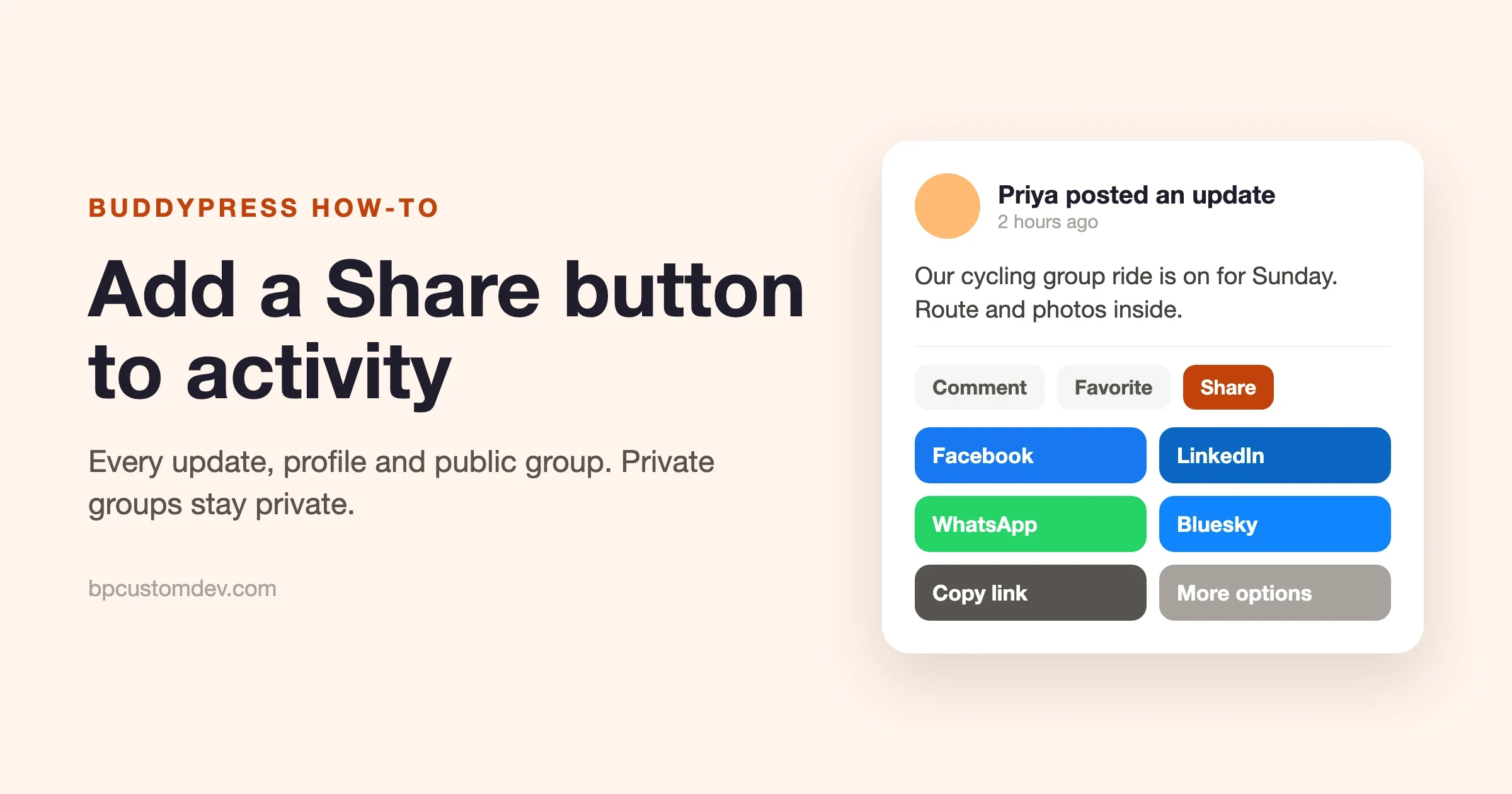
The quickest way to add a social share button in BuddyPress is the free Activity Share for BuddyPress plugin: install it, open WB Plugins > Activity Share, tick the networks you want, and every activity post, member profile and public group gets a Share button. General share plugins such as AddToAny are built for blog posts and pages, so they do not put a share link on each activity update. If you only need two or three networks and prefer code, a short snippet on the bp_activity_entry_meta hook does the job too.
We make Activity Share for BuddyPress, so this guide is upfront about what it does and where another route fits better. We checked every plugin named here against the WordPress.org plugin directory on 21 November 2026, and the code against BuddyPress 14.5.6, the current release (17 November 2026).
What is the easiest way to add a social share button in BuddyPress?
Use a plugin that understands BuddyPress activity. An activity update is not a WordPress post: it has no post ID, no featured image field and no single template that a general share plugin hooks into. It lives in BuddyPress’s own table and has its own permalink. A share button for BuddyPress has to read that permalink and respect the update’s privacy, which is the part general plugins skip.
The steps with Activity Share for BuddyPress:
- Make sure BuddyPress is active with the Activity component switched on (Settings > BuddyPress > Components).
- Go to Plugins > Add New, search for “Activity Share for BuddyPress” and install it, or download it from WordPress.org.
- Open WB Plugins > Activity Share.
- On the Networks tab, tick the networks to show and put them in order.
- On the Who and where tab, choose whether visitors can share, and whether member profiles and public groups get a Share button.
- On the Appearance tab, set the button label, its position and its colours, and check the live preview.
- Open your activity stream in a private window and share a public update to test it.
That is the whole setup. The plugin is at version 3.6.1, updated 19 November 2026, tested up to WordPress 7.1.5 and needs PHP 8.1 or later (WordPress.org data, checked 21 November 2026).
How do you set up Activity Share for BuddyPress?
The settings sit on three tabs, and each one answers a single question.
Networks: where can people share?
Facebook, X, LinkedIn, WhatsApp, Telegram, Bluesky, Reddit, Pinterest and email are built in, plus a Copy link button that shows a “Link copied” message. You tick the ones you want and set their order with up and down buttons, which also work from the keyboard.
Fewer is better. Most communities do well with three or four networks plus Copy link. A professional network might pick LinkedIn, email and Copy link; a hobby community might pick Facebook, WhatsApp and Reddit. Look at where your members actually come from in your analytics before you tick everything.
Who and where: who sees the button?
Three switches:
- Visitors: people who are not logged in can share public activity. Leave this on if your activity stream is public and you want it to spread; turn it off for members-only communities.
- Member profiles: adds a compact Share icon next to the profile header buttons, so members can share their own profile or someone else’s.
- Public groups: the same icon on public group headers, which is the easiest way to let members invite friends to a group.
Appearance: how does it look?
You can change the “Share” label (or leave it empty so each visitor sees it in their own language), put the button before or after the other activity buttons, and choose each network’s own colours or your theme’s accent colour. A live preview shows the result before you save. The menu follows your theme’s colours and dark mode; on phones it opens as a bottom sheet with large touch targets.
The plugin is built to work with most themes, and its changelog includes specific fixes for our BuddyX and Reign themes, such as keeping the menu visible under sticky headers.
Which networks can members share BuddyPress activity to?
Any network that accepts a link from a website. That covers the nine built in, and developers can add more (see the code section below).
Instagram, TikTok and YouTube are the common exception. Those apps do not accept shared links from websites, so no WordPress plugin can add a true “Share to Instagram” button. On phones, Activity Share for BuddyPress adds a “More options” item that opens the phone’s own share menu, where members can pick Instagram, Messages or any other installed app. That is the closest thing to Instagram sharing that the platforms allow.
Facebook Groups are the other frequent question. Facebook’s share window lets the person choose where to post, and posting into a group depends on that member’s own Facebook permissions in the group, not on your site.
What happens with posts in private and hidden groups?
They do not get outside sharing. Activity in private and hidden groups can only be seen by group members, so a Facebook or X share would hand everyone else a link they cannot open. Activity Share for BuddyPress leaves the external networks out for those posts, and members can still use Copy link to send the link to other members.
This is worth checking with any share tool you use. A share button that ignores group privacy is a quiet privacy leak: even if the link itself is protected, the share preview can expose the post’s text and image on another site.
How do link previews work when a member shares?
When someone pastes or shares a link, Facebook, LinkedIn and WhatsApp read the page’s Open Graph tags to build the preview: the title, description and image. Without them, the preview falls back to whatever the network guesses, which is often your site logo.
Activity Share for BuddyPress adds Open Graph tags for shared activity so the preview shows the post’s own image and text. If Yoast SEO, Rank Math, All in One SEO or SEOPress is active, it steps aside and lets the SEO plugin handle the tags, so you never get two conflicting sets. To switch its tags off in other cases, there is a filter:
// Stop Activity Share for BuddyPress from adding Open Graph tags.
add_filter( 'bpas_open_graph_enabled', '__return_false' );
After any change to your tags, paste an activity URL into Facebook’s Sharing Debugger and click “Scrape Again”. Facebook caches previews, so an old, wrong preview can stick around until you ask it to look again.
Can I add share buttons to BuddyPress without a plugin?
Yes, if you only want a few plain links. BuddyPress fires the bp_activity_entry_meta action in the buttons area of each activity item in both the Nouveau and Legacy template packs, and bp_activity_get_permalink() returns the single activity URL. This snippet adds Facebook, X and LinkedIn links and skips activity hidden from the site-wide stream, which includes private and hidden group posts:
// Add simple share links to each BuddyPress activity item.
add_action( 'bp_activity_entry_meta', function () {
    global $activities_template;

    // Skip items hidden from the site-wide stream (private and hidden groups).
    if ( ! empty( $activities_template->activity->hide_sitewide ) ) {
        return;
    }

    $url   = rawurlencode( bp_activity_get_permalink( bp_get_activity_id() ) );
    $links = array(
        'Facebook' => 'https://www.facebook.com/sharer/sharer.php?u=' . $url,
        'X'        => 'https://twitter.com/intent/tweet?url=' . $url,
        'LinkedIn' => 'https://www.linkedin.com/sharing/share-offsite/?url=' . $url,
    );

    foreach ( $links as $label => $href ) {
        printf(
            '<a class="button bp-share-link" href="%1$s" target="_blank" rel="noopener nofollow">%2$s</a> ',
            esc_url( $href ),
            esc_html( $label )
        );
    }
} );
Checked on 21 November 2026 against the BuddyPress 14.5.6 source (hook and functions confirmed) and syntax-checked with PHP 8. Put it in a site-specific plugin or your child theme’s functions.php.
Know what you give up with the snippet route. You get no Open Graph tags, so previews may show your logo; no Copy link or phone share menu; no styling beyond your theme’s button class; and no settings screen for anyone else on your team. For a small private community that may be fine. For a public one, a plugin saves time. Our BuddyPress hooks cheat sheet lists the other activity hooks if you want to place the links somewhere else.
Do general social share plugins work with BuddyPress?
They work on your blog posts and pages, and some add buttons to BuddyPress pages as a whole, but none of the ones below mention BuddyPress activity in their WordPress.org description. In practice you get a button that shares the directory or profile page, not the individual update a member wants to share. Data from WordPress.org, checked 21 November 2026; “Support resolved” is resolved threads out of those opened in the last two months.
Plugin | Shares BuddyPress activity items | Active installs | Rating | Last updated | Support resolved |
|---|---|---|---|---|---|
Yes, plus profiles and public groups | 300+ | 84% (19 ratings) | 19 Nov 2026 | No threads | |
No (posts, pages; BuddyPress page option) | 300,000+ | 94% (1,114) | 22 May 2026 | 1 of 1 | |
No | 100,000+ | 96% (5,333) | 18 Sep 2026 | 1 of 3 | |
No | 30,000+ | 94% (173) | 10 Nov 2026 | 1 of 1 | |
No | 20,000+ | 96% (194) | 19 Oct 2026 | 3 of 3 | |
No | 10,000+ | 100% (70) | 3 Oct 2026 | 2 of 4 | |
No | 10,000+ | 70% (26) | 7 Oct 2026 | 0 of 1 |
A good combination for many community sites is one general plugin for the blog and Activity Share for BuddyPress for the community. They cover different content, so they do not fight. If you use AddToAny, note that its buttons can also appear on BuddyPress profile pages; a user who did not want that was given a CSS rule to hide them there (AddToAny forum, July 2025).
Which share plugins should you avoid?
Older tutorials, including the first version of this one, recommend plugins that have since been closed or stopped updating. Status on WordPress.org as of 21 November 2026:
Plugin | Status | What to do |
|---|---|---|
Closed on 2 November 2026; WordPress.org says the closure is temporary, pending a full review | No updates while closed; watch for reopening or plan a replacement | |
Last updated 18 March 2025, tested up to WordPress 6.7.12 | Not closed, but over a year and a half without an update; test carefully | |
Shared Counts | Closed permanently on 27 September 2024 at the author’s request | Replace it |
A closed plugin keeps running on sites that already have it, but it gets no fixes through WordPress.org. Share buttons run on every public page, so they are not a place to keep unmaintained code.
What does Activity Share Pro add?
Activity Share Pro (version 3.6.1, November 2026) is the paid add-on for communities that want sharing to happen inside the site as well as outside it. According to the plugin’s WordPress.org page and product page it adds:
- Reposting inside your community, to your own profile or a group, with a comment.
- Sending a post privately to a friend (this needs the BuddyPress Friend Connections and Private Messaging components).
- Sharing of comment replies.
- Share buttons on blog posts and any other content type.
- Share counts, a trending block, share rewards and share analytics.
For most communities the free plugin is enough. Pro makes sense when internal resharing is the behaviour you want to encourage, because a repost inside the community keeps the conversation on your site instead of sending it to Facebook.
Should a members-only community have share buttons at all?
Sometimes the honest answer is no. If your activity stream is only visible to logged-in members, an external share sends people to a login screen. That can still work as an invitation (“my friend shared something, I want to see it”), but it can also feel like a dead end and makes members wonder whether their posts are public.
For private communities we usually suggest three things. Turn off visitor sharing, keep Copy link so members can point other members to a post, and enable sharing on public groups only, where the landing page is open. Public communities are the opposite case: every share is free reach, so give the button a clear label, put it after the other activity buttons where people expect it, and keep the network list short.
Whatever you choose, tell members in your community guidelines what is public and what is not. A share button on a post a member thought was private is the kind of surprise that costs trust.
Common mistakes people report
These recurring problems come from WordPress.org support threads for share plugins, paraphrased and checked on 21 November 2026. Most of them are about the networks and browsers, not the plugin.
- Previews showing the site logo or only a title. A user asked how to share an image and part of the text instead of just the title (AddToAny forum, February 2026), and an older thread on our plugin reported the site logo appearing instead of the post image (Activity Share forum). Both come down to Open Graph tags; fix the tags, then re-scrape in Facebook’s Sharing Debugger.
- Buttons hidden by browser tracking protection. One site found its share buttons missing for visitors in Firefox but present for logged-in admins and in other browsers, because the script was loaded from a third-party domain the browser treated as tracking (AddToAny forum, June 2026). Test in a private window in more than one browser.
- Facebook sharing breaks on phones with the Facebook app. A site owner found “share as a post” worked on desktop and in mobile browsers but failed when the Facebook app was installed (AddToAny forum, June 2026). Test on a real phone with the app installed, not only in a desktop emulator.
- Expecting to post into a Facebook Group. A user asked why they could not share to a Facebook Group they owned (Activity Share forum, July 2025). Group posting is controlled by Facebook and the member’s group permissions.
- Forgetting the privacy side of third-party scripts. A site asked about the external requests a share plugin makes and what that means for GDPR (AddToAny forum, November 2025). Plugins that build share links on your own server avoid most of these requests; either way, mention sharing in your privacy policy.
How do you check that sharing works before telling members?
- Post a public activity update with an image as a normal member.
- Open the activity stream in a private window (logged out) and confirm whether the Share button shows, depending on your Who and where setting.
- Share the update to each network you enabled and check the preview text and image.
- Paste the activity URL into Facebook’s Sharing Debugger and confirm the image and title it reads.
- Post in a private group and confirm the external networks do not appear on that update.
- On a phone, open the menu, try Copy link and More options, and share to one app.
- Switch your site to dark mode (if your theme has one) and check the button is still readable.
If your activity stream is slow to begin with, sharing will not fix engagement. Our BuddyPress performance guide covers the basics, and our BuddyPress setup guide walks through components and settings.
Our suggestion
- You run a BuddyPress community and want members to share updates: install Activity Share for BuddyPress. It is the only plugin in this list built for activity items, and it handles privacy and previews. Its downsides: a small install base (300+) and 19 ratings, an 84% average that includes reviews from before the 3.6.0 rebuild, best-effort support only on BuddyBoss Platform, and it stays inactive alongside Youzify, which has its own sharing.
- You also run a blog on the same site: add a general plugin for posts. AddToAny has the largest install base; Scriptless Social Sharing and Simple Social Buttons are lighter options.
- You only need two or three links and are comfortable with code: use the snippet above and add your own Open Graph tags through your SEO plugin.
- You want reposting inside the community: look at Activity Share Pro.
If you are still choosing a theme, our free BuddyX theme is a safe pairing: the share plugin’s changelog includes fixes made specifically for it. If you are planning a new community rather than extending a BuddyPress site, see BuddyNext, our newer community platform, and our roundup of WordPress community plugins. A related setup that pairs well with sharing is social login, so the people who arrive from a shared link can join in one click.
Frequently asked questions
Does BuddyPress have a built-in share button?
No. BuddyPress 14.5.6 has favorites, comments and permalinks on activity, but no social share button. You add one with a plugin or a snippet.
Can visitors who are not logged in share activity?
With Activity Share for BuddyPress, yes, for public activity. It is on by default and you can turn it off under Who and where.
Can I add Mastodon or another network?
Yes. Developers can register a network with bpas_register_network() on the bpas_register_networks action, and it appears on the Networks screen. The example below is from the plugin’s WordPress.org page; replace the icon placeholder with a real SVG.
add_action( 'bpas_register_networks', function () {
    bpas_register_network( 'mastodon', array(
        'label'     => 'Mastodon',
        'share_url' => 'https://mastodonshare.com/?url={url}&text={title}',
        'icon'      => '<svg ...>...</svg>',
        'color'     => '#6364FF',
    ) );
} );
Does it work with BuddyBoss?
Activity Share for BuddyPress is built for BuddyPress and works with BuddyBoss Platform on a best-effort basis, according to its FAQ.
Why don’t I see the Share button on some updates?
Updates with nothing to share, such as “joined the group”, have no Share button, and posts in private or hidden groups get Copy link only. If you see no button anywhere, check that the BuddyPress Activity component is on; the settings page shows a notice when it is off.
Will share buttons slow down my site?
Every script adds some weight, and plugins that load from a third-party domain also add external requests. Test your activity page speed before and after, and keep the number of networks small.
A share button is a small thing, but it is how a good conversation in your community reaches people who are not members yet. Pick the route that matches your site, test the previews, and keep private groups private.