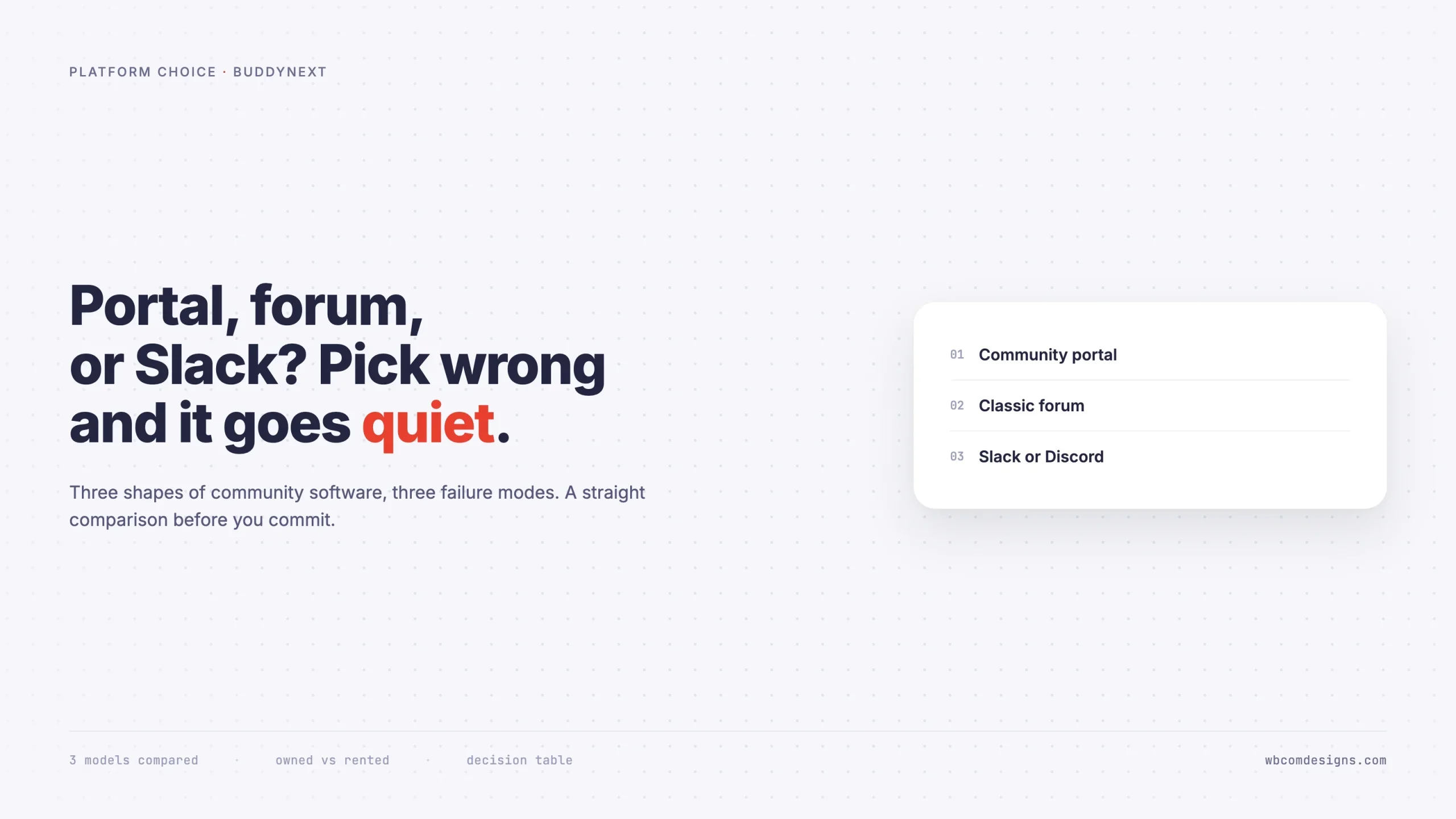
Community Portal, Forum, or Slack? Pick Wrong and Your Members Go Quiet in Six Weeks
Three shapes of community software with three different failure modes. A straight comparison of community portals, classic forums and chat tools, including which one your group will actually keep using.

Every group that decides to “start a community” reaches the same fork within a week. Someone suggests Slack because it is free and everyone has it. Someone else suggests a forum because that is what communities looked like when they learned the internet. A third person wants a proper portal with profiles and a directory.
All three are legitimate. They are also different products solving different problems, and the choice determines what your community feels like a year from now more than any decision you make afterwards.
The pattern that plays out when people choose wrong is consistent enough to predict. Six weeks of enthusiastic activity, a slow fade, and then a small group who keep talking while everyone else stops opening it. The founders conclude their members were not interested. Usually the members were interested and the container was wrong.
The short version
Community portal | Classic forum | Slack or Discord | |
|---|---|---|---|
Best for | Members who need to find each other | Questions with durable answers | Fast coordination in a small group |
Shape of content | Feed plus spaces plus profiles | Threaded topics in categories | Real-time channels |
Member identity | Rich profiles and a directory | Username and post count | Name and avatar |
Value in six months | Grows, searchable and owned | Grows, searchable and owned | Mostly gone |
Who owns it | You | You | The vendor |
Typical failure | Launched empty | Feels dated, nobody starts a thread | Noise, then silence |
Chat: excellent tool, poor community
Slack and Discord are the default suggestion because the barrier is nothing. Everyone has an account, setup takes ten minutes, and the first week feels wonderful.
The problems arrive later, and they are structural rather than fixable by better channel discipline.
Everything is urgent, so nothing is important. Chat presents all messages as equally time-sensitive. A question that deserves a considered answer scrolls past between a meme and a meeting reminder. People who think before they write are systematically disadvantaged, and those are often the people whose contributions you most wanted.
Your archive is not yours. On free plans, message history disappears past a limit. Every question answered well is a question that will be asked again in four months, because the answer is gone and nobody can search for it. You are renting a conversation and paying for it in repeated effort.
There is no identity. A name and an avatar tell you nothing. In a professional community the whole point is knowing who you are talking to, and chat platforms deliberately flatten that because they were built for teams who already know each other.
Newcomers arrive into the middle of a conversation. Joining a busy Slack six months late is bewildering. There is no front page, no sense of what this place is, no way to catch up. Most new joiners read for a week and go quiet permanently.
Chat is genuinely right for a group under about fifty people who already know each other and need to coordinate quickly. Project teams, cohorts running for a fixed period, event attendees during the event. Below that size and above that urgency, it beats everything else.
Forums: durable, and fighting their own reputation
A classic forum is categories, topics and threaded replies. Every answer has a permanent address, search works, and the content compounds. Every technical question you have ever solved by finding a ten-year-old forum thread is an argument for this format.
Forums have two real problems in 2026, and only one of them is fixable.
The blank thread problem. Starting a topic feels like a commitment. There is a title field, a body, a category to choose. That friction is precisely what produces good archived content, and it is also why most members never post once. Feeds get more participation because a one-line thought is socially acceptable.
The format signals age. Fair or not, a category list reads as something from an earlier internet, and younger members in particular are less likely to engage with it. This is a presentation problem more than a functional one, and modern forum software has largely solved it.
Forums are genuinely right when the primary value is durable answers: technical support communities, software user groups, hobbies with deep knowledge bases, anywhere the same questions recur and a good answer should be findable for years.
Community portals: identity first
A community portal is the format where members have real identities, the content is a feed, and there are sub-spaces with their own membership. Associations, alumni networks, resident groups, professional bodies and customer communities almost all want this shape.
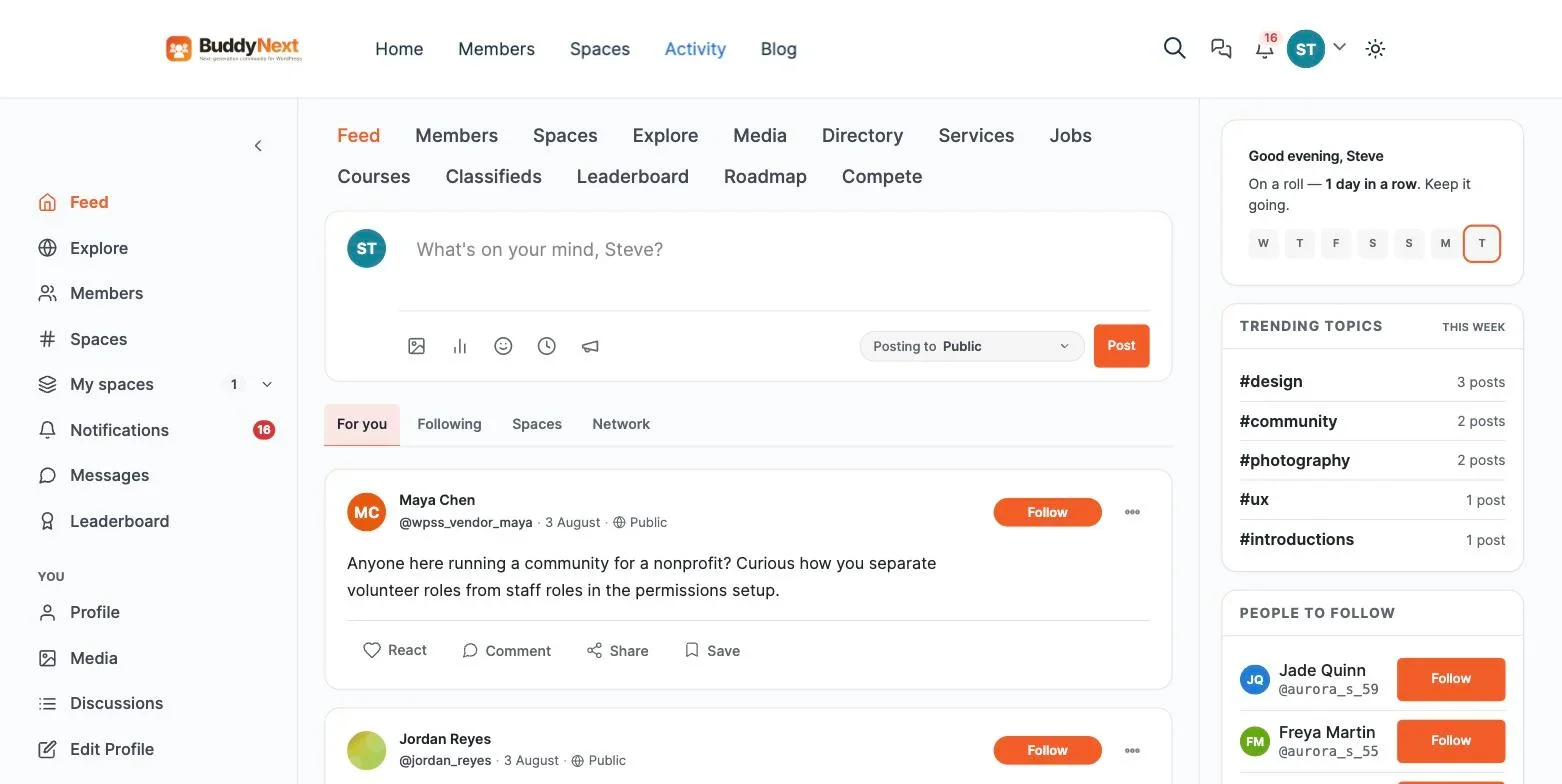
The distinguishing feature is not the feed. It is the profile. A portal knows that this member is a paediatric nurse in Leeds who qualified in 2014 and is happy to mentor, and it lets another member find them on that basis. Neither chat nor a classic forum does that, and for a professional body it is the entire proposition.
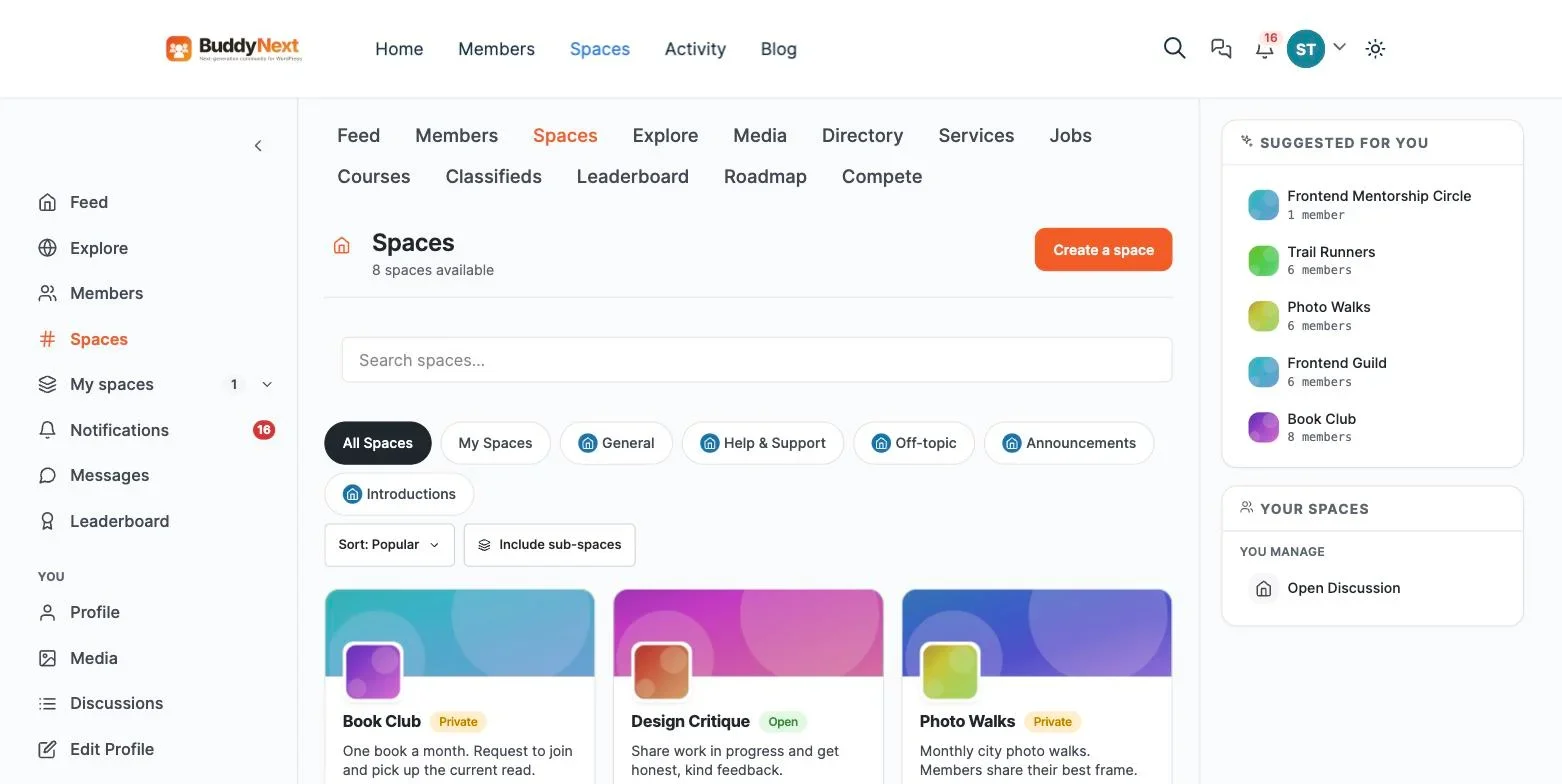
The second distinguishing feature is spaces: sub-communities with their own membership and visibility, so the London chapter, the ethics committee and the early-careers network each have somewhere that is not the main feed.
The portal failure mode is launching empty. A feed with nothing in it is far more discouraging than an empty forum category, because a feed’s whole promise is that things are happening. Seed twenty or thirty real posts before anyone is invited, and invite in waves rather than all at once.
Choosing, in four questions
- Do members need to know who each other are? If a member’s professional details, location or specialism matter, you need a portal. Chat and forums both treat people as usernames.
- Should answers still be findable in two years? If yes, chat is disqualified regardless of anything else. Both other options archive properly.
- Do you need sub-groups with different membership? Chapters, cohorts, committees, regions. Portals and forums both handle this. Chat handles it badly, because private channels proliferate and nobody can find them.
- How large will this get? Under fifty people who already know each other, chat is fine and anything else is overhead. Past a few hundred strangers, you need identity and moderation, which means a portal.
The combination that usually works
Most successful communities run two of these, deliberately, with a clear division:
- Portal as the home. Profiles, directory, spaces, announcements, and the searchable record. This is the asset.
- Chat for the live layer. Event days, office hours, a channel for the organising team. Explicitly ephemeral, and everyone understands that.
- Forum only if the archive is the product. A dedicated Q&A section alongside the feed, for questions whose answers should outlive the week.
The mistake is running two without deciding which is the home, because members then have to guess where to post and most resolve that by posting nowhere.
Write the division down in one sentence and put it where people can see it. Something like: “Anything worth reading next month goes in the portal. Anything worth reading in the next hour goes in chat.” That single line prevents more confusion than any amount of channel naming convention.
What it costs to be wrong
The cheapest mistake is starting on chat and moving later. You lose the archive, which hurts, but the members are still reachable and the habit of talking to each other has formed. Plenty of successful communities began in a Slack that got too big.
The most expensive mistake is choosing a hosted community platform that prices per member, discovering it works, and finding that success has tripled your bill. Circle, Bettermode, Hivebrite and Higher Logic all scale their pricing with your membership. That is fine at 200 members and a different conversation at 4,000.
The second most expensive is building somewhere your members cannot be found. A community with 3,000 members and no searchable directory has stored the value and locked the door.
What each option costs over three years
Sticker price is the least interesting part of this comparison, because the three formats fail financially in different ways.
Option | Year one | What changes by year three |
|---|---|---|
Slack free | Nothing | Archive limits bite. Upgrading to keep history is priced per member, and by then the history is the reason you would pay. |
Discord | Nothing | Still free, still not searchable in any serious way, still not yours. |
Hosted community SaaS | Roughly $10,000 upward | Renegotiated against your member count. Growth raises the bill. |
Self-hosted forum or portal | Hosting, plus any licence | Hosting, plus any licence. Member growth changes the server, not the contract. |
The pattern worth noticing is that the free options and the expensive options fail in the same direction. Both make your community’s success expensive, one by holding your archive hostage and the other by billing per person. Self-hosting is the only column where a community doubling in size is unambiguously good news.
That said, do not choose on cost alone at small scale. Under a hundred members, all four rows are affordable and the right answer is whichever format your members will actually open.
Running a portal on WordPress
If the four questions pointed you at a portal, the self-hosted route removes the per-member pricing risk entirely.
BuddyNext is a free, standalone WordPress community plugin. It does not require BuddyPress. The free core covers profiles with custom fields and per-field privacy, member types, a feed with reactions, comments, polls and hashtags, spaces with public, private and secret visibility, a visibility-scoped search index, and a full moderation suite with reports, strikes, suspensions, a log and an appeals route.
Direct messaging comes from the companion WPMediaVerse plugin. If you also want the forum shape alongside the feed, Jetonomy adds threaded discussions and both run standalone.
Membership tiers, checkout, analytics, push notifications and websocket live updates are BuddyNext Pro. The free version polls over REST, adaptively, starting at five seconds, which is fine for a portal and not a substitute for chat.
Moving a community from chat to a portal
This is the most common migration in this category, and it goes wrong in a predictable way: the organisers announce a move, everyone is asked to sign up somewhere new, almost nobody does, and the group concludes the portal failed. What actually failed was the transition plan.
A sequence that works:
- Do not announce a migration. Announce an addition. “We now have a directory and a place for longer discussions” invites people in. “We are moving off Slack on the 30th” asks them to do admin, and most will not.
- Move one thing that people want. The member directory is usually it, because chat cannot do it at all. Give people a reason to create a profile that has nothing to do with abandoning the tool they like.
- Copy across the twenty best threads. Anything that got asked and answered well. Reformat them as posts with credit to the original author. This solves the empty-room problem and demonstrates immediately why an archive matters.
- Let the chat become the live layer. Do not kill it. Redefine it: quick coordination stays, anything worth reading next month goes in the portal. Say that in one sentence and pin it.
- Wait for the archive to prove itself. Within a couple of months someone will answer a question by linking to a portal post. That moment converts more people than any announcement.
Expect to lose some members regardless. A portion of any chat community is there for the ambient noise rather than the subject, and they will not follow. That is a normal and healthy filter rather than a failure.
The moderation difference nobody compares
Feature comparisons of these three formats almost always stop at posting and search. The thing that actually decides whether a community survives its second year is what happens when someone behaves badly, and the three formats are wildly unequal here.
Chat gives you almost nothing. You can remove a message and remove a person. There is no report queue, no record of what was decided and why, and no graduated response between a quiet word and expulsion. In a professional or workplace context that is a genuine liability, because the first serious incident will need to be explained to someone.
Forums are usually well equipped, since the format is old enough to have learned. Reporting, moderation queues, trust levels that let long-standing members handle small problems, and a log.
Portals vary enormously, which is why it is worth checking rather than assuming. The specific things to look for are graduated responses (warn, suspend, shadow-ban rather than only delete), a moderation log for defensibility, per-space moderation so a volunteer can run their own area, and an appeals route a suspended member can still reach.
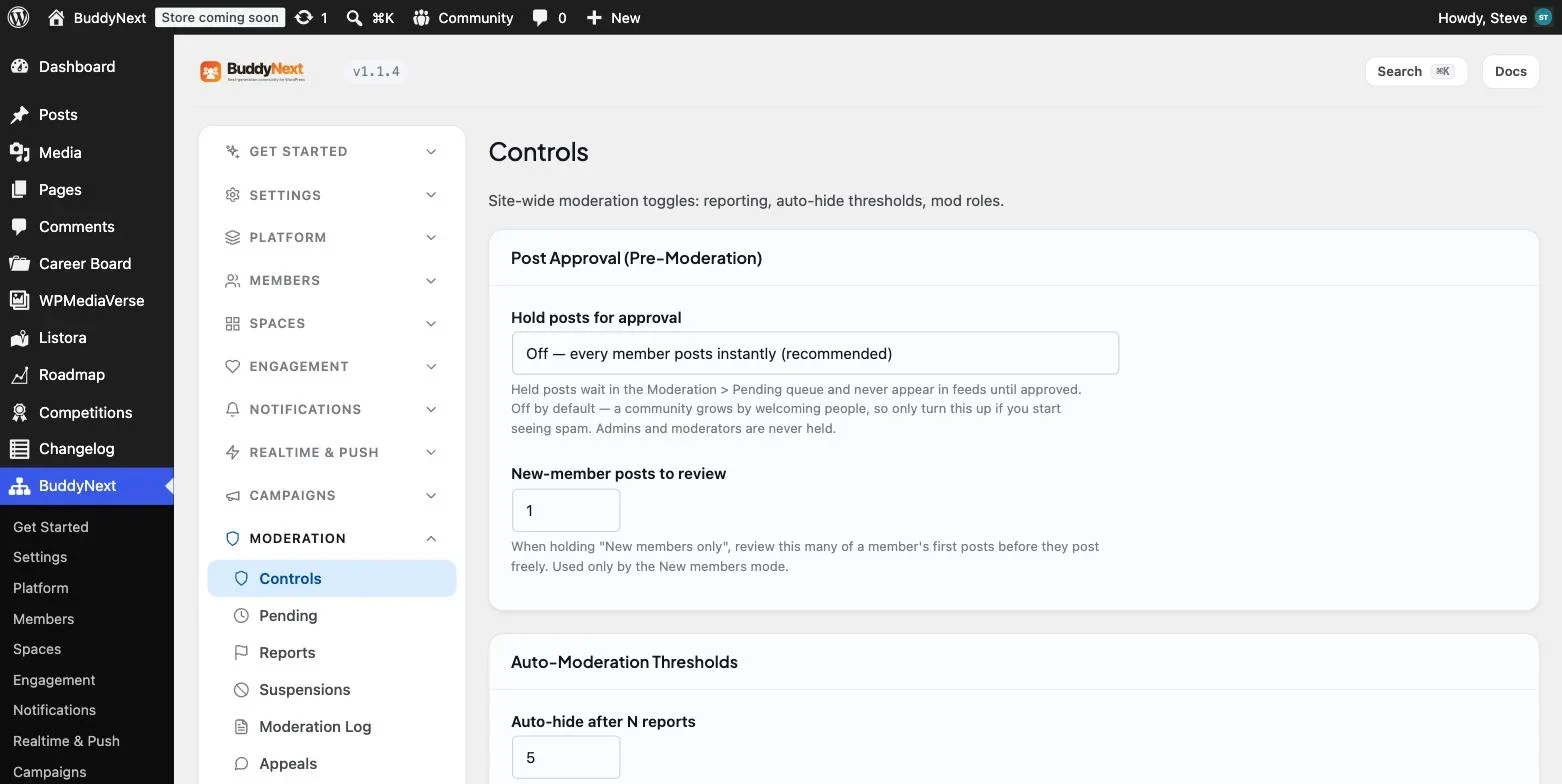
That last one is the test most products fail. If suspending someone locks them out of the page where they would challenge the suspension, the system cannot correct its own mistakes, and the first time you get a decision wrong you will discover exactly how much that matters.
What the first six weeks should look like
Whichever format you choose, the launch pattern that works is the same, and it is the opposite of what most groups do.
- Seed before inviting. Twenty or thirty real posts, several complete profiles, a genuine open question in each space. An empty community is the single most common cause of failure.
- Recruit three or four people who will post before you open the doors, and tell them plainly that is what you are asking of them. Communities launch on the backs of a handful of visible regulars.
- Invite one segment first. The group that already talks to each other by email or in person. Fifty people, not five thousand.
- Answer everything for the first fortnight. Nothing kills a new community faster than an unanswered first post from a nervous member.
- Then step back deliberately. Once members are answering each other, letting a question sit for a day is the right move, because the space you leave is where the community grows.
Groups that follow this reach self-sustaining activity in a couple of months. Groups that mass-invite on day one into an empty room usually never recover, because members form a judgement in the first thirty seconds and rarely revisit it.
Frequently asked questions
Can we just use a Facebook Group?
You can, and thousands of communities do. Understand what you are accepting: Facebook owns the relationship with your members, can change reach and rules without notice, shows your members advertising, and gives you no export worth the name. It is free in the sense that a rented room is free while the landlord likes you. For a hobby group that is a reasonable trade. For a professional body it is not.
Our members are older. Will they use a feed?
Generally yes, and more readily than a forum, because a feed matches what they already use elsewhere. The bigger barriers with any age group are login friction and email notifications that either overwhelm or never arrive. Get those two right and format matters less than people expect.
How many people do you need before a community works?
Fewer than most people think, provided they are the right people. Fifty engaged members produce a place that feels alive. Five thousand disengaged accounts do not. Concentration matters more than headcount, which is why launching to one active segment beats launching to your whole list.
What if we already have a Slack that is dying?
Do not migrate the Slack. Start the portal with the twenty people who still post, seed it properly, and let the Slack become the live layer or fade. Attempting to move an entire disengaged membership from one platform to another moves the disengagement with it.
Can a portal and a forum coexist without splitting the audience?
Yes, if the division is by content type rather than by topic. A feed for things happening now and a Q&A section for questions with durable answers works, because members can tell which is which. Splitting by topic does not work, because the same subject then has two homes and members guess wrong.
How much moderation time should we budget?
For the first three months, a few hours a week, most of it seeding and welcoming rather than policing. After that it drops sharply, provided you have recruited space moderators. Communities that never delegate moderation stay permanently expensive to run, which is usually what people mean when they say a community was too much work.
What single thing most predicts whether this works?
Whether somebody owns it. Not the software choice, not the format, not the design. A named person whose job includes welcoming new members, asking questions when it is quiet, and dealing with reports. Communities with that person succeed on any of the three formats. Communities without one fail on all of them.
Is Discourse a forum or a portal?
Discourse is a modern forum that has borrowed feed-like behaviour, and it is very good at what it does. It remains topic-centric rather than people-centric, so if your core requirement is a searchable member directory with professional fields, it is the wrong shape. If your core requirement is durable discussion, it is an excellent choice.
The one question that settles it fastest
If you take nothing else from this comparison, take this test. Imagine a member who joins in eighteen months, knowing nothing about your group, and wants two things: to understand what this community is, and to find the three people most worth talking to.
Now ask what each format gives them.
Chat drops them into the middle of a conversation with no beginning. There is no front page, no summary, no way to identify who is worth knowing beyond who happens to be talking that afternoon. Most people in this position read quietly for a week and never post.
A forum gives them an excellent archive and almost no sense of the people in it. They can find out what your community knows, which is genuinely valuable, but not who it is. For a support community that is enough. For a professional body it is half the product.
A portal gives them a feed showing what is happening now, spaces showing how the community is organised, and a directory they can filter down to the three people who match what they need. That is the whole reason the format exists.
Whichever answer sounds most like the community you are trying to build is your format. The rest is implementation detail, and implementation detail is much easier to change later than the shape of the thing.
Where to start
Answer the four questions honestly, especially the first one. If members need to find each other, no amount of good chat discipline or forum moderation substitutes for a directory and real profiles.
Then build the smallest version and put it in front of the group that already talks. Our full walkthrough on building a community portal on WordPress covers the setup, and the portal plugin comparison covers what to pick if it turns out you need gating or billing as well.